The Menstrual Litmus Test for the Divine
What religious restrictions on menstruating women reveal about the nature of God and hidden idolatry
Commonly, across religions, we find restrictions on access to godly spaces imposed upon menstruating women.
The Old Testament, as it begins to define the laws of the God that spoke to Moses, lays out very clear instructions for the physical building inside which that God wants to be worshipped. Within this physical building are to be placed certain physical artifacts that have precise dimensions and require precise forms of veneration often via ritual blood sacrifices.
Intriguingly, not everyone is permitted to enter the building—the Temple—at all times.
Herein gets introduced the concept of ritual cleanliness.
Certain actions can make a person unclean and require certain purification rituals before the person is clean again to enter the Temple.
Menstruating women are considered unclean.
The adherents of the Old Testament viz. the Jewish people and (Judeo-) Christians, believe it to be a non-idolatrous religion. And yet, intriguingly, there is a noticeable overlap in how the Old Testament religion treats menstruating women and how its idolatrous cousin Hinduism treats them too.
Growing up in 90s middle-class Mumbai in a joint Maharashtrian family deeply embedded in the patriarchal structure of conservative Indian society feels like such a trip from my current vantage point. Truly what a trip, mates! Throw in a healthy dose of non-consensual summer sex camps out in the woods with my grandpa and his buds, and it makes sense why I never spoke to my sister about menstruation till a few weeks ago.
(Sexual trauma induces shame which thereby stifles expression but we have jabbered about that enough number of times now :)
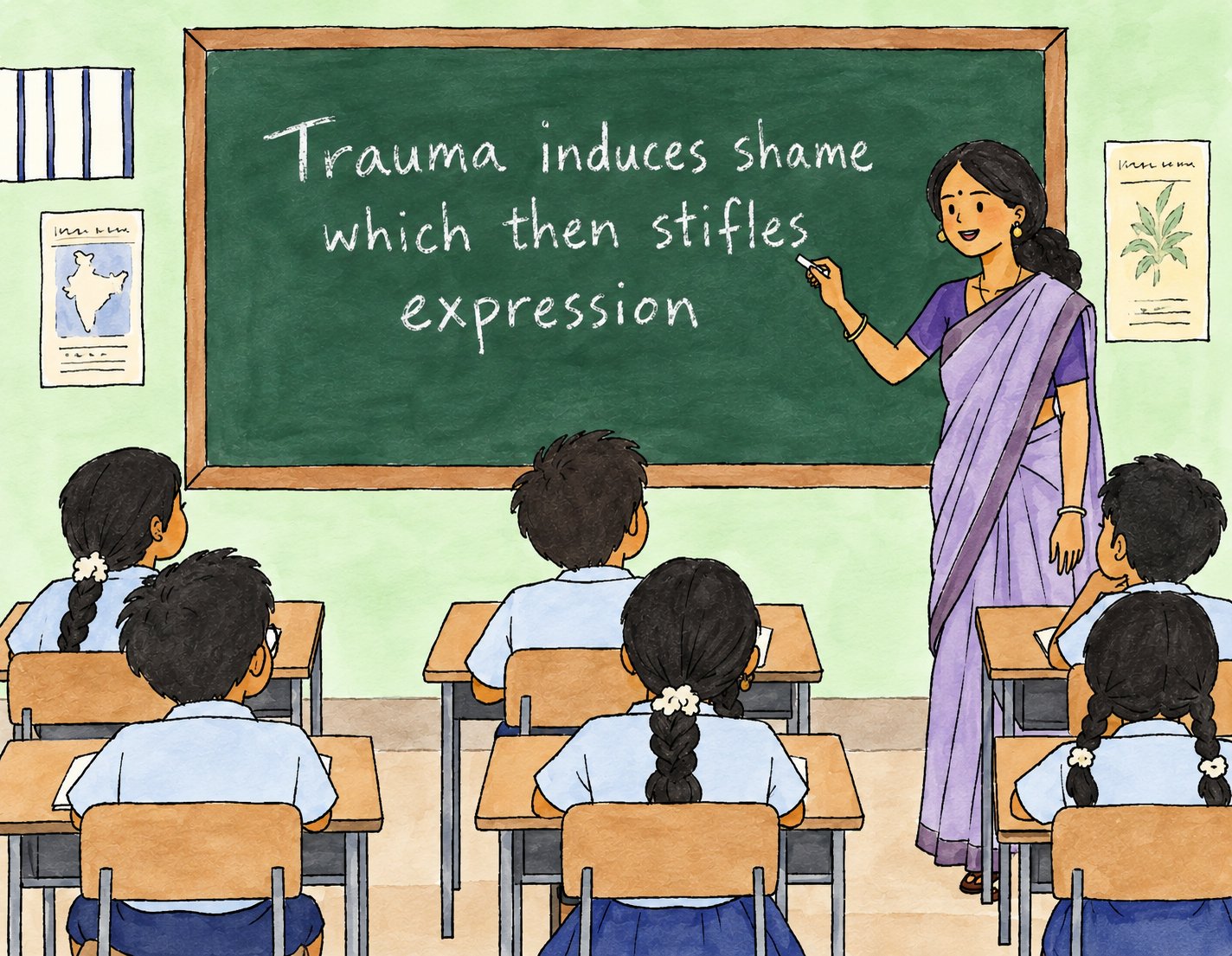
I asked her quite naively if she experienced any restrictions while menstruating as a child, and she was surprised I was even asking that question.
“Of course, I did! You didn’t know?”
I attempted a memory recall from childhood festival times. Where was my attention when such restrictions were being imposed upon her and the other ladies in the family? All I could recall was a fun, crowded familial party atmosphere with good clothes and even better food. Vaguely, I recalled women eating last, but nothing really about menstruation. To be honest, I don’t even remember when I learnt about menstruation first and even through my first marriage, I understood little about it other than that my wife went through chums—the chosen euphemism—periodically and was a bit off when that happened and that she needed sanitary pads as she bled then.
Typically, this restriction on the agency of women is explained away with a couple of different reasons. A study of the structure of those reasons reveals much about how controlling authorities operate.
A culture that doesn’t think twice about shaming people, sticks to the clean/unclean differentiation. Menstruating women are simply unclean; hence they are not worthy of being close to God.
In a slightly more egalitarian culture, that has evolved past the stage where it is okay to label humans derogatively—where the Classical Liberal principle of “all humans being equal” has taken root to some extent—the reasoning relies on safety arguments.
“It is not good for the health and safety of a menstruating woman to be exposed to the energy of a temple or a worship ritual”, they say.
Asa mhantat.
Aisa log kehte hain.
That’s what they say.
Now those of us who are living lives conditioned by Fear have a proclivity to take a step back as soon as we hear the cue phrase—“It’s for your own safety.” Like Pavlov’s dog on the ring of a bell.

But then you experience the overhead of imposed safety measures and perhaps start questioning its efficacy a bit—thank you TSA! Just enough of an introspective pause in those long lines waiting to board a flight, to realize that you had backed off and adopted the claimed safety measure imposed upon you without every wondering if it was actually for your own safety.
Perhaps you experience the thrill of what you thought was an unsafe environment—say in a boxing ring with a larger, more experienced guy—to notice that your body is actually quite resilient. More so than you thought! A punch on your face isn’t the end of you! And it hurts a bit, but it goes away pretty quickly.
Safety, it seems, is not a permanent trait associated with an object or an environment, but a temporal trait associated with how you relate to that object or the environment.
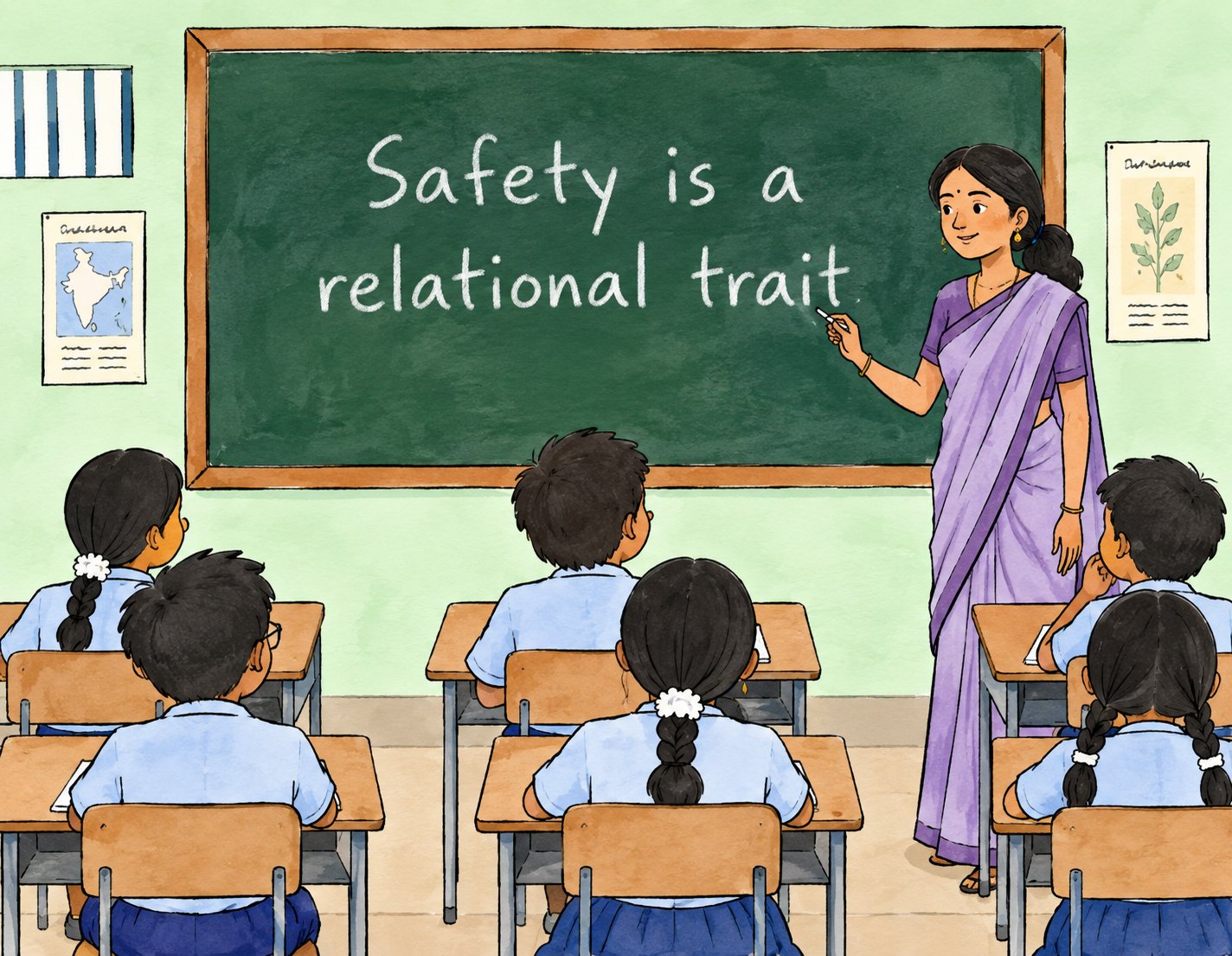
So then you wonder why is it that this cue phrase “It’s for your own safety” has so much agency on how I act.
“It’s for your own safety.”
Two steps back.
“It’s for your own safety.”
Two more steps back.
“It’s for your own safety.”
Till you are fully backed up at the edge of a cliff and you wonder if the voice speaking actually knows you well enough to tell you what’s good for you.
And more importantly, if you either understand the reasoning of that particular claim well enough or have had a sufficiently long moment to intuit your body’s response to that particular claim, so you may act instead of reacting.
The skeptic is born—not the reactively closed type who lives in denial of the spirit world without ever exploring it, but the curious, open, adventurous type.
Now you turn snoopy.

You snoop around.
Snoop around in the crevices of your own subconscious. Snoop through many a valley in the shadows of Death. Snoop inside others, sensing subtle bodily cues when they speak, revealing the difference between truthful clarity and fearful conditioning.
Till no longer do you reactively back off out of fear. Now you are in love with the alchemy of fear and the surprising fruits it brings!
Now you snoop around inside authoritative texts. Texts that typically only the middlemen had access to, but thankfully due to the efforts of Messrs. Gutenberg, Martin Luther, Dnyaneshwar, Berners-Lee and others and due to your fate that you are born in such an era, you can make a few tip-taps with your finger tips and access these otherwise inaccessible texts, that the middlemen relied on for their authority.
Now you notice another reason!
It so turns out that in order for an idol to be worshippable by the laity—that is, for a physical object to be converted into an idol of a deity—certain specific rituals are done to establish the spirit of the deity in that object. That tracks with your childhood memories of how neurotic your grandfather would get while bringing the stone sculpture of Ganapati home to do the rituals needed to establish it—sthapana—as an idol for the day and a half celebration every year during the monsoons.
Once established thusly, the spirit of the deity can bestow blessings on the laity via the physical idol.
Now there are many open questions this leads to—
What is the underlying karmic transaction that’s happening? As the deity fulfills the wish of the worshipper, is the worshipper accruing any karma?
Are there any laws governing the types of prayers and asks that are fulfilled easily vs. the type that aren’t fulfilled so easily?
How do you tell whether the deity is properly established inside the idol vs when the establishment ritual has failed?
Intriguing questions for your curious mind.
But it does seem that this method has some potential for the physical object in the form of the idol to relieve the suffering of the worshippers, at least temporarily.
Until something happens that drains the idol of the spirit, rendering it powerless.
Imagining yourself as someone in the business of maintaining temples, you would, of course, operationalize it in a manner where such unfortunate occurrences are minimized no?
One of these unfortunate circumstances where an idol gets drained of the spirit of the deity is when a menstruating woman comes close enough to it. How close is unclear, because we are referring to energetic closeness and not physical closeness. If you’ve ever experienced a human in a room taking up space without even speaking where their presence is felt very clearly even though they might be of a diminutive structure, you have experienced the difference between energetic closeness and physical closeness.
Energy within a human body can flow in a variety of directions. Two of the dominant ones are up and down. Prāna and apāna. If you are a man that has battled the demons of lust during lovemaking attempting to prevent a premature closure by pulling up with your breath, you probably know what I’m talking about even if you haven’t heard of these words before.
Menstruation creates an apānic whirl in the woman’s body wherein all that is no longer needed for the woman—and thereby her environment as her energy body extends past her physical limits—is sucked out and sent down with the blood. If you squint a bit, you could label it an automated, ritual, periodic blood sacrifice of the creative potential—the unused eggs—in a woman’s body. Not that different from the ones recommended in the Old Testament or in the Temple of Kali, just that this one happens naturally, in the strictest sense of the word, as a part of the normal functioning, again in the strictest sense of the word, of a woman’s body.
All that needs to go down, goes down, funneled by this powerful phenomenon occurring in roughly half the human populace, a fourth of the time every month.
And, seemingly, that includes established deities inside idols in temples. And so temples bar menstruating women from entering.
I haven’t cussed out loud in a minute, but I remember encountering this reasoning the first time and my eyes went wide in an expression that is best captured by the words—
WHAT. THE. FUCK.
Who the fuck are these gods whose presence can be dissolved by literally any menstruating woman?
If there is indeed a God, powerful above all, creator of all, clearly the spirit shouldn’t be drainable by energetic contact with a menstruating woman, no? What am I missing here?
I’m pretty sure—although my memory might be failing me on this—but understanding this was the brief moment in my spiritual journey where I laid down a case for atheism. That was before my definition of God itself evolved, and I actually directly experienced this inexplicable aspect of prayer, which is direct conversation with God.
But ever since this realization, I have carried—let’s call it—a Menstrual Litmus Test for the Divine in my back pocket.
If a deity is has a physical instantiation, either in the form of an idol (overt or covert) or a temple, but the physical instantiation cannot handle a few drops of good old menstrual blood dripping out of a nearby pussy, that deity fails the Menstrual Litmus Test for the Divine.
The practical implications of this are that most Hindu idols—I’m open to the possibility that there might be some Hindu temples that don’t fail this test, the Old Testament deity, and the Islamic deity associated with the Kaaba, get discounted from this consideration.
I call the Old Testament religion and Islam covertly idolatrous religions. The deities are sneakier than the Hindu deities in that they vehement proclaim against idolatry while somehow convincing devotees to still construct and worship a peculiar physical structure that needs to be built a particular way and worshipped in a specific manner.

My friends, if it walks like an idol and quacks like an idol, it is an idol.
I don’t say this to criticize my good Christian, Jewish or Muslim brethren. There are Jewish people who have never bothered about the Tabernacle, Muslims who pray ardently from their hearts without caring where Mecca is located, and Christians who love Jesus and all the humans he sacrificed his life for.
I believe we are presently in very late Kali Yuga, so the Truth that God lives in your heart—has bubbled through all the varied religious dogma that humans live smothered under.
And thank God for that—the only God that passes the Menstrual Litmus Test for the Divine—the One that lives in your heart!