Atheism is the Objective Truth
But not in the way most Atheists connect to it. In this essay, I describe the objective truth of Atheism, without the disconnection from and dismissal of the Spirit realms.
A collateral from the advent of Liberalism, born in the ghastly French Revolution, is this orientation towards the equality of everything in an apparent pursuit of reducing the harm that has historically stemmed from discrimination. Following the typical human tendency to pendulate from one extreme to another, this aspect of Liberalism refuses to see the differences altogether because the seeing and acknowledgment of differences is considered (subconsciously so) a slippery slope into harmful discrimination.
This trait of Liberalism shows up in different societal tropes – in denial of biological differences of men and women, in denial of difference in athletic prowess of different races, and in the “all religions are the same” trope.
Unsurprisingly, those who parrot the “all religions are the same” trope are either those who have *not* explored *any* religion to any reasonable extent to be able to comment on one leave alone compare and contrast all OR those who have gone so deep into the exploration of the spirit underlying all religions that they have seen the underlying foundational commonality but are blind to the wild differences in the manifestations of different religious faiths amongst the lesser evolved crowd. The latter types perpetually fall prey to the No True Scotsman fallacy and they’ll look at an example of a human being killing others in the name of a religion and shake their head saying “no true follower of my faith would ever do such a thing”, “that’s not what the holy book says” – thereby exalting their own interpretations of the religious doctrines over the human that they are comparing it to.
Those under the “all religions are the same” camp typically either lean towards the “love is at the core of all religions” trope sub-camp or “all religions are horrible” sub-camp. The former seem to cherrypick religious teachings and specifically cherrypick what constitutes the core of those teachings. The latter are often victims of some horrible religious trauma that they will avoid speaking about but instead project their trauma into vitriol against all religions. Often in the West, such humans are oblivious to the existence of religions other than the Abrahamic ones – Islam, Judaism and Christianity and will often follow up with arguments about how ridiculous the concept of God as a big man in the sky is – revealing this obliviousness. Or they’ll talk about how incongruous it is for the existence of an all-compassionate God and the existence of large scale human tragedies – “if God was all compassionate and all powerful, how could he allow the Holocaust to happen?” revealing, again, their obliviousness to non-Abrahamic conceptions of God.
This atheistic orientation is commonly found in scientific and engineering circles. Along with such an orientation often comes a dismissal of anything spiritual. It’s an unfortunate facet of the physical realm orientation of attempts to understand the cosmos that science and engineering represent. It’s quite wonderful that western science has emphasized the physical realm thereby really facilitating the emergence of rigorous experimental procedures to verify objective truth, that are easily reproducible by individuals of varied intellectual capabilities. However, in its current state, it has not managed to resolve questions around consciousness – an exploration of which bridges one into the spirit realms. I believe that it is quite possible to develop similarly rigorous peer-verifiable procedures for objective truths about the spirit realms even though we haven’t gotten there yet in the journey of western science. Unfortunately many in western scientific circles conflate the fact that we haven’t established objective spiritual truths with the fallacious dismissal of the spirit realm entirely.
This is the most common form of atheism today. Atheism that rejects not only the presence of God but is also oblivious to the presence of complexities of the spirit realms.
I did a comedy set recently where one of the audience interactions involved me asking people if there are any atheists in the crowd and then mocking a 45y old man for being an atheist – because of the perceived ridiculousness of the weak logic that atheistic beliefs often stand upon – some of which I have outlined above. In hindsight, I wasn’t happy with that crowd interaction moment (I’ve been striving to create humor that doesn’t rely on mocking others) and acknowledge also that I had no idea what this person’s belief structure was. I have noticed that it is helpful for me to allow myself to mock ideas reactively with passion as it allows me to witness better the part of me that has that reaction and helps me develop better nuance in the long run. Something similar happened in this instant. If you had asked me about “atheism” prior to this moment, I’d have laughed at it and called it ridiculous. But since then, I have actually come to believe that “atheism” is actually accurate – just not in the way most people see it. Let me explain.
Becoming a Messiah
History is littered with humans stepping into the role of a Messiah, thereby leading to the birth of a religion – Christianity, Islam, Mormonism are some examples. Often these messianic moments involve those humans hearing a voice from the sky. Voice of God, these humans think and thereby feel inspired to preach the message of God.
How does such a human know how to differentiate between the voice of *some* powerful spirit and the voice of *God*? To the spiritually misattuned ear, any sufficiently powerful spirit will sound like *God*, no?
Take the example of Prophet Muhammad. The phrase “La ilaha illallah” holds special relevance in Islam – translating to “there is no deity but Allah”. Factually, this seems false – just that there are so many other deities based on the subjective experience of other humans. So was it that God spoke to Muhammad or a spirit entity named “Allah” spoke to Muhammad and told him to not listen to other deities?
Objective v/s Subjective Truth
On the flight from Philadelphia to Amsterdam, I watched a movie “Freud's Last Session” – a semi fictional conversation between Sigmund Freud and CS Lewis on the subject of God, which also brought in their own direct personal trauma into the equation. After watching the movie, it was apparent to me how much of their respective fears (unresolved traumas) influenced their views on the nature of God – CS Lewis’ trauma from being a soldier in World War 1 (a underratedly traumatic war – WW 1 was when people learnt, the hard way, that horseback charges don’t work against entrenched machine gun defense – let that sink in.) and Freud’s trauma bond with his daughter. I don’t think it’s possible to arrive at the objective truth of the nature of God when one has large amounts of unresolved personal trauma.
A truth is objective only if it can account for and can be reduced to any subjective take on it. An objective truth is all-encompassing. It encompasses all possible subjective attempts at uncovering it. The objective truth is what is, while the subjective truth is what is perceived by an observer. So the subjective truth is always a reduced subset of the objective.
The Objective Truth of Atheism
What I have arrived at is that Atheism is the Objective Truth. That there is no *God*, but varied spirit entities whispering into men ready to step into being Prophets, striking deals with them, consciously or unconsciously. As such, most world religions (especially the Abrahamic ones) are spiritual cults – each in service of one powerful spirit entity. Islam in service of Allah. Judaism in service of Yahweh, Christianity in service of Jesus’s spirit Father.
Followers of these religions feed the energy of their attention to these spirit beings who then bestow some amount of release of suffering onto the followers.
Karmic Deals with Spirit Beings
These kind of karmic deals form the basis of Hinduism. In ancient Hinduism, yagnas (fire ceremonies) are conducted to alchemize nutritional offerings like ghee, rice, nuts, honey from the physical plane into the spirit plane so as to appease the spirit beings in the environs or specific spirit beings called in by chanting their names. The spirit beings then, in exchange, help release some of the energetic contractions that humans experience while in physical bodies due to trauma.
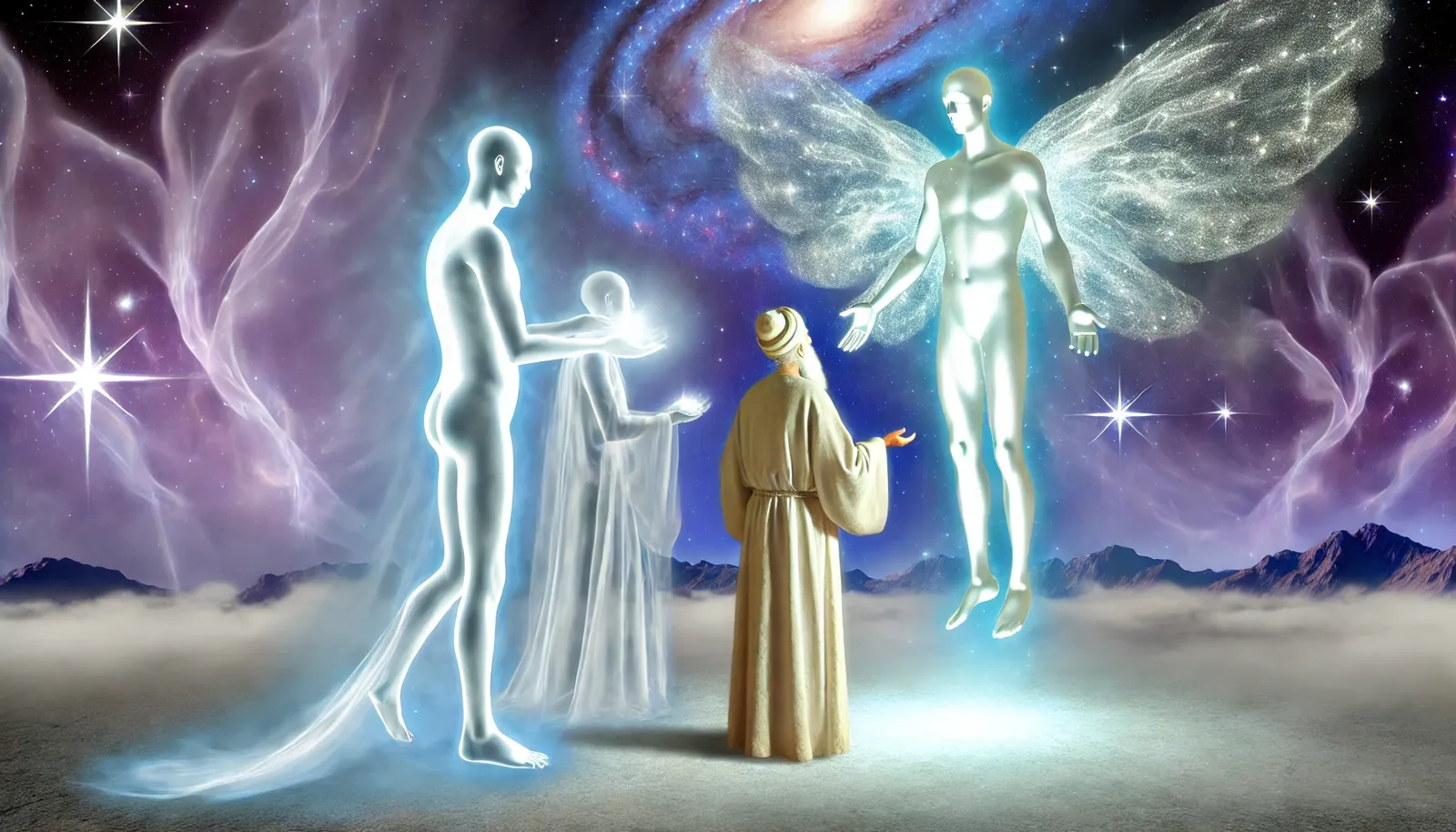
Note here that this is a mutually beneficial exchange because the spirits themselves *yearn* for the delights that can only be experienced in physical bodies.
To be specific then, there is nothing particularly special about any particular *God* that spoke to any of the Abrahamic (or otherwise) Prophets – they were just different spirit entities. And as such, there is no God. This is congruent with the Buddhist metaphysical model of spirits cycling through the varied realms of existence – some of them on the physical plane, most not and one very rare and precious physical realm being the human realm. It is also congruent with the models of each of the Abrahamic faiths in that it encompasses what they see although claims that the God that they follow is a spirit being that has deluded their Prophet into believing that it is more than what it actually is. (It’s possible that the spirit itself did not do so but later attempts at synthesizing the spiritual wisdom that the spirit being shared, caused the spirit being to be seen as “God”).
Some personal context
Continuing with my practice of sharing personal storied context for any ideas that I present (born from the frustrations of thinkers projecting their unaddressed trauma onto societally prominent theories – looking at you, Frued), I’m gonna share some brief personal context in this section about how I arrived at this framework.
This is perhaps a longer story but the gist is that for a couple of years I felt devoutly devoted to the Goddess Kali till there was a clear point where I noticed a spirit entity (I know, this sounds wild to those of you with a more scientific frame of mind) inside me which I then released using an IFS unburdening session. At varied points in this journey (prior to the “exorcism”), the spirit being claimed to be Kali herself and then claimed to be a fallen form of Archangel Michael. In hindsight, both were ruses to keep the spirit being in my system, with direct access to my physical body. These claims of being a deity and the attachment and yearning of the spirit for my physical body was something that fed into (as you can see) the theory I’ve presented above. Also I learnt some stuff directly about the spirit world through these engagements – all spirit beings know these basic facts about the spirit world, I think – just like any human could tell you basic facts about the human world.
I’m not happy with how lucid this essay feels presently because it builds on a variety of dense subjects that I have learnt about independently and threads them together. But I am, myself, a bit opaque to the density of some of these subjects. So if you find yourself stuck on a dense phrase or line, please reply back or comment with questions – it’ll be of great service to me as I attempt to elucidate this line of reasoning.