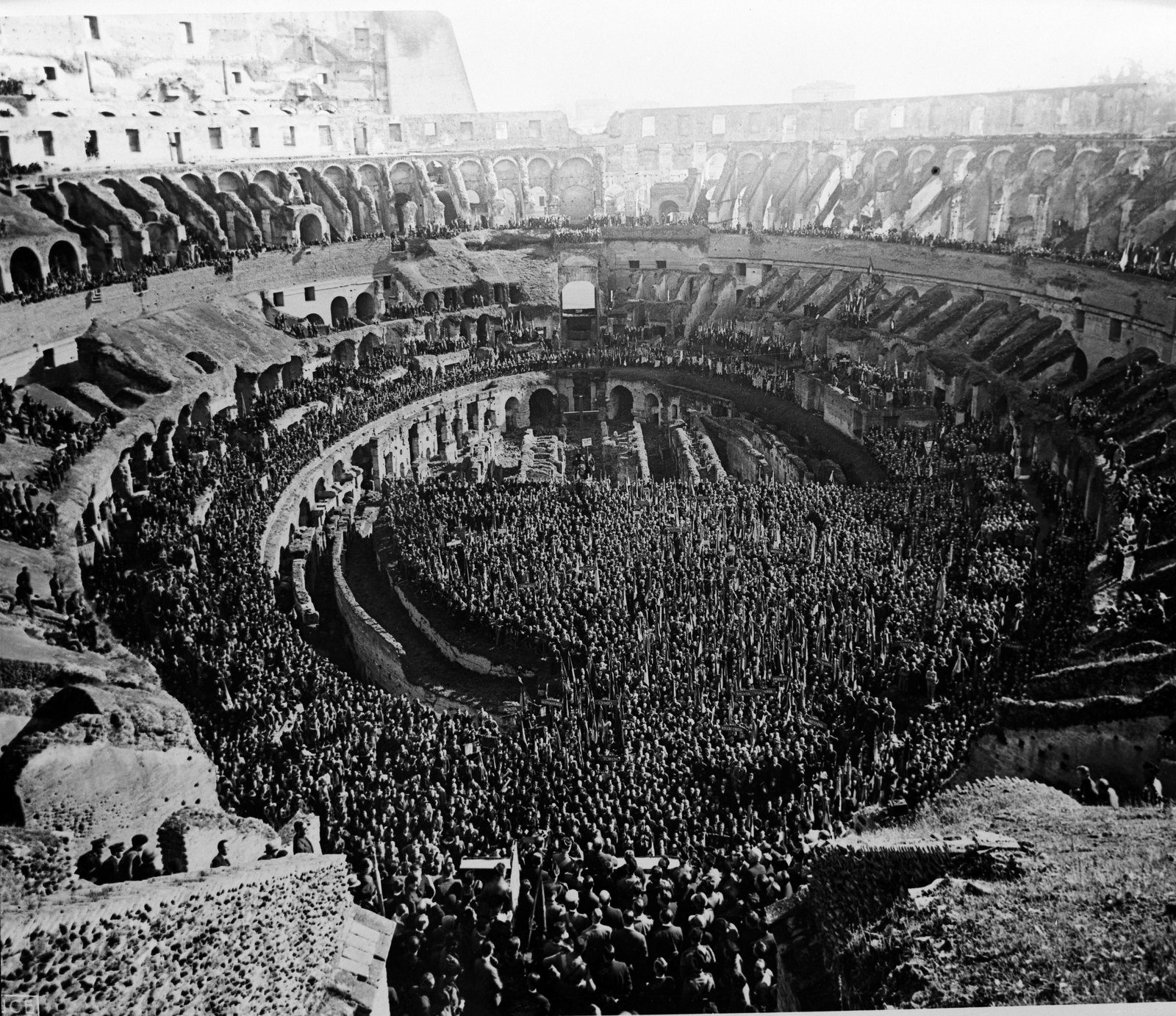
The Appeal of Fascism
Is the Nation a Collective? Does the Collective have its own Will?
Finally, I have somewhat of a grasp of both Communism, and its successor Fascism.
Isn’t that wild?
These words—they’re thrown around so often along with their nemesis, Capitalism in socio-political discourse, and it is now, after having spent years engaging in such discourse, that I have finally grasped each piece enough to be able to present them in a manner that would do some justice to their progenitors.
To present any Ideology in a manner that does justice to the folks who came up with it, one needs to be able to connect to the Heart of the progenitor.
The Heart intends good even though the attempts at doing such good may end up being horrible!
To connect to the heartful intent of the Ideology looking through the history of the horrible excesses of attempts made to follow that intent. That’s especially difficult, in this day and age, with Fascism.
Let us assume that all humans, including and especially the ones who create the Ideologies that you hate, are created in the image of God and are thereby gifted with a heart, wherein lies the seed of Love.
Creativity emerges through this seed of Love and births Ideas. Ideas cluster together to form Ideologies.
The end results of attempting to implement the Ideologies might not be very nice, but to understand and evaluate the Idea itself, it is important to assume good intent.
Liberal Capitalism, Communism and Fascism are the 3 main directions, that the varied attempts to organize a nation-state, have taken in the post-Feudal era.
Prior to the Feudal era, warring families ruled across the planet, in the form of Kingdoms, and then as they grew bigger, Empires.
As the Kingdoms grew both in size and away in time from the spirit of the original conqueror, they increasingly relied on middling feudal lords for administration. The power gradually dissipated from the center onto these smaller lords and we entered the Feudal Age.
Land and the means of production were owned by these Feudal lords, who owed (and switched) allegiance to these Kings and Emperors.
Together, the feudal lords, Kings and Emperors formed the aristocratic elite.
New risky ventures required patronage of the aristocrats.
That’s why it was so revolutionary when the Dutch East Indies Company decided to skip the aristocrats and raised money by selling stocks—literally a stock or a promised box of commodities that the ship intended to bring back from the East—directly to the people to fund the long perilous voyage from Amsterdam to India.
(Oh, how I pine for an era where the voyage from Amsterdam to India was perilous!)
(Sometimes.)
Capitalism was unlocked.
The mercantile class could now pull resources together for ventures. No longer was patronage of the aristocrats necessary to try out something wild and risky, like bringing black pepper from Indonesia to continental Europe.
(Oh, how I pine for an era where bringing back black pepper from Indonesia to Europe was risky!)
(Sometimes.)
The mercantile class nudged out the aristocrats as the elite. Some of the aristocrats themselves became merchants.
Capitalism fit in very well with the Classical Liberal thinkers of the time, who were beginning to wonder if all men are equal. Perhaps the Kings and the Emperors do not have the Divine authority that they often claim? Perhaps the King could be guillotined just like a commoner? What a wild concept!
The Renaissance had ushered in an era where man had been uplifted as the subject of art instead of God.
Capitalism created space for men to be equal and take risky bets together.
Marx saw that even though Capitalism freed us from the cage of Feudalism, it tended towards oligarchy—concentration of production power in a small group.
The elite just moved from a handful of aristocrats to a handful of oligarchs.
The profit-oriented structure of Capitalism, where the risk takers benefited out of proportion to their labor, while the workers benefited only in proportion to their labor, was bound to increase the divide between the owners of the means of production and the laborers viz. the producers.
If all men are indeed equal and self-interest is what drives man, why should the laborers direct their energy in a way that benefits the oligarchs disproportionately?
Why wouldn’t they just direct their energy to kill off the oligarchs and seize the profits for themselves? Perpetual bondage in the form of wage-labor while the oligarchs benefit seemed inconsistent with the Liberal Capitalist idea that all men are equal and are driven by self-interest.
If self-interest is what drives Capitalism, doesn’t it follow then that rebellion is an eventuality?
Marx thus first predicted the cycle of unrest in Liberal Capitalist society—which has turned out to be quite true—and then provided a blueprint for how to conduct rebellion. While I was still identifying as a Libertarian Capitalist, I had missed realizing that Marx predicted unrest and thought he just fostered it with his writing. That realization switched me from uneducatedly calling him an idiot—like many Libertarian Capitalists do—to marveling at his capacity to make such a deduction that has since turned out to be quite true!
One of the stages of the Communist blueprint involves the Communist Intelligentsia—a group of humans sufficiently indoctrinated in the principles of Communism—taking over the reigns from the Oligarchical elites. Eventually, this Intelligentsia was supposed to step back from the limelight to bring forth a Communist utopia.
Most attempts at implementing Marx’s blueprint did not make it past the stage where the elite switched from Capitalist Oligarchs to the Communist Intelligentsia, who themselves became oligarchs.
Throughout this arc of varied attempts at organizing the nation-state, this duality between the elites versus the laborers sustains itself.
Liberal Capitalism and Communism both attempt to free the individual from being subject to elites but practically end up swapping out the existing elites with a new form of elites.
The Fascist philosophers took a different route.
They embraced the concept of an elite, not as a bug but as a feature of human society.
On top of that, they layered mythical superiority of their own peoples to further bolster the idea of the elite.
Look at how your life has unfolded so far and honestly answer: are you the hero of your own life story? Do you more often see good in how you act than how others act?
If the answer is yes—which often is the case for those of us blessed with an Ego—then perhaps you could see how from your Egoic perspective, you are the Elite. Above the others. Often good-er than the others. Something about this mechanism seems essential for preservation of the Self. Transcending the Self is a different matter, mind you, but preservation requires consistent belief of our own goodness.
The Fascists extend the individual ego to a nation. They conceive of a nation as a breathing, alive entity—a group of peoples that organizes itself to become an organism with its own ego.
Often, Fascism is critiqued as not having a clear ideological foundation. I’d counter that with the question: how many humans you know of act in a way whereby the ideological foundation of their actions could be clearly deduced and stated in a handful of simple axioms? I’d say almost none!
Fascism attempts to bring about the mysterious ways of how a human with their own ego operates, but at the national level. How do units come together and organize into a group such that the group itself has a life of its own?
Now before you come at me with pitch-forks, note that I’m not saying that the concept of an ego necessary needs to be mapped up to the group level. I’m not even sure about the concept of a nation-state itself honestly, the borders of which seem to be at the heart of physical war.
Many critics often describe fascism as an extreme form of nationalism. How I understand it now is that it attempts to bring forth the nation as an entity! In a sense, that is a pretty extreme take on nationalism. The nation quite literally ism-s.
Imagine yourself in relationship to the cells within you. You could take actions that may be impossible to explain to the individual cells within you—say you could scratch off a scab that’d kill off a few million individual cells. Or pee and release another million cells that were inside you and flush them away. Could you ever justify these actions to those cells?
If your body is a nation of your parts, then your Will is their dictator.
Fascism—and read the word for a moment, while holding off whatever negative connotations you have associated with it—was an attempt to have the Nation be led by its Will!
If we are to organize global human society as a group of nation-states—and again, that’s a big relatively modern if—then Fascism takes the radical stance that the Nation is a living, breathing organism that is made up of, but separate and bigger than its individuals and thereby the Nation’s Will takes precedence.
In practice, over the last couple centuries, Fascist states seem to have failed at bringing harmonious conditions for life, but separating attempts from ideas for a minute, and especially for those of us who have flirted with collective consciousness through practices like Circling, Quaker prayers, comedy and vocal improv—the appeal of the concept is unmistakeable, no?