Exploration of the True, yet Unprovable
In Mathematical Logic, and in Repressed Memories of Childhood Sexual Abuse
Truth & Provability
Repressed memories of childhood sexual abuse feel so true in the body of the adult survivor, yet to prove them is a gargantuan task. Before diving into my study of Mathematical Logic, I conflated the trueness of a statement with its provability. Now I know that these are independent traits. Even in the most rigorous of scientific disciplines–Mathematics–it has been proven that there exist true statements that are unprovable. The more I’ve explored this subject, the more space has been created in my being for staying rooted in my own truth, while accepting all the painful questioning and interrogation I’ve been subjected to whenever I’ve spoken up about my repressed memories.
In this note, I’ll chart out how I went deeper into Logic.
Journey into Logic
I began teaching myself Physics in 2020 after sensing that a simultaneous exploration of Physics, Astrology and Buddhism had the potential to shine light on the unanswered questions surrounding Light, Gravity and Consciousness.
I was grateful to locate a phenomenal online course–Geometrical Anatomy of Theoretical Physics–and started working through it. A third of the way, I realized that Mathematical Logic was the foundation of Modern Physics and that there were hidden unconscious references to Greek Philosophy inside Logic.
So I decided to go deeper into Logic first. I was specifically fascinated by Kurt Gödel’s Incompleteness Theorems–a phenomenal result in 20th century Logic. Perhaps as powerful as Einstein’s Relativity, but less known. The proof itself makes use of self-referential techniques and paradoxes–piquing my curiosity as to how paradoxes–the essence of spiritual work–could be represented in Mathematics–the divine language of the Sciences.
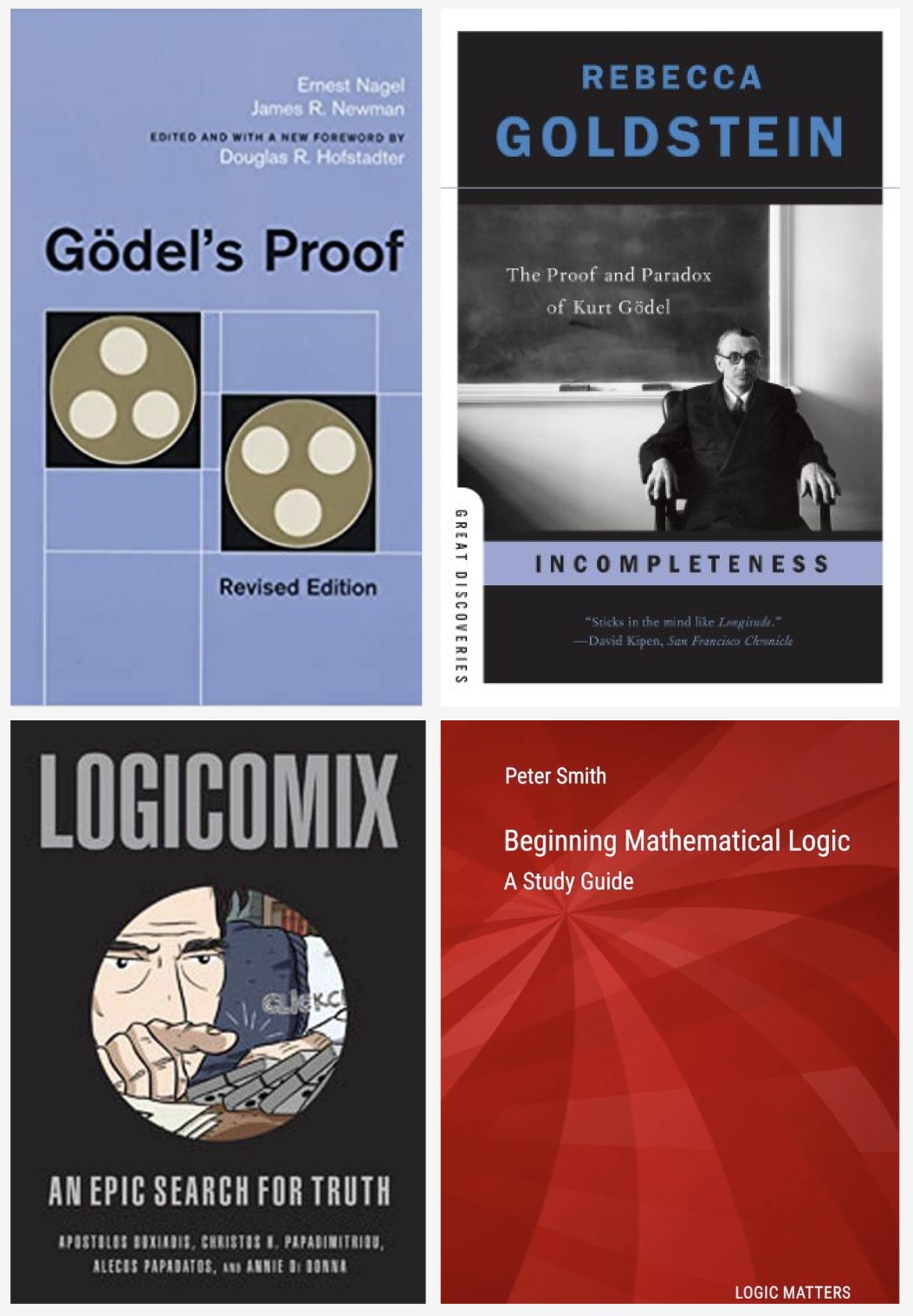
I began with a brilliant narrative of Gödel and Einstein's friendship by Rebecca Goldstein, that also described the heated cultural wars amongst logicians with the Viennese cafés being the battlegrounds, each deeply committed to a way of seeing Mathematics. The book also made an attempt at explaining the proof itself albeit perhaps skipping the mathematical details. Like many YouTube videos, it did not describe clearly what the Gödel numbering scheme looked like, which was surprisingly well presented in this article from Wired.
In parallel, I realized that teaching myself an undergrad Logic syllabus would make it easier to understand common terms (eg. syntax v/s semantics) referenced in the proof. Or at least create awareness of where to look for what question–an important scaffolding to set up whenever I’m teaching myself a new subject. So I found this wonderful resource–thanks to Reddit and a friend who is a professor at CMI–it’s useful to gauge the lay of the land of Mathematical Logic. I have been skimming the guide every now and then, but haven't dived into any of the texts it references.
When Gödel's proof came out, only a small group of Mathematicians were actually able to understand it. And an even smaller set understood the significance of it. Ernst Nagel’s “Gödel’s Proof”, written in the 1960s, is a wonderful exposition on the evolution of mathematical logic and thought, and does a great job of explaining the proof. I'm currently reading it, as a detour from Goldstein's book. Douglas Hofstadter, famous for "Gödel, Escher, Bach" amongst other things, considers Nagel to be amongst his mentors and wrote the preface for the latest print of this book.
I had come across the graphic novel–Logicomix– a long time ago, but picked it up again, as I was moving into the Logic guidebook. It colorfully describes the life of Sir Bertrand Russell, who co-wrote Principia Mathematica. Gödel’s paper was in response to Principia Mathematica. Coincidentally, Sir Bertrand Russell’s foray into logic stemmed from some traumatic incidents in his childhood which were denied by his family, thereby bringing up the question of “what is true and what isn’t?” in his young mind.
The Delight of an Autodidact
It’s so wonderful to be able to learn things on my own and seek guidance from the Internet. In many ways, I like it much more than enrolling into some program in some university. There have been times when I’ve spent a week on just a page of whatever I was reading. Reading it, walking with it, sleeping over it. No pressure to meet any deadlines. Truly learning because I want to understand a subject matter with no ulterior motives. What an absolute delight! If you’d like to embark on a similar journey, please do reach out to me via email and I’ll be happy to guide you!