Decolonizing the Mathematical Foundations of Physics
Could we develop a Mathematical framework for Consciousness if the Scientific endeavor replaced its Greek-inspired Mathematical foundations with wisdom from Buddhism?
In the summer of 2019, inspired by a then lover, and a reading of Cal Newport, I embarked on a sudden digital fast. Sudden because prior to that moment, I was posting quite regularly. In the performative manner of social media culture. I deleted all my social media accounts and cleaned out a majority of the apps from my phone. I dropped into a void space of sorts. In hindsight, the digital device provided me an escape from “boredom”. I have since realized that my “boredom” – which was quite well known amongst my friends and family by the way, KV would joke that “Viggy, you are always bored” – was a somatic experience where I’d feel the complex emotions associated with the trauma bubble up under a layer of numbness but I couldn’t feel them because they were under a blanket of numbness. It’d create a numbed out agony, which I then labelled boredom. I’d often fall asleep after feeling “bored” for a while. This was slow body dissociation in action.
This time I stayed with the voidal boredom. Thankfully, I had access to a variety of movement practices and I had scrubbed myself diligently clean of all numbing addictions. This was probably the most extreme I was about staying away from substances.
From this void space, emerged an intellectual curiosity to explore and understand consciousness through 3 different lens – Astrology, Physics and Buddhism. I had already dived fairly deep into Buddhism – both theoretically and experientially. The Buddhist path seems to have cyclically given me the sense that I’m quite deep into it and I’m so new at it. Lol. A read of “Teach Yourself Physics” and intuitive knowledge gained during JEE and Physics Olympiad prep in high school gave me the confidence that I could teach myself graduate level Physics along with the underlying Mathematics. I knew little about Astrology so had uninformed confidence about my ability to pick it up.
I wrote a manifesto of sorts in August 2020–
The gist being that Light, Gravity and Consciousness are somehow interrelated in a way that we don’t have clear understanding of. And if someone could simultaneously become an expert in Physics, Buddhism and Astrology, they could further the bounds of human knowledge.
This is an update post focussed on my exploration of Physics & Mathematics.
Civilized Physics
I read a bunch of books by pop-Physicists Carlo Rovelli and Sean Carroll and then started off on a course available on YouTube called “Lectures on the Geometrical Anatomy of Theoretical Physics”. The course claimed to start from Mathematical Logic and gradually build the entire Mathematical foundation that all of theoretical Physics rests upon. The magic bullet.
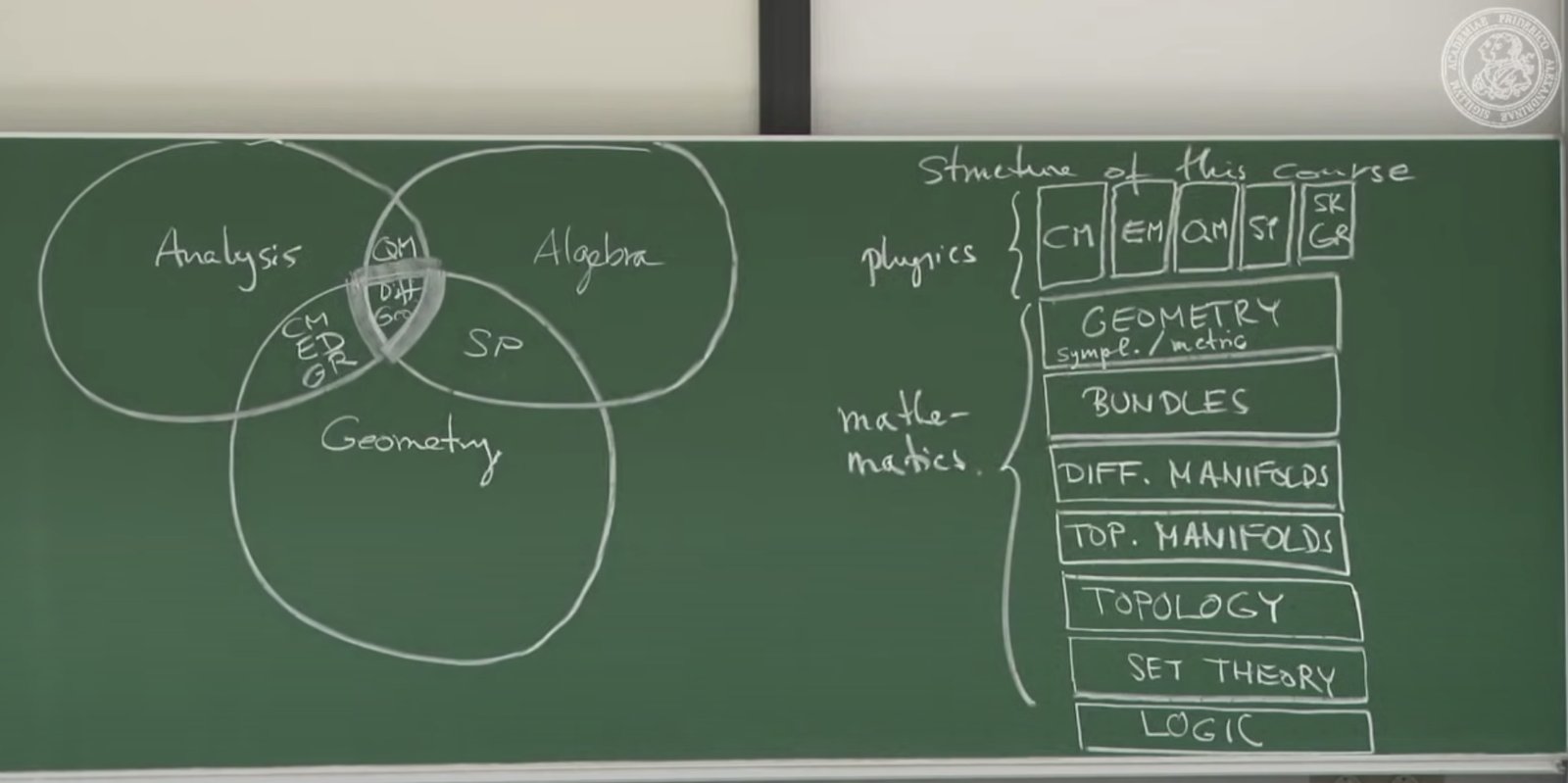
Logic underlies everything. So beautiful. Truly.
But wait, where does Logic come from?
Drumroll…
From Greek Philosophy.
The course itself makes subtle references to Greek Philosophy, without explicitly calling it out. Allow me an anti-colonial rant here. I love ranting as a form of expression :) It feels so alive. I used to not like it, but then I made friends with the depths of my Darkness where my Rage resides in its purest Divine form.
The West often implicitly thinks that its Science is the only Science. Its Philosophy is the only Philosophy. It amusingly infuriates me that “Logic” has been claimed to be of only one form – the Greek form. This implicit assumption is buried deep under the structures of Science, which I shall henceforth refer to as “Western” Science. As if the rest of the world were bumbling illogical fools. Just because we lost the colonization wars, we are assumed to be illogical, barbaric, uncivilized brutes.

Updating this implicit link between Logic and Greek Philosophy is the key. There’s a brick or two that’s weak there, and if that brick can be replaced with a stabler brick then everything else should follow suit with existing mathematical proof methodologies.
The Weak Greek Bricks
Logic is typically represented by truth tables. Truth tables define how truth flows, when it is operated upon. Most operators and accompanying truth tables seem intuitively obvious. To the parts of me that are connected to Buddhism and Hinduism, different from the Western conditioned parts.1
There are two places in Logic, where Greek Philosophical bias creeps in.
Implications
The first one is the “implication” operator.
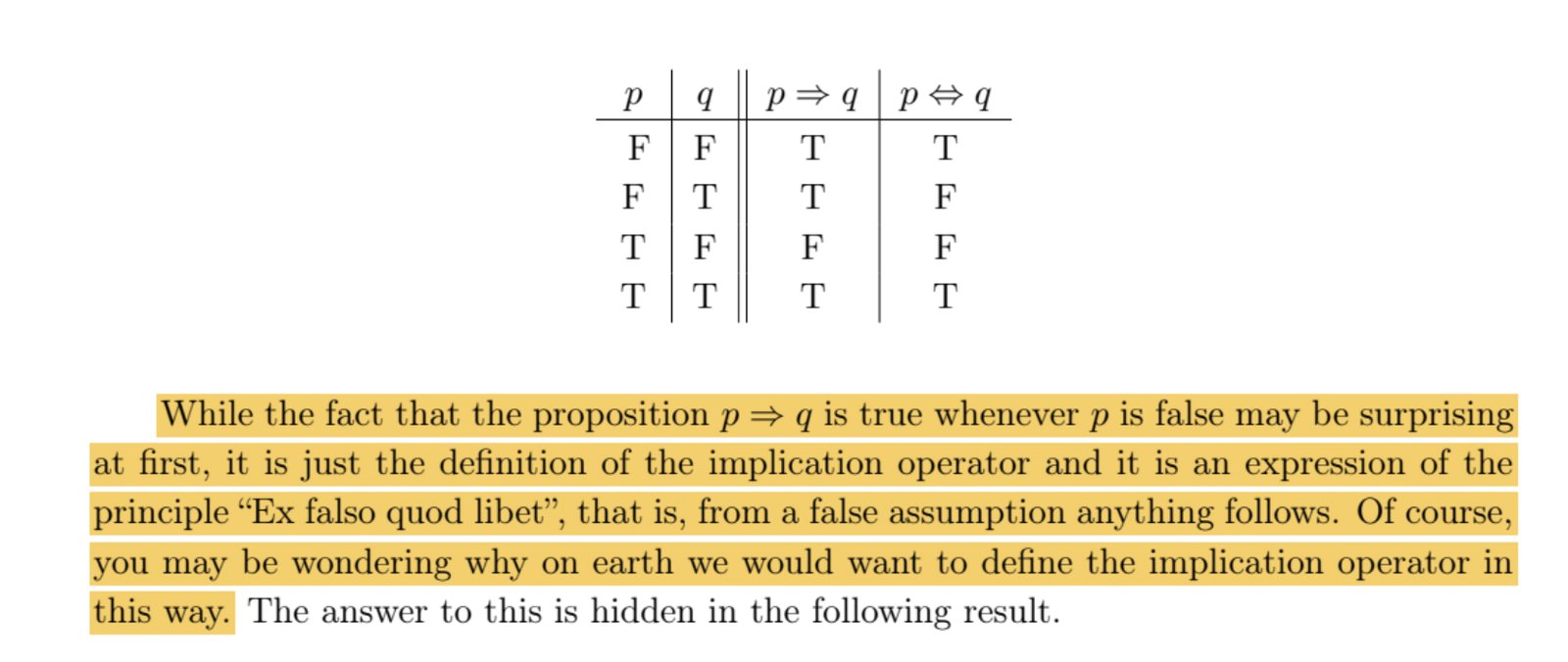
Here is the explanation of the truth table for the implication operator and the “simple” explanation for a “surprising” aspect of it, referencing a Latin proverb – Ex falso quodlibet.
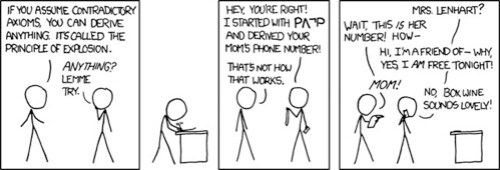
I haven’t yet traced the origins of this principle but suffice to say that the Buddha didn’t utter it, nor did the ancient Rishis who developed Jyotish nor Lao Tzu.
It’s quite western in origin.
From a falsehood, anything follows. So if there’s a false assumption, then we can prove anything. Is that really the case though? Or is it that from a falsehood, nothing follows. That if we discover a false assumption, we should be discarding all the logical conclusions we have derived from it. I’m not sure. It seems like a weak brick to me, at the very least.
Mathematical logical implication is the basic building block of all mathematical proofs. Every mathematical proof is a series of logical implications leading us from the set of propositions to a result. Imagine the earthquake that the realm of Mathematics and Physics would experience if the truth table of the implication operator were to change. Speak of a metaphorical rug pulled out from underneath the structures of western Science.
The notion of mathematical implication also winds its way to the inherent assumption of “causation” in classical Physics.
For e.g., the idea of a “Force” is inherently causative in nature. We apply a force, causing change. This clashes directly with the notion of “codependent arising” that one encounters in Buddhist metaphysics. Buddhism believes that phenomena can emerge simultaneously and codependently, without one being the cause of another. Depending of course upon who you speak to, the widely agreed upon explanation for Astrology is that the Cosmos is a reflection of the dynamics unfolding in the human realm on Earth.
Which brings me to the other weak foundational brick.
Truth or False
The design of the truth table implicitly assumes that true and false cannot co-exist. The nature of a paradox is such that it is simultaneously true and false. Well, actually it isn’t either. It exists in a different realm than truth and false. The categorization into truth and false is an intellectual exercise. Paradoxes live in the realm of the heart and soul. Western Science gets caught up on paradoxes time and again. Cantor’s Paradox and Russell’s Paradoxes in Set Theory inspired the entire (might I say, now failed?) attempt to formalize Mathematics and rid it of intuition. Theoretical Physics is stuck on the Wave-Particle Paradox for the past century.
What if there was a way to represent paradoxes in Mathematics, would that allow us to create a (global) Scientific framework that perhaps can break through the Wave-Particle Paradox? That’s where my exploration of Mathematics-Physics is at right now. I got through a third of the course I mentioned above before I could no longer intuitively understand the concepts being presented. My intention in pursuing an intellectual exploration of (western) Science was to study at the pace of embodied, intuitive understanding. So I paused. This intention is borne out of what I used to consider a handicap. I can’t read something that I can’t absorb intuitively and somatically. I tend to dissociate and fall asleep.
A month ago, I decided to explore Gödel’s work. Since the mid-1800s, Mathematicians have been split on whether Mathematics should relate to real world phenomena or not. Whether it should rely on human intuition, which is influenced by the human experience of the real world, or just rely on intuition-free deductive reasoning.
David Hilbert believed that it should be the latter, because intuition is fallible. A reasonable argument. Large droves of people in the 1930s believed that it was intuitively obvious to send Jews, Slavs and handicapped folks to concentration camps. Intuition has its flaws.
David Hilbert instantiated a program to “formalize” mathematics. In the “formal” mathematical world, that Hilbert imagined, mathematics would be a bunch of symbols (rid of their intuitive relationship to the real world) along with a set of ways to combine the symbols. 2 would become just a symbol and no longer represent 2 things. Hilbert called this a “formal system”. Formal as in rid of fallible human intuition. It felt validating to read Gödel’s take on it. Intuition is fallible, yes. But the solution isn’t to avoid it, but to sharpen it.
Intuition allows us to abstract what we see in reality so that we may build a mathematical framework that can correctly represent objective reality. Plato was a resolutely intuitive mathematician.
Plato himself argued that the beauty of the abstract realm, which immeasurably exceeds that of any single particular, can and ought to kindle a passion far larger than any prompted by individual beautiful persons (fickle, imperfect creatures who cannot even be counted on to love us in return and whose beauty not only cannot compete with the transcendent sort but also is subject to the corrosive actions of time).
Goldstein, Rebecca. Incompleteness: The Proof and Paradox of Kurt Gödel
Einstein was similarly motivated. Einstein wanted to develop a mathematical description of objective reality. Reality that exists independent of our sense organs. In his theory of Relativity, he deduced a vastly different picture of spacetime than what my senses are used to. I find Einstein’s approach beautiful and spiritual, in a sense. Most spiritual traditions attempt to rein in the sense organs so that they can see the world for what it truly is. One could instead leverage the power of Intellect to deductively figure out what objective reality is and then subtract that from one’s own sense perceived reality to clearly see what one’s senses are doing. If one could clearly see what one’s senses are doing, then one could figure out what one’s karmic load is.
Maths could be the key to creating a picture of objective reality.
Gödel was motivated to work on such math. Math that felt meaningful to him. He was quietly opposed to the Hilbert program.
In 1900, Hilbert declared a list of 23 problems, which once solved would establish the formal structure of Mathematics, rid of all intuition. The key was to prove that Arithmetic, the most basic of Mathematical disciplines, could be consistently and completely formalized without any paradoxes.
Gödel’s Incompleteness Theorems from the 1920s proved that this was not possible.
Gödel did so by presenting a mathematical representation of paradoxes! The only instance of such an attempt that I’ve encountered!
My sense is that if we could understand the strategy of his proof and apply it to the implication truth tables at the heart of Logic, then it might open up the flood gates for mathematical and scientific transformation.
Greek Philosophical Trauma
Plato was likely someone who had sex with underage boys. Likely Socrates too. It’s possible that in many of these situations, the sex was non-consensual because of the power dynamic involved and the age of the boys. There are veiled references to this whenever ancient Greek philosophers are mentioned. I find it important to state this clearly.
“Here is the life, Socrates, my friend,” said the Manitean visitor, “that a human being should live—studying the beautiful itself. Should you ever see it, it will not seem to you to be on the level of gold, clothing, and beautiful boys and youths, who so astound you now when you look at them that you and many others are eager to gaze upon your darlings, and be together with them all the time. You would cease eating and drinking, if that were possible, and instead just look at them and be with them.”
Goldstein, Rebecca. Incompleteness: The Proof and Paradox of Kurt Gödel
Perhaps if the ancient Greeks had done more trauma healing work on themselves, they would have come up with logical structures that better represent paradoxes.
Epilogue
I’m writing this note with the hope that able brains who get what I’m talking about pick this work up in their spare time. Too much brain power is being wasted on gaming stock and crypto markets when there are really exciting questions to be answered about life!
I’d love to hear any responses to this post on my email – [email protected]. Please be kind.
-
Daniel Quinn claims that Hindu, Buddhist and Abrahamic thought all are biased in similar manners, away from the animist ways of being that predominated before settled agriculture swept human civilization, leading to a proliferation of religions seeking “salvation” from the backbreaking life filled with suffering that settled agriculture and accompanying expansionist tendencies bring. Uncovering that layer of bias and applying that to the purification of Science might require a whole ‘nother level of effort. ↩