An Inquiry into the Nature of Things
My attempts at understanding the inherent Chaos of existence
Aug 2020
Over the last year, I’ve found my varied intellectual explorative interests coalesce into a desire to fundamentally understand the nature of things. In this document, I attempt to present the underlying thesis of this exploration and present the syllabus I’ve cobbled together for the same.
How does one begin inquiring into the nature of things? Every ‘thing’ is a system. Every system is made up of units and the interconnections between those units. One could also define subsystems within the larger system and could further analyze the subsystems themselves in a similar fashion.
If one were to explore the nature of humans, one could look at the human body as a system, composed of human cells - the units (red blood cells, neurons etc.) and subsystems (circulatory system, nervous system etc.). One could also look at human society as a system composed of units - humans, and subsystems - various communities.
If one were to explore the cosmos, one could define the Milky Way as a system, that’s part of the larger system of the Universe and contains the subsystem - our Solar System and each of these systems has units - stars and planets.
I’ve come upon 3 distinct approaches to this question of the fundamental nature of things. There is a lot of nuance to each approach but I’ll skip the nuance while introducing them.
- The nature of things is empty i.e. nature lies in relationships => Buddhism
- An attempt to understand the nature of things by understanding their units => Physics
- An attempt to understand the nature of things by understanding the archetypal subsystems that compose them => Astrology
I look at these 3 approaches as 3 blind men attempting to describe an Elephant.
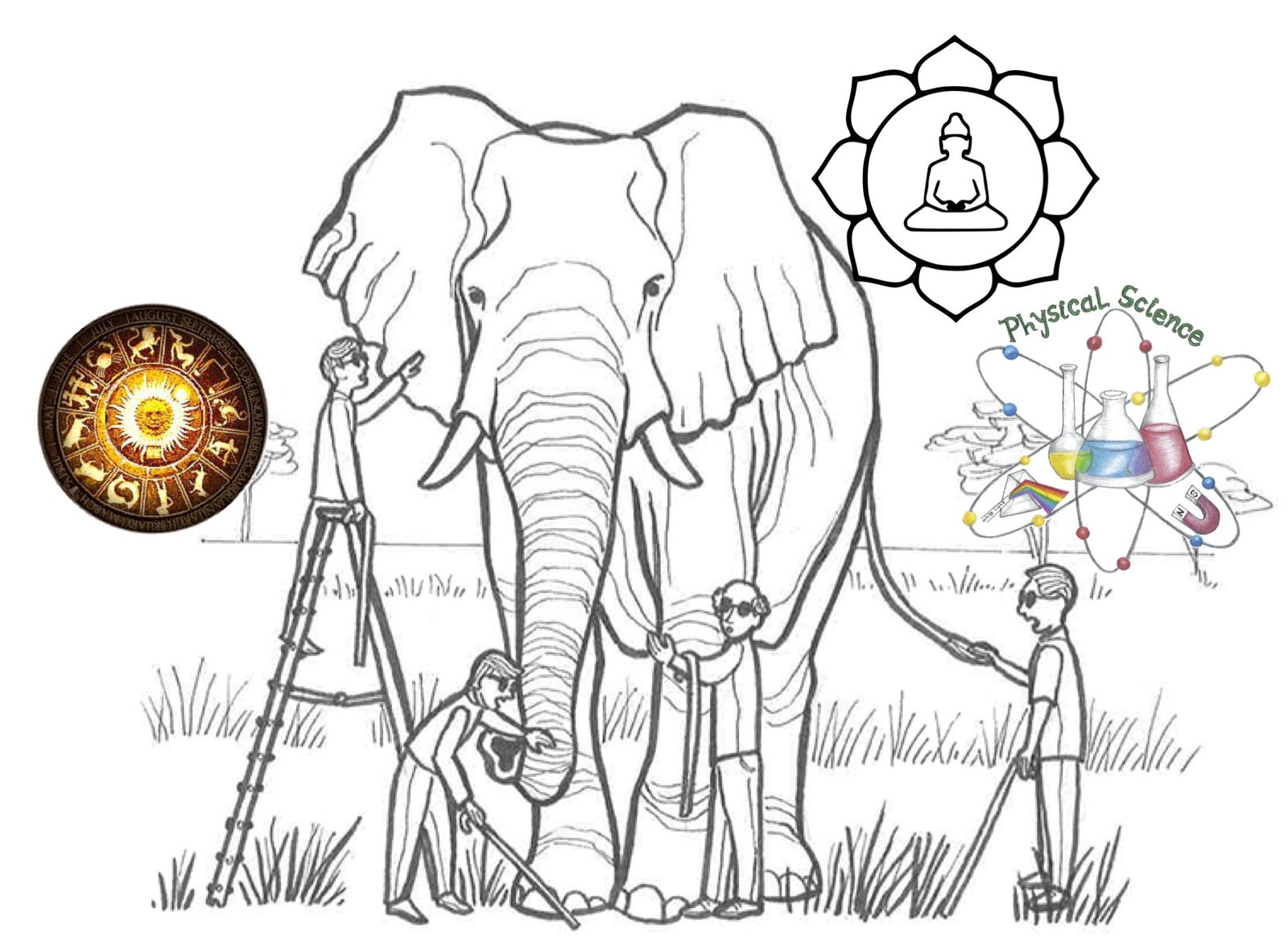
Hence, I believe that studying these 3 together should shed light on the true nature of this behemoth that is our cosmos. I’ll note here that these 3 aren’t the only approaches available but serendipitously, I find myself with them.
In the next 3 sections, I’ll present the syllabus I’ve drafted for this exploration. I believe our collective human intelligence is not being utilized to its fullest capacity. Way too much brain power is being spent on supporting a consumerist, capitalist culture that attempts to convince people they need more than they truly do and then guessing, priming and fulfilling their needs before they could take a breath and think fully for themselves. Education has become a business and the false notion that it stops at the brink of adulthood, is widespread. I believe it’s within the capacities of anyone who reads this document to do these explorations themselves and serve the furthering of our collective understanding of the world. I’d be thrilled if you had a burning desire to draft your own exploratory path by the end of this essay and would be glad to help you chart it.
Physics
I had some exposure to Classical Mechanics and Electrodynamics during high school. And by that I mean that I was able to calculate things that’d get me good grades (I.E. Irodov anyone?) and I loved the simplicity and beauty of the theories. I remember getting turned off the moment Modern Physics (Relativity, Quantum Physics) was introduced because it was very difficult for me to understand what was being presented.
Last year, I reignited my relationship with Physics. I was prompted to do so when I unearthed flaws in my past arguments against Astrology and when I came across the open problem of Quantum Gravity. This reignition began with reading pop-sci books by Sean Carroll and Carlo Rivelli. I then came across Frederic Schuller’s lectures on the Geometrical Anatomy of Physics and am currently on the 5th one. I must note here how nice it feels to be able to take my own sweet time with every lecture and not be burdened by silly 3-6 month timelines influenced by the monetary incentives of a for-profit education system (US) or a system that mimics it (IITs).
Most recently, I read “Teach Yourself Physics” by Jakob Schwichtenberg. This book put to rest qualms I had about being able to pursue this exploration without being enrolled in a graduate program in Physics.
So here are the stages that emerge to me from my journey so far-
- Interest Cultivation - pick some pop-sciency books here to see where Physics seems to drift from your understanding of the world
- Mapping - grasp the landscape of Physics to figure out where to start using TYP or some such guide
- Rigorous Exploration - pick a path, find a resource for it and dive deep
Astrology
I opened up to Astrology after realizing that a couple of tech-y people that I respect read into it on the side. I took Joseph Addeo’s introductory class earlier this year. And I’m now doing Austin Coppock’s Fundamentals of Astrology Year I class. I read some pop-Astrology on and off over the last year but found it to not provide sufficient substance. If you want something to ease yourself into Astrology, I’d recommend Chris Brennan’s The Astrology Podcast. Austin Coppock does a tremendous job of presenting the “mandala” of Hellenistic Astrology.
Buddhism
I did a Goenka Vipassana in the summer of 2018, followed by a service Vipassana in 2019. Since then I’ve idly mused over the notion of enlightenment. This year I came across the wonderful Asian Classics Institute which has done the painstaking work of translating Tibetan Buddhist texts into English. I also came across Three Jewels NYC which offers the 18 foundational ACI classes. I did the one on “Death and Other Realms of Existence” - a very timely class given the nature of the times that surround us right now.
The syllabus I’ve drafted here is to do all 18 classes of ACI accompanied by either the Youtube lectures or the Zoom ones, accompanied by copious Internet exploration of the concepts and the Pali words themselves. Note the emphasis on the Pali words - I believe it’s critical to get as close to the source as possible to not suffer from the ill-effects of translation.
Images
https://www.pngwing.com/en/free-png-bbetq/download
https://www.kissclipart.com/physical-science-clipart-chemistry-physical-scienc-h4fku2/download-clipart.html
https://www.ncregister.com/blog/the-parable-of-the-blind-men-and-the-elephant-retold