"If you look at the data, you'll find no evidence of anti-Blackism"
My thoughts on incorrect data analyses used to prop up arguments that aim to disprove systemic anti-Blackism.
I’m addressing those of you who are putting forth intellectual, data based arguments to claim no evidence of anti-Blackism in police brutality. Specifically the ones quoting research papers. I won’t paste the specific links here because I don’t want to further promote disingenuous research but the data in these papers often focuses on ‘police shootings of unarmed humans’ and claims ‘no evidence of racism’.
Please recognize that systemic racism is like an iceberg. What follows is a representative yet incomplete picture from top to bottom.
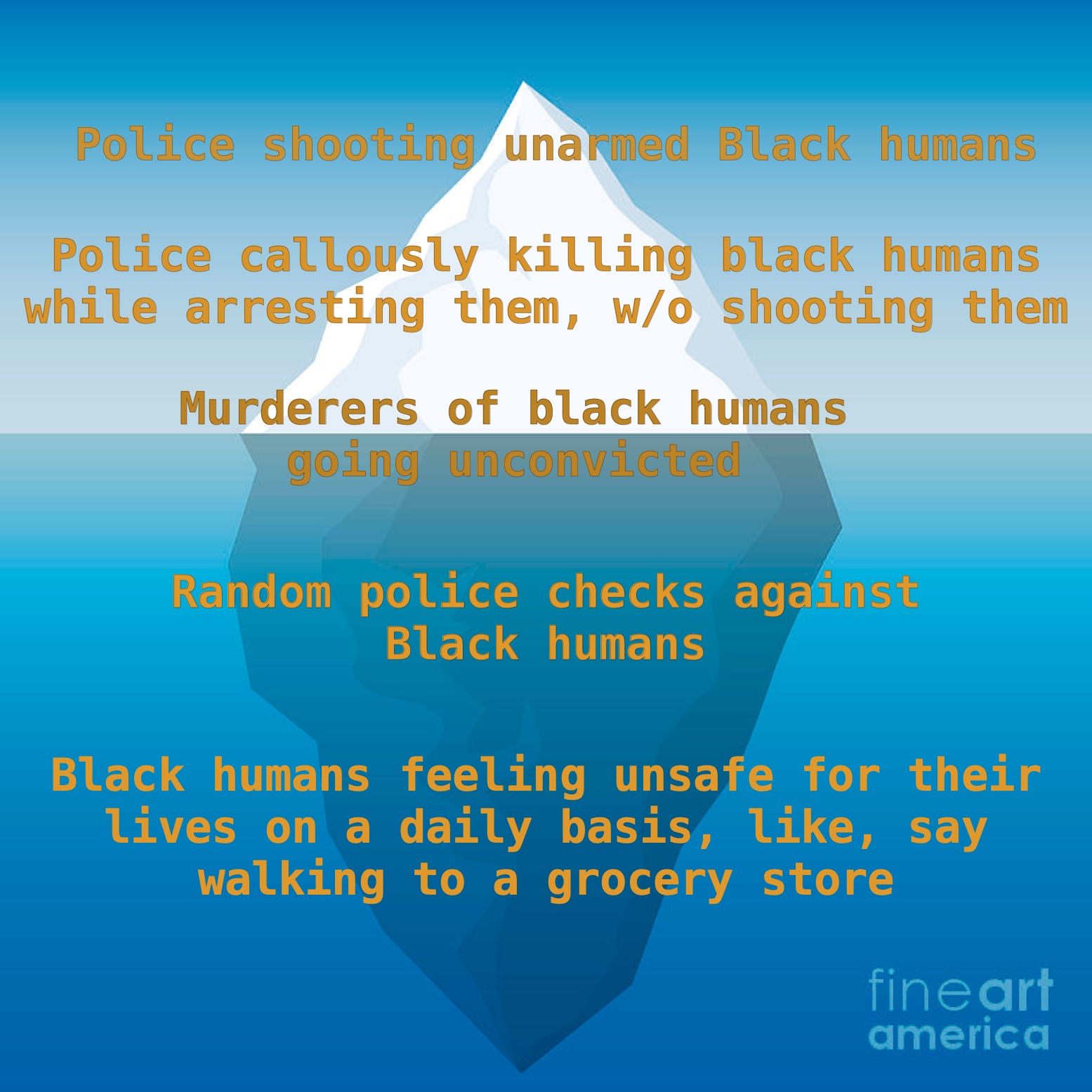
It’s an academically dishonest approach to look at data for only the top line item when trying to understand the protests and the proposed solutions. If you are doing that, please improve your approach.
Do not look at the tip of the iceberg and conclude that there is no evidence for a systemic problem.
Please carefully read the conclusions of the papers you are quoting. I’ve noticed that the papers are very careful in stating their own conclusions. Their conclusions are narrowed down to the domain they are examining–police shootings–however people quoting the papers seem to expand the conclusions to cover a much broader domain.
The protests are against this broad domain of anti-Blackism. They are against the entire iceberg. If you are relying on papers that use data about 1, please collect more data points for 2-5 and then estimate the size of the iceberg using a back of the envelope calculation. You don’t need this to be proven rigorously in academia to act.
Check if the conclusions claim “no evidence of racism”. Please note that absence of evidence is not the same as evidence of absence. Please understand the distinction well. If you are asserting that there is no racism based on such a conclusion, please understand that your assertion is incorrect and fallacious.
When you read such a paper, further ask yourself why the researchers chose to collect only data for 1? Why did they focus on investigating just the tip of the iceberg? What incentives must have driven such a decision?
Please note that academia is also a part of the same system that is anti-Black.
Academics aren’t free of biases. What makes you confident that a white academic system won’t have the same biases that we are addressing here? More so, in the academic discipline of Humanities, it’s difficult to collect statistically significant data. Please look up Nobel laureate Kahnemann’s reversal of his conclusions about ego deletion after realizing how small his sample size was. Think of how you’d feel if the same happened to the paper you’ve been quoting.
Don’t define your system boundaries too narrowly. Don’t just look at data that’s easily available.
My appeal to you all is to investigate 5 via digging into the lived experiences of just a handful of Black men (please be sensitive here) with regards to their daily experience of safety while going to grocery store, while going for a run. And compare those to your.
If you don't have any Black friends, ask yourself why that's the case and what kind of blind spots that might have caused?
Regardless, there’s plenty of experiences being shared on social media. If you read one and notice that you tend to disbelieve it, ask yourself why that might be happening? What kind of biases do you hold that your brain automatically seems to assume the invalidity of these experiences?
If you notice a strong discrepancy in the direct lived experiences of Black humans and yours, please note that that gives you strong hints about the relative sizes of the bottom of the iceberg. Sufficient enough for estimating the size of the iceberg.
This won’t be a rigorous proof but it should suffice. If you are intent on a rigorous proof, ask yourself how often you make back of the envelope estimations to make decisions at work and life? How often do you look at some correlations to figure out your next project? Do you always wait for rigorous academic peer reviewed causation to be established before you act?
If you are still intent on waiting on a rigorous academic proof to act in this humanitarian crisis, please look up history to check if there has ever been a case where humanitarian crises were solved AFTER peer reviewed academic research was published proving its existence.
Please don’t be on the wrong side of history.
Lastly, if your instinctual reaction to this situation is to crunch data to figure out what side you’re on, I earnestly believe you’d benefit from increasing how much you listen to your heart v/s your head. To clarify, that's not the same as "stop listening to your head". Just to increase the input from your heart and body.
(Published Jun 2020)