The Internet is Broken
Let's fix it – what prompted me to join the Facebook Groups team in May 2020
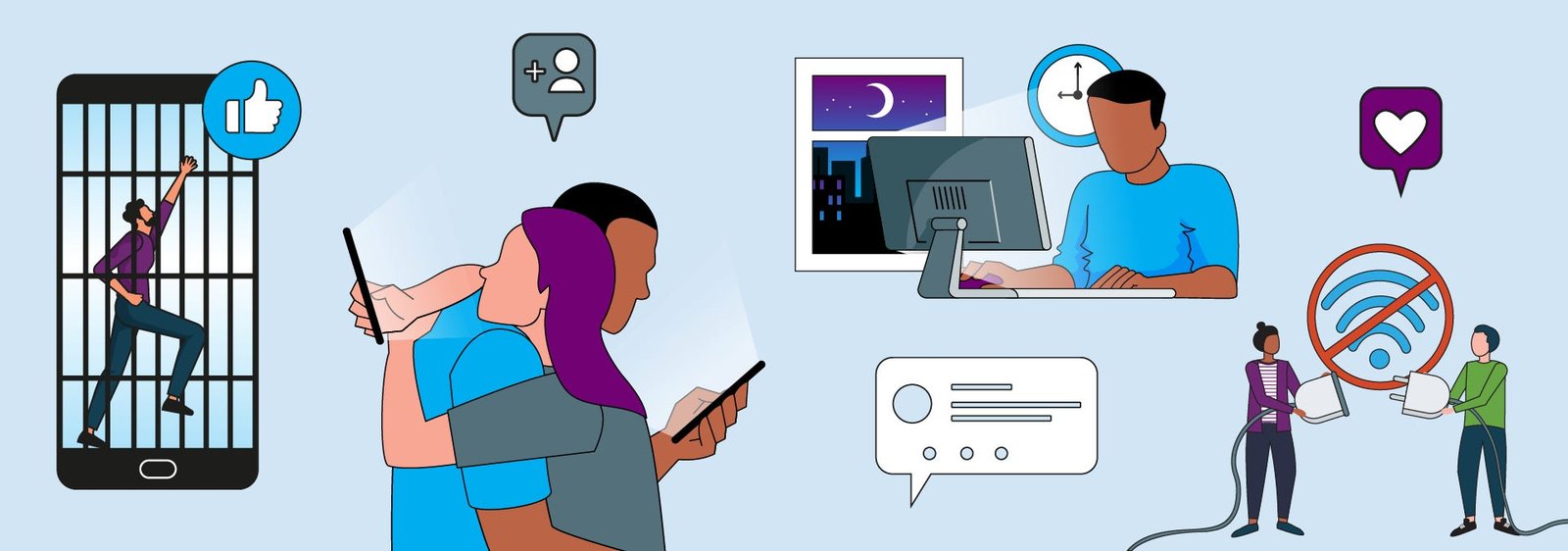
(Credit: https://www.ghostery.com/internet-addiction-infographic/)
I have come to believe that the Internet is quite broken as it stands. It's evolved in an unconscious and unconscientious manner to primarily monetize user attention. An emphasis on efficiency of actions (looking at you, 'Like' and 'Share' buttons) has driven the design of Internet products to tap into the reptilian brain of the humans who use it. Fight or flight responses are constantly active during its use leading to the igniting and stoking of the fires of reactive hatred.
An emphasis on monetizing user attention has led to the creation of distractive user interfaces. Internet products are 20% tool, 80% attention battlegrounds.
I believe these design choices that brought us here were made with good intentions. For eg. the person who invented the 'Like' button most likely wanted to spread joy and was unable to account for the nth-order effects of its introduction. They were unable to predict how the complex system of humanity would evolve in response to it. The persons who developed push notifications likely did not predict the flood of notifications constantly desiring attention. Underlying these design choices is the Silicon Valley mentality of moving quickly and reacting to perceived user choices in rapid product development loops. I label these user choices as "perceived" to note that an addict isn't necessarily capable of making sane choices that are good for them in the long run. Underlying this Silicon Valley mentality is the quarterly stock market cycles that push organizations to do things that pay off in the short term. Underlying quarterly stock market cycles is human greed masquerading as self-interest. Greed is listed as #1 amongst the ten mental defilements per the detailed Buddhist psychological canon - Abhidhamma Kosha.
How did this emphasis on monetizing user attention come about? It came about because advertising became the primary economic model for the Internet. I'll note here that advertising in its purest form is about fulfilling user demand. As such, it is theoretically possible to have an advertising system that presents the user with answers whenever the demand is ready to be fulfilled. However, in an economic system that values Growth above all else, these attempts to satisfy user demand have moved up the funnel into generating user demand. "But wait! What if the user stops having demands? Well, we can't let that happen, can we? Let's preemptively convince the user that what should be their comforts are actually their needs and let's use social pressure to enforce this false idea".
So where do we go from here? I envision an Internet of the future that will foster deep meaningful connection in humanity instead of incentivizing polarization, addiction and loneliness. I believe step 1 is to evolve Facebook. Facebook has been a frontrunner of technology companies over the last 2 decades – boasting some of the best engineers, some of the most innovative products and a culture focussed on growth.
From what I understand, Facebook has been at the forefront of data-driven product decision making. At first glance, this concept seems quite rationally flawless.
"Let's measure what users do. That'll give us a sense of what they want. And then let's use this data to build products that'll meet their needs. Very objective! Very efficient!"
This reasoning easily falls prey to the "What You See Is All There Is" fallacy. In an attempt to build data-driven products, engineers chose to measure what they could easily measure rather than measuring what ought to be measured.
For eg. if you want to foster connection between humans, and you adopt a data-driven approach that falls prey to WYSIATI fallacy, you end up with assuming that *number* of friend connections on social media is a good heuristic for the unmeasurable concept of "connection between humans" and actually end up contributing to the loneliness epidemic, the exact opposite of what you set out to do.
Another symptom of WYSIATI as applied to data-driven product development is the emphasis on time-based metrics as an indicator of a product's success – Time Spent, Monthly Active Users, Daily Active Users. If you want to have some objective measure to guide your product decisions but you don't have a clear sense of what you are trying to achieve with the product, but know that investor money flows in if you have more users, you pick the easiest to measure metric – time spent – and end up with addictive products.
So where do we go from here? Within Facebook, from what I can see, we have squeezed all the juice possible from these time-based metrics. Not surprisingly, an impact curve based on time starts to flatten once 1/3rd of humanity uses the product on a monthly basis. 3 years ago, the company pivoted on to more complex metrics referred to as the "Meaningful Family of Metrics". This includes an abstract metric called "Meaningful Connections" and associated flowchart that computes the value of that for a user. This work is still ongoing, driven by amazing conscientious user researchers (very grateful to them!) and the metric is yet to be operationalized across the company. To give you a flavor of what this metric might look like, if two humans interact in a Group and then end up friending each other, that's considered a more meaningful connection than if they just belong to the same Group. I believe the key here is to incentivize offline or video based connection thereby evolving the software to play the role of facilitating deeper connection. There's a lot of work to be done here, but I see a possibility of this evolution happening. I believe that if this is done well, then it opens up a whole world of possibilities that tap into the unique potential of the Internet in breaking geographical barriers and expand our mental horizons. Imagine someone who subconsciously assumes that people of a different race are intellectually inferior, connecting with a person of that race on a Facebook Group about identifying birds, having a moment of cognitive dissonance and updating their belief system. I believe that Facebook, and the Internet at large, has the potential of doing so at scale. But in order for that, a lot has to change and I joined the Groups team earlier this year in an attempt to contribute to this change. I'd love to help Facebook evolve in this manner, thereby creating a model for the rest of the Internet to follow. I'm excited at the possibility of the Internet truly fulfilling its potential as a platform where humans connect to collaboratively solve the biggest problems that face our society. Not just solve these problems but collaboratively work towards our collective liberation. I appreciate you reading thus far and hope that you'll carve out your own way of contributing to this important project!