Exploring Buddhist Scriptures
I drafted a syllabus for beginning exploration of Buddhist scriptures
Why do so?
I believe that most self–help books and pop behavioral psychology books are, knowingly or unknowingly, influenced by Buddhist thought. Buddhist thought that you might encounter in the western world is often influenced by the western lens of looking at things. So if you want to live a better life, I believe that it’s best to study from root Buddhist scriptures.
My Syllabus
The current syllabus I’ve defined includes incursions into both the Pali Canon (Majjhima Nikaya) and the Tibetan scriptures (Lam Rim Chen Mo). In addition to these, I’ve come across Sri Lankan, Thai and Chinese literature but haven’t really explored any of those.
Pali Canon
Around the time of the Buddha (~400 BC), most of the teachings were passed by word of mouth. A few score years after the Buddha’s death, a bunch of experienced monks came together and compiled the teachings into what is now referred to as “The Pali Canon”. It is split up into 3 parts–
-
Vinaya Pitaka deals with rules of monastic life
-
Sutta Pitaka contains individual discourses (all the “lectures” of Buddhism)
- Digha Nikaya (long discourses)
- Majjhima Nikaya (middle length discourses)
- Samyutta Nikaya (connected discourses)
- Anguttara Nikaya (numerical discourses)
- Khuddaka Nikaya (minor collection)
-
Abhidhamma-Kosha contains the entirety of Buddhist metaphysics, meticulously structured and organized by the Buddha towards the end of his life
I tried reading 3 directly first via some online translations but found it to be quite dry. 2 seems more approachable (and applicable to day to day life) since it contains individual stories.
I’ve started off on Majjhima Nikaya per syllabus drafted by Sati Center for Buddhist Studies, which I came across via a WhatsApp forward from my mom which blew me away by doing an amazing job of listing out the subtleties of the 4 Brahmaviharas.
I compiled the syllabus from Sati Center here for ease of printing. The syllabus contains 10 sections, each with a handful of suttas from the Majjhima Nikaya along with a reading guide that provides introspective questions.
There are a bunch of web apps that provide translations of the suttas. This and this are two good ones. I also ended up ordering Bhikku Bodhi’s paperback translation during a Black Friday spree :)
Tibetan Scriptures
Je Tsong-Khapa was a Buddhist monk from 1400 AD who translated a lot of Pali stuff into Tibetan. He compiled both old-school Theravadan Buddhist philosophy and united it with more esoteric Vajrayana/Tantric philosophy into the Lam Rim Chen Mo (The Greater Treatise on the Stages on the Path to Enlightenment).
I first attempted exploring this via Asian Classics Institute, which has tried to compile the entirety of a Tibetan Buddhist monastic curriculum into 36 ACI courses. I did a course on death (ACI-8) via Three Jewels NYC community.
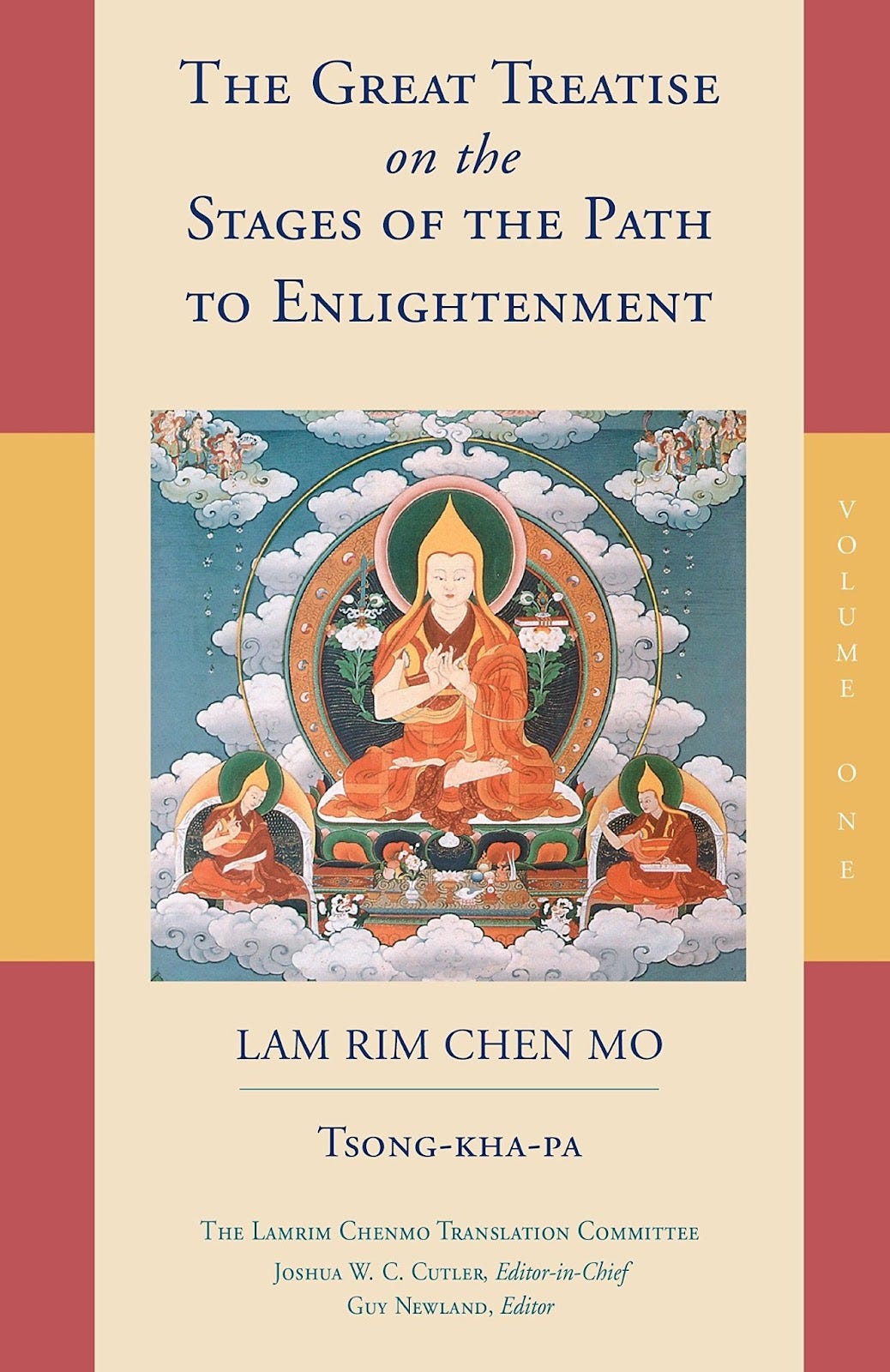
I really liked the course and the teacher but didn’t connect with the translations they provide. I also noticed that the video lectures did not rigorously backlink to scriptural sources. I’m concerned about ideas getting lost in translation and interpretation and prefer studying in a manner that I can self-verify. So I have paused exploring the ACI courses for now and got myself a translation of the Lam Rim Chen Mo by the (official sounding) Lam Rim Chen Mo translation committee. I have really liked the book so far – it’s very rigorous.
My current plan is to read the book for a bit and then pick up where I’ve left off on ACI-1. I feel drawn to pursuing the ACI path because developing a personal teacher–student relationship seems to be a critical aspect of learning Buddhism.