To Believe Is to Apologize
On the responsibility we bear, for what is done in the name of the Ideas we love
Ideas as Entities
I've been reflecting on the concept of apologetics—not just within Christianity, but more broadly, as a framework for reckoning with the shadow side of any Idea you believe in. There's something profound in treating an Idea not just as a notion, but as an entity—something akin to Plato's Forms, existing beyond us, yet taking specific shapes within us. Each of us embodies and interprets Ideas differently, and we bear responsibility not just for the Ideas we espouse, but for how those Ideas manifest through us. And, I propose, through others.
Let’s say you deeply believe in an Idea, and it inspires you toward good. But that same Idea, in the hands of another, takes on a form you find dangerous or destructive. What then? What is your responsibility when harm is done in the name of an Idea you cherish? In an era so saturated with abuse—which I define simply as the violation of boundaries, or, more strictly, a form of connection that leads us away from God, from goodness—this question feels especially urgent.
Consent, Abuse, and Misuse
And I don’t limit abuse to just non-consensual acts. Consent is often held up as the gold standard, but consent alone doesn’t guarantee goodness. People can consent to things that cause great misery later on. If your causal reasoning is underdeveloped, you may never trace your suffering back to the moment you said "yes." Consent can cover up a deeper disconnection from truth, and in that way, abuse can happen even within consensual acts.
History of Shadowed Ideals
So what do you do when others use your Idea—your God, your ideology, your philosophy—to justify abuse? You see this tension all over the place.
Take Islam. There are terrorist attacks carried out in its name. In response, many peaceful Muslims denounce the violence, insisting that Islam is a religion of peace and that these attackers are misinterpreting it.
Or take communism. Here in the U.S., I see many left-leaning people defending communism by disowning the atrocities committed under its banners—Stalinist purges, Maoist famines. They say, "That wasn't real communism," or, "They got it wrong; we won't." It's a kind of subtle faith in one's own incorruptibility. But what if that faith in your own goodness–when you're faced with real, historical evidence of the shadow side of your Idea–what if that denial strengthens the very shadow within you?
The same applies to Christianity. Unspeakable horrors have been done in the name of Christ. How should a Christian respond when someone says, "The church hurt me"? There is a real temptation to distance oneself, to say, "That wasn't true Christianity." But that, too, can be a version of the no true Scotsman fallacy. It denies the shadow side of an Idea you believe in.
Take the most grotesque example: Catholic priests sexually abusing children. How could such a thing happen in the name of Christ? It's clearly a corruption. And yet, it's also a historical reality that cannot be dismissed if you want to remain honest.
Repentance That Works
Throughout history, I’ve seen Christianity call forth flawed men who, in mulling over the teachings of the faith, find their way out of their flaws. I a reminded of Ayaan Hirsi Ali, who journeyed from Islam to atheism to Christianity. She has spoken about this. There is a clarity that Christianity provides around what is sinful, along with strong pathways it offers out of a sinful life – via repentance that works.
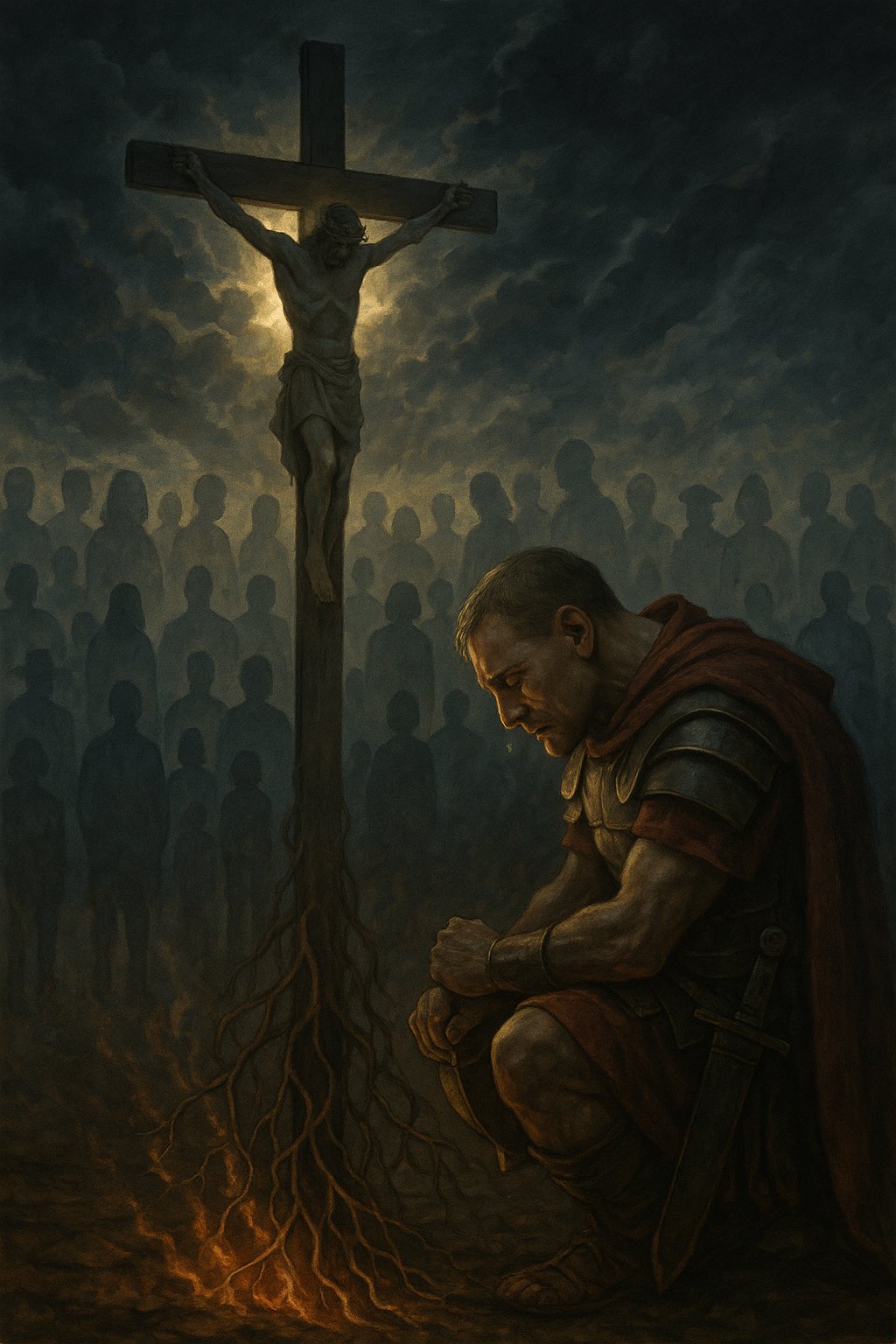
You could explain this psychologically, sociologically, or theologically. But I believe it's because the one true God is the Father of Jesus Christ. He is both all-powerful and all-loving. Through Jesus’ crucifixion, full forgiveness of sins is made possible. In my experience, Christian repentance works. When I believe in Jesus and repent, something in me actually shifts. Old sinful tendencies—gluttony, lust—don’t just reduce in intensity; they disappear. It’s like they’re pulled up by the root and burned away. Other disciplines often just manage the symptom.
Matthew 15:13
“Every plant that my heavenly Father has not planted will be rooted up.”
Matthew 3:10-12
Even now the axe is laid to the root of the trees. Every tree therefore that does not bear good fruit is cut down and thrown into the fire.
“I baptize you with water for repentance, but he who is coming after me is mightier than I, whose sandals I am not worthy to carry. He will baptize you with the Holy Spirit and fire. His winnowing fork is in his hand, and he will clear his threshing floor and gather his wheat into the barn, but the chaff he will burn with unquenchable fire.”
Matthew 13:40-41
“Just as the weeds are gathered and burned with fire, so will it be at the end of the age. The Son of Man will send his angels, and they will gather out of his kingdom all causes of sin and all law-breakers.”
In other religions, many rituals have become hollow. In Hinduism, for example, people often go through the motions of rituals with no expectation that they’ll actually transform anything. It becomes community theater. Standards have quietly lowered. But Christianity, especially through the practice of apologetics, holds to the Idea that there is a standard, and that we should care when it's violated.
Apologetics begins with an apology. It doesn't defend the Idea at all costs. It says, "I'm sorry that harm was done in this name. I'm sorry that you've suffered." I felt this personally when an acquaintance of mine shared how much pain he experienced in the Catholic Church. I had previously expressed wonder at how people leave Christ, but his story made me pause. I felt real sorrow. I felt an apology. It surprised me. I'm a brown Indian man who grew up Hindu. Why did I feel sorry for what Catholic priests did?
From a surface-level identity politics framework, it doesn’t make sense. Why would I, a brown Indian man who grew up Hindu, feel sorrow over what Catholic priests have done?
Embodied Apologetics
The next day, I was at the gym—leg day. And a quick aside here: my relationship with leg day has shifted dramatically ever since (guided by YouTube fitness influencers) I began leading with back-chain activation—hamstrings and calves—before hitting any kind of squat. I’ve also swapped out back squats for the 45-degree leg press to better isolate my quads. And then moving onto the gold standard–Bulgarian Split Squats. A beast of an exercise. I wrap things up with ten minutes of reverse walking on the treadmill. Total game changer for post-ACL knee pain. Being a gym bro in your late 30s is a very different game.
Lately, the gym has become a kind of temple for me—not in the superficial way people say walking is their meditation, when they’ve never sat with their breath for five minutes—but in a real, grounded way. It’s a place where I transmute energy. Where I confront and repurpose old trauma. I show up with presence. With breath. With effort aligned to something deeper than aesthetics (but also aesthetics 😉)
It’s also become a place of emotional release. Sometimes I cry. I burp. I fart. I let things move. It’s very Ayurvedic in that way—honoring the body’s desire to release, even when it doesn’t look pretty. It takes some courage to move past social discomfort, but I think it’s worth it.
Crucifixion and Sacred Memory
So there I was, grunting through a heavy set on the leg press, and I felt tears welling up. And then it came—the feeling. A vivid, almost cellular awareness of the crucifixion of Christ. As if I were there. As if you were there too. We were all there. I felt the same kind of recognition wash over me that must have overtaken the Roman centurion who stood facing Him.
Mark 15:39
“And when the centurion, who stood facing him, saw that in this way he breathed his last, he said, ‘Truly this man was the Son of God!’”
Every soul—past, present, future, human, deity, unborn—witnessed the crucifixion. We were merging into his body as he bled, absolving us of our karmas and sins. That’s why the church is called the Body of Christ. That’s why the blood of Christ becomes wine and his body becomes bread: it is a feast, a sacred consumption of the sacrifice that ended the old system of appeasing “gods”–the intermediaries to the one God–through violence.
And yet, here we are, two thousand years later, still forgetting. That’s the heartbreak. How could we forget that moment? How could we forget that all who have hurt us, and all whom we have hurt, were standing beside us in witness? In awe of the Son of God bleeding on the cross, staying sinless through the agony, knowing that Death is not of God, and can be overcome and it’s only sin that makes us susceptible to it.
That’s the true root of Christian apologetics for me. It’s the sorrow of remembrance. It’s the grief of witnessing someone else forget. And saying: I’m so sorry they forgot. They were right there with me. And I am so sorry for the moments I forgot. How could I forget? There’s an odd resonance here for me in a similar experience I had after recovering repressed memories of sexual abuse. How could I have forgotten?
I am sorry for all those who forget. I am sorry for the harm that continues in the name of Christ. I repent for the moments that I have forgotten we were all there.
A Theology of Apology
I pray for the emergence of Muslim apologetics, communist apologetics, secular apologetics—for people willing to say, “Yes, this was done in the name of the Idea I believe in. And I am sorry.” That, to me, is the truest expression of belief. Not the defense. Not the dismissal. But the apology. If you believe in an Idea, you must also love its shadow—not by approving of the harm, but by turning toward it. By acknowledging its presence, taking responsibility for it, and choosing to stay in relationship with the whole of what the Idea has become in the world. You love the shadow through apology. A real, heartfelt apology. That’s how you truly honor an Idea.
Dedication
For Nabeel Qureshi, a Pakistani-American Muslim who became a Christian apologetic. Your life broke a mold in my mind—the idea that a Christian apologetic must look a certain way. Thank you for showing that conviction, sorrow, and love can speak through any skin.