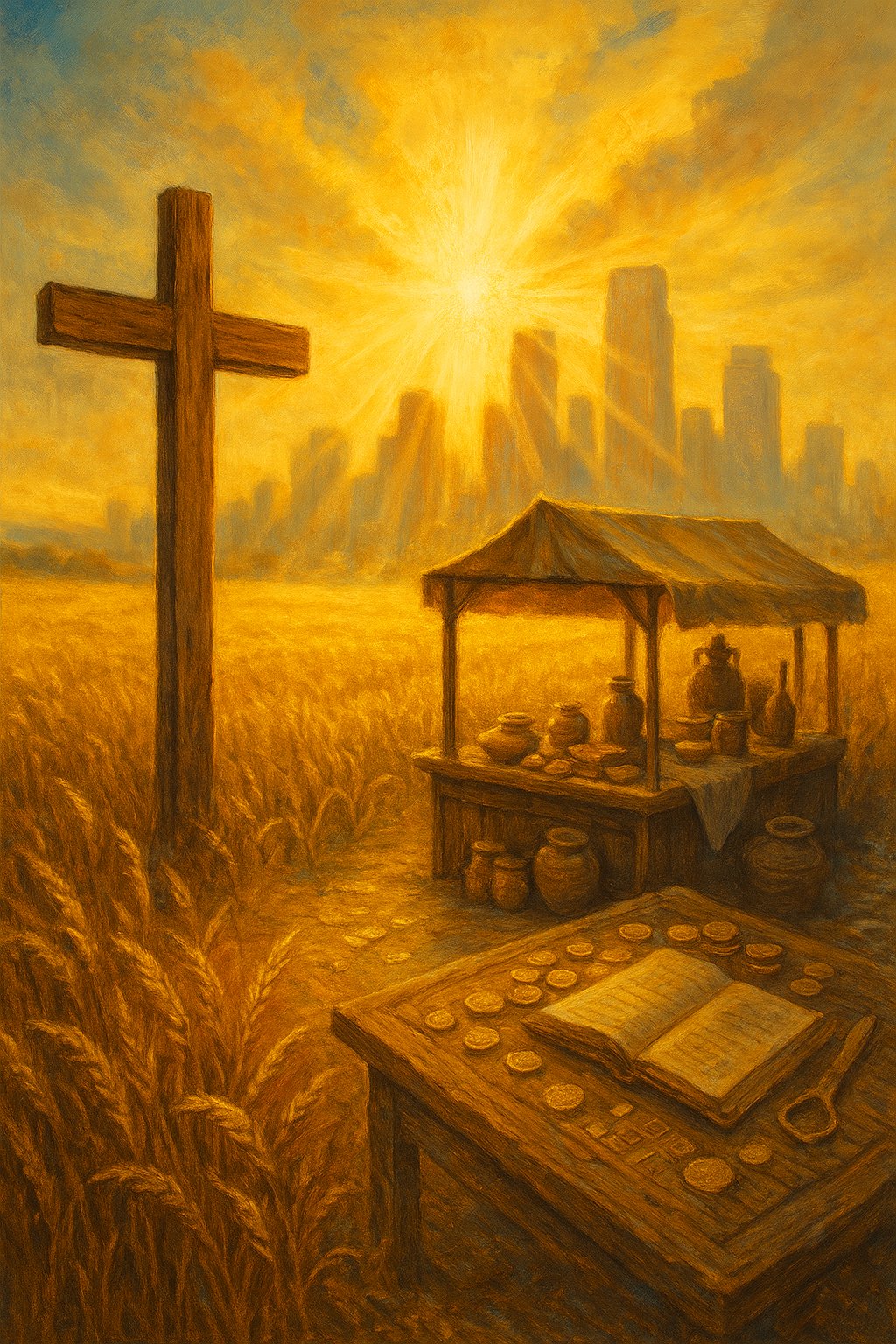
Grace and the Free Market
How Christian Theology and American Capitalism Reflect a Shared Logic of Redemption
Capitalism, Misunderstood
I find myself continually amazed by the profound overlap between Christianity and capitalist entrepreneurship, particularly as it has evolved in the American context, most evident to me as I have watched videos from this YouTube channel called The School of Hard Knocks.
There is what I believe to be a fundamental misunderstanding about capitalism itself, and how this misunderstanding obscures the deeply spiritual nature of free market economics. When most people think of capitalism, they immediately conjure images of consumer excess, corporate greed, or the relentless pursuit of material wealth. But this conflation of capitalism with consumerism or collective human avarice misses the essence of what capitalism truly represents. At its core, capitalism is simply an orientation that recognizes humans can privately own the means of production and use that ownership to fulfill the needs of their community. This involves a process that is inherently spiritual in nature: first sensing and observing the world around us, identifying where there are unmet needs in the community, and noticing what kind of needs one feels motivated in their own self to fulfill and then privately owning the means necessary to fulfill those needs.
The concept of private ownership of productive capacity is remarkably new in the sweep of human history. For millennia, the ability to own something that could produce value was restricted to monarchs, feudal lords, or those who had successfully curried favor with ruling elites. The democratization of productive ownership represents a revolutionary shift in human organization, one that I believe reflects something profound about our nature as beings created in the image of God.
The Cauldron of Creation
Consider this: in order for creation to flow through humanity, we who are made in the image of God the Creator need to be free to own the "cauldrons of creativity" - the tools, resources, and means through which we can bring forth new creation into the world. There is something deeply theological about this arrangement, something that speaks to our fundamental calling as co-creators with the divine.
What strikes me as particularly brilliant about capitalism is how it creates a mechanism that simultaneously incentivizes individuals to orient toward their own self-interest while forcing them to consider the interests of the collective. This is not a bug in the system - it is perhaps its most elegant feature. In order to succeed in meeting their own needs and desires, entrepreneurs must become exquisitely attuned to the needs and desires of their community. They must serve others in order to serve themselves.
This creates what I can only describe as one of the most brilliant mechanisms for incentivizing collective liberation that humanity has ever devised. As the needs of the collective evolve and change over time, new entrepreneurs emerge to fulfill these emerging needs. We witness communities and societies collectively ascending what Maslow described as the hierarchy of needs, moving together toward collective actualization through this remarkable mechanism of aligned self-interest and community service.
In all my reading of history, across cultures and civilizations, I have not encountered anything that matches capitalism's attunement to human nature and human needs as a societal framework.
Built-In Redemption
This is not to suggest that our current stage of capitalist evolution is without flaws - far from it. But what I find remarkable is that capitalism itself contains within its structure the mechanisms for addressing and overcoming these flaws, much like another system I know well: Christianity.
The parallel here is striking and, I believe, not coincidental. When someone becomes a follower of Christ, they do not suddenly acquire the supernatural ability to stop sinning. They retain the God-given gift of free will, including the freedom to choose sin. However, they gain access to tremendous support and resources to move away from a sinful life. They are no longer trapped in the same way they once were.
Before the crucifixion of Jesus Christ - which I see as a shamanic act that cancelled the karmic debts of all humanity - every sin led to increasingly severe consequences. People became debt-ridden in a spiritual sense, caught up in cycles of karmic debt that seemed impossible to escape. Even the Buddhists acknowledge that very few are able to exit the cycle of life and death, i.e. overcome Death, in a single lifetime. The grace offered through Christ's sacrifice broke these cycles, providing a pathway to freedom that had not previously existed, irrespective of a person's spiritual aptitude.
Grace in Bankruptcy
Remarkably, capitalism operates with a similar structure of grace and redemption. While it is certainly possible to become caught up in debt cycles within a capitalist system, the American legal framework in particular provides safety nets for risk-takers that mirror the grace offered through Christianity. The avenues available for offloading debt, particularly through bankruptcy legislation, represent some of the most graceful and forgiving approaches to financial failure found anywhere in the world.
When I compare American bankruptcy laws to their European counterparts, the difference is striking. The American system provides what amounts to freer access to a form of economic grace - a second chance, a clean slate, an opportunity to begin again. This is not perfect, but it is remarkably generous compared to the alternatives available in other legal systems.
Critics often argue that America lacks the social safety net found in European countries, but I would contend that America does indeed have a social safety net - it is simply tuned toward risk-takers rather than risk-avoiders. This makes profound sense when we consider that creation itself requires risk. To create something genuinely new, one must be willing to risk death in a metaphorical sense. Creation requires fighting against entropy, against the forces of decay and dissolution, and overcoming them.
Victory Over Death
This connects to a fundamental Christian truth: by living a life free from sin, we gain access to the eternal life promised through Christ Jesus. This eternal life represents a victory over death itself, because death is not of God - it is the absence of God, just as darkness is the absence of light. The creative act, whether in business or in spiritual life, is fundamentally about choosing life over death, creation over destruction, being over non-being.
The more I explore these parallels, the more fascinated I become with the overlap between Christianity and American capitalism specifically. Both systems acknowledge human fallibility while providing mechanisms for redemption and growth. Both are designed with the understanding that their flaws can be overcome from within the system itself, rather than requiring external intervention or complete systemic replacement.
Spaciousness for the Denier
In my study of the Bible, I must admit that I have not yet found explicit passages that clearly articulate capitalist principles in modern terms. A comment on the video that prompted this essay suggests the book of Proverbs. However, the fact that capitalism emerged and flourished specifically within the Christian world seems far from coincidental. Some might argue that capitalism actually emerged from an increasingly secular or atheistic worldview, but I would counter that Christianity is unique among world religions in making genuine space for atheism and doubt.
There is something profoundly graceful about a faith system that creates room for the denial of God within God's own world. Islam does not provide this kind of space for doubt and questioning. Buddhism and Hinduism offer some room for skepticism, but not to the same degree. This spaciousness, this willingness to allow for the possibility of disbelief, reflects a confidence in truth that does not require forced compliance.
The creative output of Christian civilization over the past two millennia speaks to this dynamic. The Buddhist world, the Hindu world, and the Islamic world, for all their wisdom and beauty, have not demonstrated the same level of literal creativity and innovation that has emerged from Christian civilization. This is not a judgment of spiritual worth or human value, but simply an observation about material and technological creativity. The fruit, as they say, speaks for itself.
A Hopeful Fulfillment
And yet, I want to close by acknowledging where capitalism—especially American capitalism—has missed the mark. The widows, the homeless, those without means—these are the very people scripture calls us to care for. And at times, our economic system has failed to see them.
But I don’t believe that failure is final. I don’t see why American capitalism can’t rise to that occasion. In fact, I think it must. Not by abandoning profit, but by expanding what we see as valuable. I see entrepreneurs already moving beyond self-interest narrowly defined as money—and toward self-interest as connection. Not in an extractive way, but in a truly human way.
That gives me hope. I carry hope that American capitalism can grow into the kingdom economics described in the New Testament—not perfectly, not overnight, but steadily. Of all the systems I’ve encountered, it still feels like the one most capable of fulfilling that promise.