Exploring Sober Intimacy
The questions that come when I’m not led by Lust
Don’t let the em dashes scare you off
Disclosure: I use AI to help finish my writing. My current process involves voice-dictating my thoughts—something that feels far more natural than typing into a document or scribbling in a journal. I then bring those voice notes into ChatGPT and ask for help shaping them into writing that reads more fluidly. I specifically ask it not to add any poetic flourishes or stylized language that isn’t mine. It’s just a tool I use to make spoken thoughts easier to read. After that, I go over the draft myself and revise it further to make sure it’s aligned with what I really mean to say.
Over the last year and a half, especially as I’ve been divorcing lust, my experience of dating—and even forming male friendships—has completely changed. It’s become strikingly clear to me just how much lust can blind a human being. It cloaks perception in a way that makes it hard to truly see the other person. You think you’re being present and tuned in, but you’re really just chasing a feeling.
A question that’s been alive in me is: what does sexuality without lust look like? I don’t have a neat answer yet, but what I do know is that most of my past pursuit of women was led by lustful instinct. Since putting that on the back burner, a new kind of sober dating has emerged—and it’s been so clarifying.
One big shift has been space to ask the harder questions. And by “putting lust on the back burner,” I don’t mean suppressing all desire—I still notice whether there’s a spark—but I’m not acting from that place right away. I’ve been avoiding erotically charged flirtation and limiting early physical contact. Instead, I let myself soften. I let my heart lead the pace and direction of connection, not my arousal.
There was even one moment where I named this explicitly. I’d matched with someone on a dating app, and when we met, our connection naturally leaned into playful, flirtatious banter—which is so common in that context. But at some point I paused
and said, “Hey, it seems pretty clear that we have solid verbal chemistry and playful flirtation down. How about we just put that aside for a bit and talk about some real stuff?” I was honestly surprised by how well it landed—she met it with curiosity and openness. That moment affirmed for me that there’s often a shared hunger for something deeper; it just takes one person to name it.
In the past, if there was a pause in conversation and we’d already entered some kind of physical intimacy, I would fill that pause with a touch or caress—subtle, but intentionally erotic. There was a whole internal playbook running that was designed to move things forward physically. And I’ll say, I don’t think that playbook is inherently wrong. It can be beautiful in a committed relationship. But outside of that, it was often manipulative—and more importantly, it kept me from actually getting to know the person.
It was so easy to drift into that sensual rhythm, to enjoy the chemistry and closeness, and then when red flags did show up, there’d be this inner tension: do we pause and address this, or do we just keep enjoying the intimacy? More often than not, I’d choose the latter. Until, of course, I’d be slammed by something shocking or painful—something that, had I seen it clearly on the second date, I might not have continued at all.
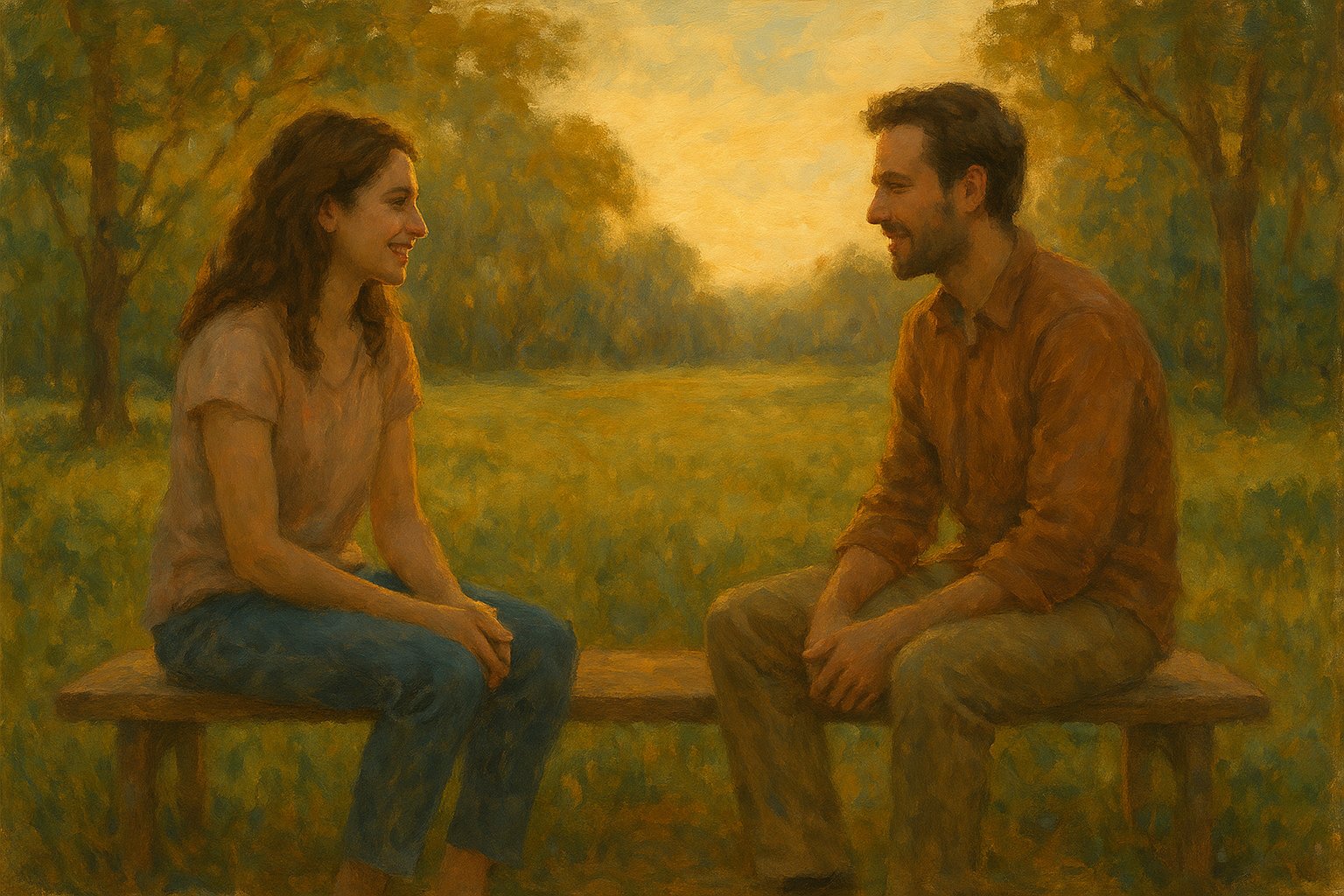
These days, in those same pauses, I find myself leaning into curiosity instead. Asking questions. Opening up space for deeper conversation. Letting the moment breathe.
I’ve noticed this shift with men too. In the past, I’d fill space with adventure proposals—platonic but still chemistry-driven. Now, there’s more space for deeper inquiry. It’s helped me see what makes someone truly compatible, both in friendship and romance.
Here are some of the questions I’ve been asking in these spaces:
- What’s your relationship with substances? (Alcohol, weed, tobacco, psychedelics, psychiatric meds)
- What’s your relationship with biological parenthood?
- How do you orient in relationship—monogamous, polyamorous, something else?
- What was your last relationship like, and when did it end?
- Have you ever cheated?
- How do you feel about porn?
- What kinds of things do you enjoy during the week?
That last one may seem surface-level, but it helps me understand someone’s rhythms and where our connection time might naturally fit.
Some other curiosities:
- What’s your relationship with streaming services or ice cream?
- What’s your eating style?
These kinds of habit-based questions can offer insight into how someone relates to coping patterns—without judgment. We all have our stuff. The point isn’t to find someone who’s flawless, but someone who’s aware of their patterns and actively working with them. And more than that, someone who’s spiritually yoked—at a similar level of inner work and orientation toward growth—so that the relationship isn’t about one person dragging the other up, but about both people charging forward together into creation.
That said, sometimes it becomes clear that one person is on a very different part of the path. And that’s not inherently a problem. When that’s named honestly, it can open the door to a heart-centered mentorship connection—something with its own kind of beauty and power. But when we try to force peerness where what’s actually called for is guidance or humility, that false equality creates strain. It erodes trust. The relationship collapses under the weight of unspoken hierarchy.
Two questions I’ve found especially revealing:
- What’s your relationship to grief?
- What’s your relationship to anger?
These ones get to the heart of someone’s healing journey. I often think of grief and rage as twins of trauma—grief being unprocessed sorrow from the past, rage being a response to past boundary violations. When those parts are active but unexamined, they tend to spill out in the present in ways that confuse both people.
Once I’ve had a sense of those foundations, I’m also curious about someone’s creative orientation. That often shows up through their relationship with biological parenthood—but not always. I realize this may be provocative to say, but I’ve come to believe that a deep disconnection from the desire to have children is often trauma-related. When someone works through numbness, grief, rage, and addictive patterns—around substances, sex, or love itself—what often emerges is a powerful, embodied desire to create. Not just to create art or ideas, but life itself. I’ve come to believe that, beneath the layers of avoidance and pain, there’s a natural, somatic longing to generate life—often in the form of children.
This isn’t about moral pressure or cultural expectation. It’s about coming home to the body and its innate orientation toward generativity. When those deeper wounds begin to heal, the fears and intellectual arguments against creating life tend to lose their grip.
And with that creative impulse comes a kind of grounded discernment. Not rigidity, not recklessness—but a sober, open-hearted presence that can meet relationship and connection with clarity and care.
So that’s the evolving list I’ve been tracking—curiosities that help me see where someone is in their own healing and how we might relate. I’m curious about your journey too: what has sobriety in dating looked like for you? What questions do you like to ask when getting to know someone?