On Overcoming Death
From the Buddha to modern biohackers — and the one Victory that stands apart
Every time we are born into a physical body, we arrive carrying karmic seeds from past lifetimes. We are given a fresh start — an innocent body created in the image of God — with the task of overcoming the poor behavioral tendencies, the “sinful” tendencies, rooted in those karmic seeds. But it’s not just the past we’re up against. From the moment we arrive, we’re also wounded anew — physically, emotionally, even sexually — by the unhealed people around us. So the work of living sinlessly becomes a gargantuan task.
Every sinful action we take weighs down the body and the soul, showing up over time as disease. The body becomes more burdened until, eventually, it has no more light left in it, and death occurs. Most of us fail to burn away our karmic weight in a single lifetime.
Seen from this lens, all spiritual traditions — and even many modern, non-spiritual ones — are attempts to overcome the forces of death. The only difference between them is the extent to which they acknowledge the existence of the non-physical spiritual realm. It’s a recurring pattern. You see it in the mythical stories of tantric gurus or Hindu yogis, in the story of the Buddha, in modern biohackers trying to reverse aging, and in Western doctors striving to cure disease.
The Buddha’s Victory — and Its Limits
In the story of the Buddha, the victory he achieved was essentially over the reactive impulse to be reborn after death. He achieved agency over that — an incredible victory, when you consider how most of us struggle to overcome far smaller impulses, like eating a piece of cake or lusting after someone the moment we notice them.
To grasp the difficulty of this, imagine I asked you not to do something in your dreams — for example, to feel no lust if you encountered someone attractive, or to resist rage if provoked. Unless you’re skilled in lucid dreaming, you’d likely say, “That’s impossible — dreams just happen.” Now imagine applying that same restraint in death, the ultimate sleep, as you leave your body in agony and are offered another chance at life. That’s the scale of mastery attributed to the Buddha.
The Problem of Verification
Buddhist wisdom says that even after overcoming the impulse to be reborn, the Buddha chose to return to teach others. But this raises unresolved questions: If he returns, how can we be sure he truly escaped the cycle? How do we know it’s by choice, not compulsion? And if he returns in another body, how can we confirm it’s really him? Even the idea of spiritually advanced people verifying it together leaves room for error or even manipulation by religious authorities. Without a clear method of verification, his victory over death remains unconfirmed.
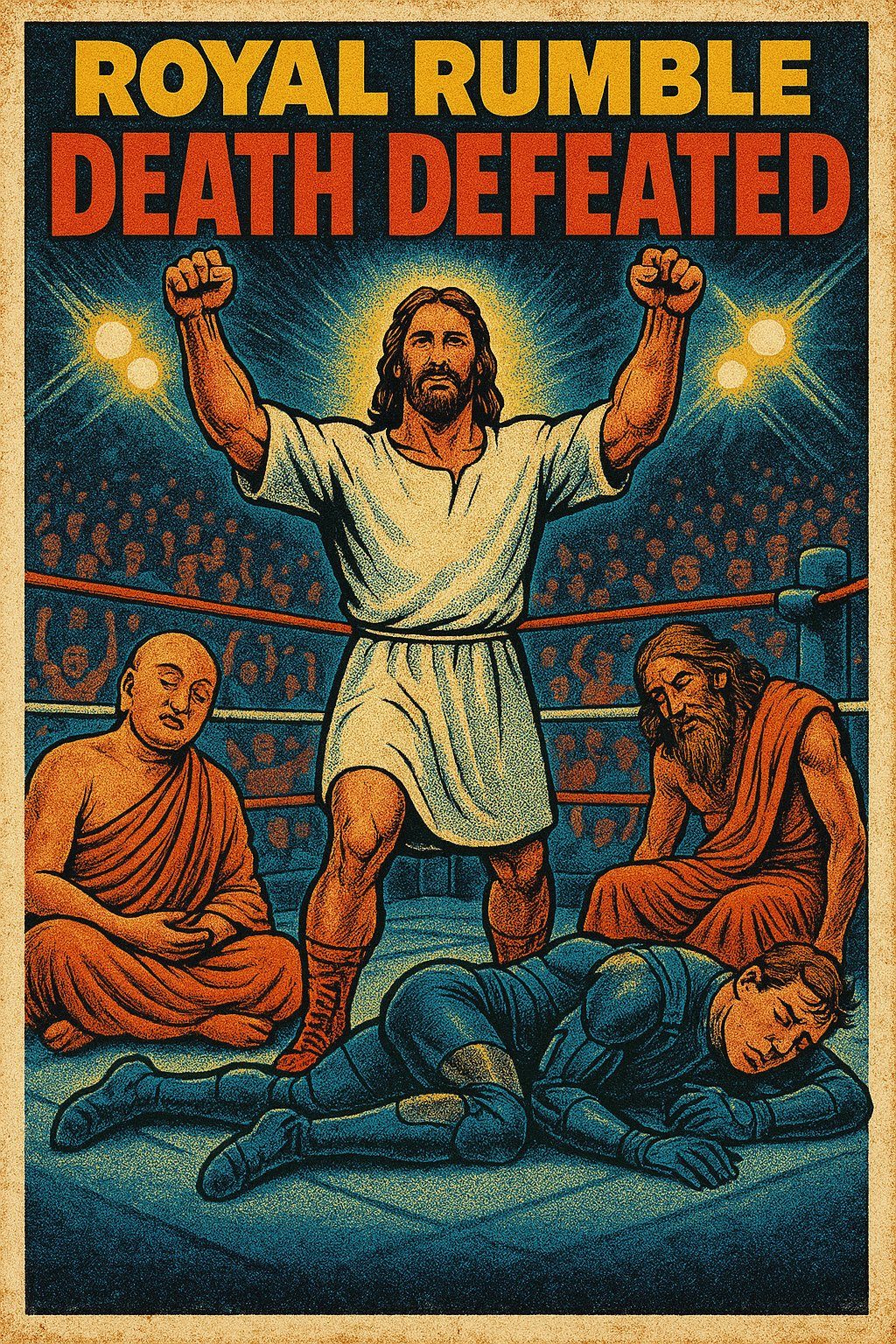
A Different Kind of Victory
When I bring this same lens to Jesus, the difference is stark. Unlike the Buddha, whose victory remains difficult to verify, Jesus’s triumph over death comes with a concrete timeline, multiple witnesses, and prior demonstrations of his power.
Once you get past the broader debate over whether the Bible is historically true — a debate many Christian apologists have addressed thoroughly — his story is remarkably verifiable. Yes, the events are miraculous, and in a world where most of us live without miracles, it’s natural to doubt them. But if you accept the Bible’s historical reliability, Jesus’s life is a conclusive, observable victory over death.
He died in a physical body and returned in that same form within three days. That body was changed in certain ways — much like accounts in other traditions of ascended yogis or Tibetan masters achieving a “rainbow body” — but it was recognizably him. Unlike the Buddha, he gave a precise timeline for his return, and kept it. Even before his crucifixion, he resurrected others, showing mastery over death well before proving it in his own resurrection.
The path he offered for others to share in this victory didn’t require rigid asceticism or years of monastic training. Following him — and in doing so aligning with God’s will — was the requirement. For some, this might look ascetic, involving letting go of past attachments, but it wasn’t a universal demand to live as monks.
Victory over death here doesn’t mean avoiding physical death. It means that after death, the soul doesn’t lunge for another physical existence, trapping itself in the cycle. Instead, one transcends the physical realm entirely and lives in eternal heaven.
Buddhist cosmology has its own “heavenly realms,” but they’re still impermanent because the beings there still hunger for sensory pleasures. That hunger can lead to corruption, as seen in myths about deities like Indra or Zeus. In contrast, the eternal heaven Jesus promises is free from the roots of these tendencies altogether.
The Nature of the World to Come
Before I believed in one Creator God, I dismissed the “simulation hypothesis” as a tech-world fantasy. Now I’m more open to the idea that we live in a designed reality — one created by God — and that eternal heaven is not just “another form of His world” but perhaps something entirely different, where we may even stand as peers with Him. I can’t say for sure.
Across all these varied attempts to conquer death, from ancient yogis to the Buddha to modern biohackers, Jesus’s path is the most conclusive. It’s the clearest, most evidenced victory. And if he was able to do that, why wouldn’t we trust his claim to be the Son of God? If I created a video game and then entered it as a player, I’d know exactly where the traps and shortcuts were, and how to reach the end. In the same way, the Creator entering His own creation would know exactly how to lead us past death itself.
Three Hurdles I Had to Overcome
For me, seeing Jesus’s victory as the clearest path to overcoming death meant getting past three major hurdles.
First was letting go of a false “scientific” dismissal of miracles. Science at its best doesn’t reject what it can’t explain — it holds the unknown with humility and seeks better theories. To deny something simply because it doesn’t fit our current models is unscientific and disrespectful to the mystery itself.
Second was applying a uniform standard when judging historical documents. If I accept the biography of Alexander the Great based on the available evidence, then to reject the Bible using stricter criteria says more about my bias than about the evidence itself.
Third was loosening my cultural identification with certain gods I grew up with. If truth is truth, it doesn’t matter whether it comes from within my own tradition or outside it. If someone defeats my “champion” in the ring, I acknowledge the better fighter — and in this case, the victory over death belongs to Jesus.
I’d invite you to consider whether these same hurdles might be shaping your own view. Because if the Creator truly stepped into His creation and showed us the way past death, then the question isn’t whether we can trust Him — it’s whether we will follow.
I use AI to polish my dictated drafts and to create representative images, while keeping the ideas and linguistic style my own.