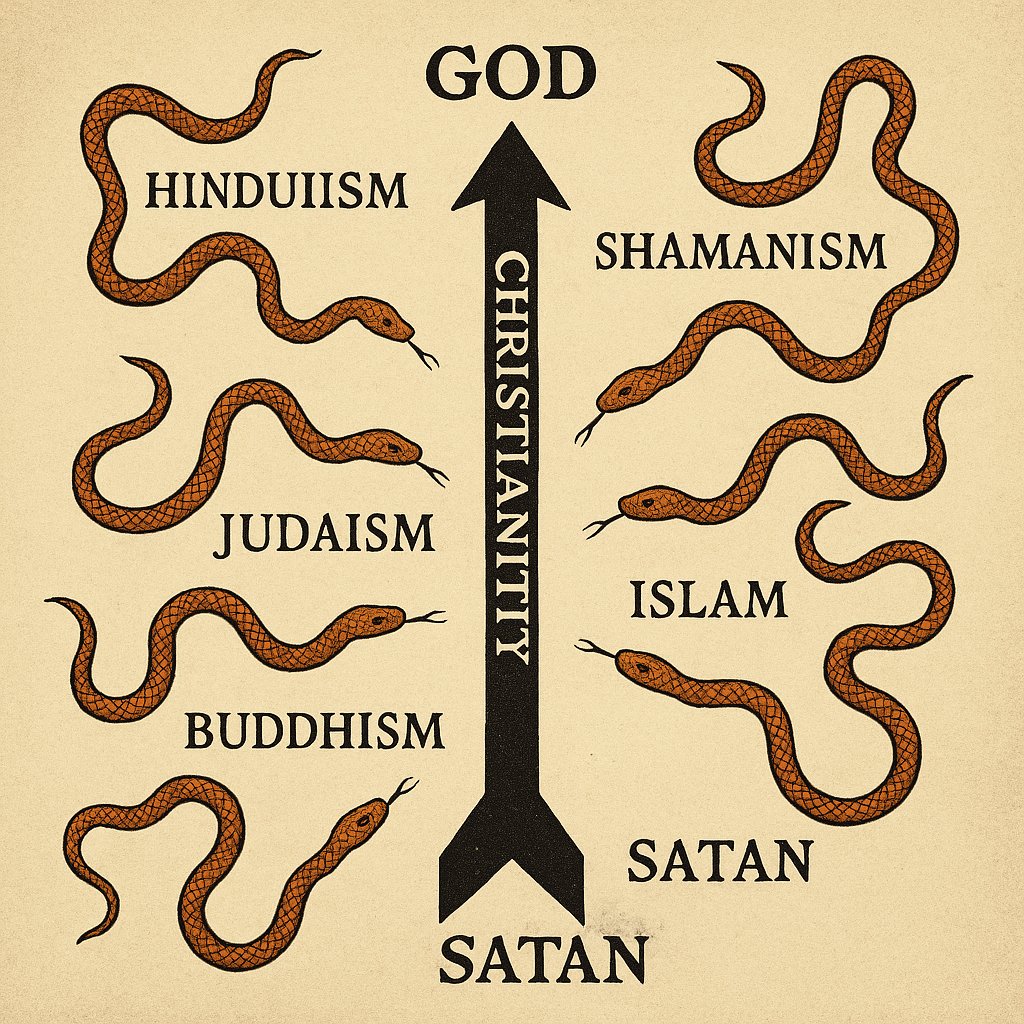
The Law Beneath All Faiths
Why Christianity Doesn’t Erase Other Paths — It Completes Them
Joshua 1:8
“This Book of the Law shall not depart from your mouth. But you shall meditate on it day and night, so that you may be careful to do according to all that is written in it. For then you will make your way prosperous, and then you will have good success.”
Fate & Free Will
There is a oneness to all religions — but not in the postmodern, liberal sense that flattens their differences onto the same pedestal or dissolves them in a feel-good haze of relativism.
They are all, in their own way, trying to answer one fundamental question: What actions lead to what consequences? In other words, they’re all grappling with the Law of Karma — the law that governs how our choices and actions bear fruit.
Now you might ask — Vighnesh, why do you think such a law even exists? For one, many before me — theists and atheists alike — have observed a pattern in how actions bear consequences. But more deeply, I believe God established this law to reconcile the seeming contradiction between Fate and Free Will — the paradox at the heart of nearly every human attempt to make sense of the universe, religious or scientific.
Fate is the path the Creator God has charted for each of us. His Will. And yet, He also gifted us Free Will, so that we may choose — through our own agency — to walk in alignment with His Will. For this process of learning and choice to unfold, there must be a consistent law that connects action to consequence: the Law of Karma. Over time, through our innate desire for good outcomes — not merely external rewards, but also the internal peace that comes from harmony with truth — our innate desire for God – we begin to walk His path.
God’s Appointment — and Judgment — of the gods
Each religious tradition has built a structure to help people live in alignment with this Law, despite our incomplete knowledge of it.
Hinduism, like many indigenous and shamanic traditions, approaches this challenge by striking ritualistic deals with powerful disembodied spirits — beings that benefit from the energy of those rituals. But the full nature of that exchange is often obscured. It’s like a life coach selling you a “transformational” course while quietly needing to make rent.
I now believe these beings — these deities — were originally appointed by God to serve as spiritual intermediaries. This is evident, to me, in Hindu mythology: all the deities, when overwhelmed, eventually run to Vishnu. It’s also evident in the concept of the “kuladevata” in Hindu societal structure – each family ancestry is assigned a “god”. In my study of Hindu mythology and modern Hindu ritual systems, I have often wondered – if Vishnu is the all-powerful, why isn’t He worshipped directly?
Still, Hinduism’s greatest achievement was preserving a vast mythological system through oral tradition. In that sense, props to the British colonists, who — driven more by greed than by religious fervor — focused less on annihilation and more on co-opting, unlike their Portuguese and Spanish counterparts. Greed, it seems, is a more tameable sin than fanaticism.
The Buddha, through deep spiritual discipline, was able to access what seemed to be a large swath — perhaps all — of his past lives. From this, he deduced the mechanics of Karma: how actions in one life shape birth and suffering in the next. These insights are preserved in the Jataka Tales.
I believe Moses received the same Law directly from God. And Jesus? He was sent to fulfill and abolish the Law — because God was fed up with the spirits He had once appointed as intermediaries between Him and humans.
Psalm 82:1–2, 6–7
“God has taken his place in the divine council; in the midst of the gods he holds judgment:
‘How long will you judge unjustly and show partiality to the wicked?’ …
I said, ‘You are gods, sons of the Most High, all of you; nevertheless, like men you shall die, and fall like any prince.’”
The Gift That Ends the Striving
Yet today, many people still perform rituals echoing these ancient patterns. I see countless posts of self-reflection and ritual offerings — and it all looks like a spiritual hamster wheel.
A wheel that turns endlessly, promising progress but never offering rest. The harder you strive, the more you stay in the same place — hoping that enough shadow work, enough ancestral honoring, enough inner child healing will finally crack the code.
But what if the code has already been broken? What if the Law has already been fulfilled — and abolished — and the door to God’s presence has been flung open, not through spiritual accomplishment, but through undeserved grace?
That’s the scandal of Christ. That someone with no rituals, no qualifications, and no mystical credentials can be welcomed into the Holy of Holies, while the seasoned initiate is still burning incense that actually no longer pleases God.
That is the victory offered to each of us through Christ.
1 Corinthians 15:57
“But thanks be to God, who gives us the victory through our Lord Jesus Christ.”
How We See: The Power of Frames
Now, you might say:
“Oh Vighnesh, this is just your latest shiny belief system. Play with it while it’s shiny and stop telling others that theirs are less shiny.”
Fair point.
But what should one do if a belief system truly seems to encompass all others?
I still maintain that Christianity is my present frame.
A frame is a way of seeing the world — a set of underlying principles, often unconscious, that shape how you perceive reality and form value judgments. Whether you’re aware of it or not, you’re always operating within one.
When we encounter something that doesn’t fit our current frame, we have a few options:
-
Dismiss it and double down on the frame we already have.
-
Reactively switch to a new one that feels more complete, simply because we haven’t yet explored its blind spots.
or
-
Stay with our current frame, acknowledge its unknowns, and set them aside until we’ve gathered enough of them to form or test a more complete one.
I do sometimes wonder if I’ve made a reactive switch. But so far, Christianity — as described in the scriptures — feels like the most comprehensive frame I’ve found.
Most critiques I’ve heard of Christ or Christianity stem either from a misunderstanding of karma — or, in Christian terms, sin (“Why does God allow bad things if He loves us?”) — or from the corruption of the faith by false prophets (“How could good Christians kill so many people?”).
Jesus directly warned us about false prophets and told us how to recognize them.
Matthew 7:15–20
“Beware of false prophets, who come to you in sheep’s clothing, but inwardly they are ravenous wolves.You will know them by their fruits. Do men gather grapes from thornbushes or figs from thistles? Even so, every good tree bears good fruit, but a bad tree bears bad fruit. A good tree cannot bear bad fruit, nor can a bad tree bear good fruit. Every tree that does not bear good fruit is cut down and thrown into the fire. Therefore by their fruits you will know them.
False Frames and Corrupted Variants
In that sense, Christianity is still a young religion — and much of what goes by that name today are distortions of what Jesus actually taught. The three most significant distortions, in my view, are Catholicism, Orthodoxy, and Islam. Yes, Islam.
Islam makes very confident claims about Jesus — recognizing Him as a prophet, but explicitly denying His divinity, His crucifixion, and His role as Savior. From a biblical standpoint, these are not minor differences — they are core contradictions. But even apart from doctrine, the fruits of Islam as a religion are deeply troubling.
Three stand out to me:
– The Prophet Muhammad’s own conduct, including his marriage to a child
– The suppression of women’s agency in many Islamic cultures — not as historical relics but as ongoing realities
– And the repeated use of religious violence in the name of God — including calls for the death of apostates, blasphemers, or dissenters — often more widespread and normalized than in any other major religion today
These are not marginal or extremist deviations. They are woven into the structure of the faith. Given Islam’s focus on directly contradicting core Christian truths and its eschatological preoccupation with Jesus, I therefore consider Islam to be an extremely corrupted variant of Christianity.
Catholicism and Orthodoxy, despite centuries of sincere devotion and rich tradition, seem to have settled for something far short of what Jesus promised in scripture. Their institutional forms have layered centuries of ritual, hierarchy, and theology over the radical simplicity and power of the Gospel. They’ve canonized tradition to the point where the living presence and promises of Christ are sidelined, symbolized, or treated as unreachable ideals.
Mark 16:17–18
“And these signs will accompany those who believe: in my name they will cast out demons; they will speak in new tongues; they will pick up serpents with their hands; and if they drink any deadly poison, it will not hurt them; they will lay their hands on the sick, and they will recover.”
That’s not metaphor. That’s the standard. We just stopped expecting it.