Somatic Boundaries
How Muay Thai helps me establish healthier boundaries, quicker
In order to not get caught up in Boundary Perfectionism, one needs to imbibe boundaries somatically into the body.
The trauma triggers in the body.
One could respond to that by training one’s mind to notice the trigger, analyze it, come up with a verbal response and speak it out.
Or one could train one’s body to instinctively present a firm No. A body No could look like hands folded in a namaste, arms rising up to stop an action, physically stepping back to create more space while maintaining eye contact and centeredness in the spine. Responses that bypass the mind. Somatic responses.
The mind-based strategy is prone to be laggy. The lag of noticing. The lag of analyzing. The lag of constructing a verbal response. It’s also susceptible to different trauma coping mechanisms. Once you are in a trauma coping mechanism, you are already in the trauma cycle. Analyzing could cause dissociation – where a lot of the consciousness leaves the bod and concentrates itself in the mind. Restricting oneself to speak out a No leaves one susceptible to being caught up in a clogged throat response, unable to speak. People who ask a sexual abuse victim “why didn’t you say something?” reveal their ignorance of how trauma can clog up the throat, making it impossible to speak. Dr. F.M. Alexander discovered the Alexander Technique as he was attempting to regain his lost voice because the cyclical trauma triggers in his life had increased in frequency to the point where he could no longer speak. The creator of Dilbert, Scott Adams, went through something similar.
The somatic boundary strategy trains the body to say No. This No response can be trained right where the trauma triggers are kicking off and the trauma pathways are engraved in the nervous system. Somatic No’s come from the spine, the seat of martial consciousness in all humans.
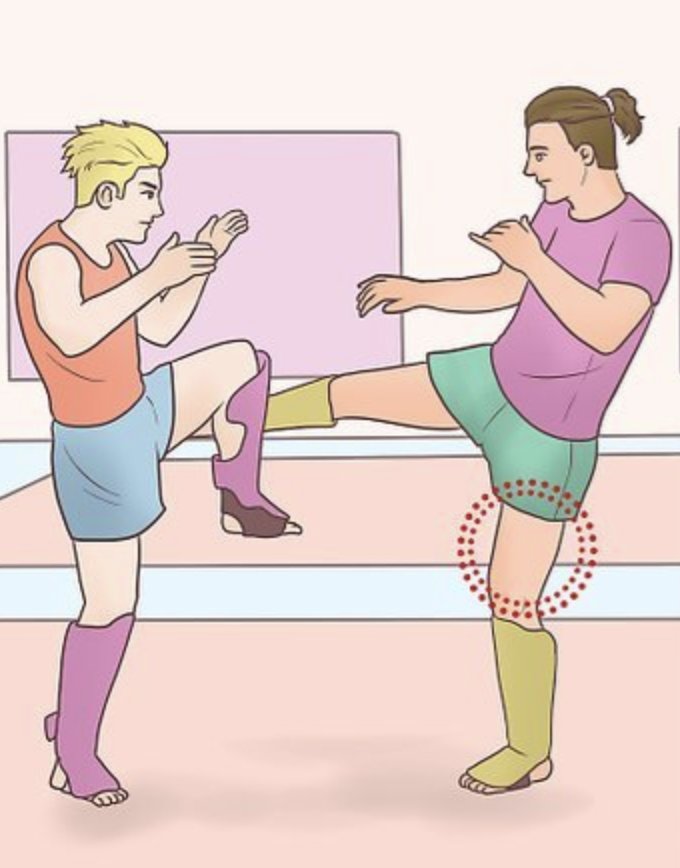
In Muay Thai, one practices defense by lifting up a shin to fend off an incoming kick.
Sexual trauma stored in the hips can lock and tighten them up. This could lead to chronic hip pain, an inability to sit cross-legged and accompanying systemically interconnected body issues – knee pain, plantar fasciitis, lower back tightness and pain, shoulder issues. In my Ayahuasca journey, I was able to see how my body had locked up while being bent over and sodomized and much of the pain from that moment got locked up and stored in my tight hips, which were being held by the Perpetrator’s hands.
In Muay Thai, one trains oneself to quickly lift up a shin from the hip to fend off a kick. In doing so, one learns to maintain centeredness and balance on the back leg. If I lose balance while fending off a kick, it makes me susceptible to follow up attacks. In day-day life, this translates to quickly expressing a No, while maintaining composure.
Earlier on, in Muay Thai, I’d have a tendency to lean into an incoming kick to meet it and push it away with aggression. Too much energy expended and it also left me off balance falling forwards, susceptible to further attacks. This relates to a tendency in day-day life to unconsciously find situations to say No to. Perhaps even perceive situations as an attack. I don’t know about you but I’d rather be living a life where I’m unconsciously finding situations which are a Yes. Instead the practice is to softly meet an incoming kick with centeredness, swiftly fend it off & be prepared for the next move. You can watch any video of the Muay Thai fighter Tawanchay PK to get a glimpse of centered, calm martial energy in action.
More advanced martial artists would know how to channel the incoming energy of the attack and flow it back to the opponent expending very little of their own energy. Uno Reverse.
Regularly practicing lifting one’s own heavy leg at the hip shakes up & loosens the trauma induced hip tightness and translates to reduced tendencies for trauma freeze in day-day life.
Lesser freeze allows for better flow.