Mama’s Boy 🚩
A man’s perspective on why it is a red flag and the protocol to overcome being one
The past 4 years or so, I have increasingly felt at ease approaching women that I’m drawn towards while out and about in the world. In doing so, I have noticed that there is a certain amount of courtship that a man needs to lead with for a woman to open up to him.
To reveal her curiosity for him.
Attraction dictates when and how a woman reveals her curiosity towards an approaching man. Sometimes the visual attraction, which has a few layers in it—physical, presence and energetic—suffices. Sometimes the attraction builds with the quality of the approach itself, which is the first demonstration of the penetrative element that a man carries viz. masculinity. Sometimes you start engaging and gradually find avenues to smooth over the initial coldness through a combination of humor, presence and curiosity—charm—to gradually develop the attraction. Sometimes you do all of that, and yet the spark just isn’t there.
Most of my experience introducing myself to unknown women has been in the west or in spaces influenced by western culture. Over time, I have noticed a healthy wariness develop as I approach them.
You see, in the west, we live with relative ease of access to punitive legal systems. Westernized women, who are actively shaking off generations of patriarchal abuse, sometimes course correct too aggressively and turn the punitive systems of the west—legal or not—upon unwary men.
Access to power without a healthy sense of accountability is visible both in the patriarchal systems being railed against and in the women railing against those patriarchal systems.
Over time, I have cultivated a sense of wariness as I’ve become more aware of this phenomenon. I find such wariness to be healthy. I have noticed that it slows down my own approach—faster approaches, on my part, have historically been hooked by lust. So I appreciate the slowing down that such wariness brings.
Intriguingly, this wariness has also shown up in how I perceive what my mother shares with me.
Previously, I had considered what my mother spoke as gospel.
A bit ironic, I must note, since gospel means good news—as in the Gospel of Jesus being that you don’t need to avenge past harms and be stuck in the cycles of samsara, you can just forgive (what great news!).
And amongst the varied flavors of shares from my mother, there is a category that I would label complaints about past events with other relatives. My mother, amongst all the positive traits that she carries, sometimes can slip into a series of complaints about such past events with relatives in my family.
Previously, when my mother would share a complaint, I would consider her rendition of those events as objectively true. In that sense, I was a mama’s boy.
A mama’s boy is someone who, due to unprocessed trauma, can see no fault whatsoever in his mother. Such inability to see the faults, and thereby the humanity and wholeness of his mother, shows up inadvertently in romantic relationships, where he then pokes at his woman.
If he were to look at the parts he has repressed that voice their critique of his own mother, thereby humanizing her, he may find greater access to grace for when his woman falters. While these parts stay repressed in his relationship with his mother, thereby seeing her as perfect and flawless—like the Virgin that gave birth!—these repressed parts activate strongly in his relationship with his girlfriend or wife—gradually tearing her self-esteem down.
Mama’s boy.
Often, westernized women will express a healthy wariness towards any early red flags in dating that indicate mama’s boy behavior in a prospective mate.
While I, myself, was a mama’s boy, I did not understand why. Now I do and consider such wariness healthy in restrained amounts.
Now, when my mother shares, I have noticed a wariness pop up that expands me from pitying her for being victimized by her relatives in a patriarchal society to holding a place of compassion for her experience whilst not needing to demonize the relative (often a woman) she is complaining about, while also holding space for the possibility that the relative might have her own version of the story where my mother would be at fault.
Isn’t that the tragedy of relational conflict? Individuals reaching out towards each other from the seed of love in their hearts, failing at loving each other and then pulling back and demonizing each other to soothe their own egos.
Isn’t that the wondrous design of egotic individuation? Each ego maintaining its sense of its own goodness while being engaged in conflict with another, through selective memory and selective narrations. A particular event, thereby having multiple subjective narrations. Says something about the nature of stories and how they are themselves alive, no?
As I make room for alternate versions of my mother’s complaints, I can also hold space for the uneven playing grounds that women like her have had, in conservative patriarchal societies. What a tragedy! Truly!
There’s nothing more attractive than a free woman, and some cultures seem to have done a better job of creating space for the freedom of a woman than others.
The framework of Nonviolent Communication has been an important tool in this journey. The more I have absorbed NVC, the easier it has been to listen to what I call the heart-thread of what is being spoken.
Underneath the harshness and self-centeredness of words being spoken is the heart of the human engaging with you. Now there are some of us blessed with the capacity to listen directly to the heart, but for the mentally driven folks (like me) NVC is the best framework to train your mind to surrender to the heart.
Even as the words may sound harsh, the heart is often saying:
I feel ____ because my need for ____ is met/unmet. Would you be open to [request]?
The more I practice mapping all relational speech onto this underlying template, the easier I have found it to be in an inner posture of compassion for all.
In this frame of listening, I have increasingly connected to the fullness of my agency for action. No longer do thoughtforms of compulsion have as much sway over me as they used to.
The template of a thoughtform of compulsion is:
I need to do ____ because [an individual/a culture] expects me to.
The more an individual entertains thoughtforms of compulsion, the more powerlessness they sow, separating the individual from the fullness of their agency.
The truer structure of a thoughtform of compulsion is:
When I consider this thought, I feel afraid because my need for spacious decision-making is unmet.
I feel afraid that if I took my time to act, instead of reacting to the thought, I might feel discomfort and I don’t like to experience discomfort.
Hence, I am compelled to act. A thoughtform that compels me to act, through fear, is a thoughtform of compulsion.
Fear compels man away from perceived discomfort.
When I act from fear, I act to self-preserve. The instinct to self-preserve can take one of two forms:
- Preservation of my physicality
- Preservation of a particular ego image
An ego image is a snapshot of how I see myself or how I believe the people around me see me, which is, in a sense, indistinguishable from the former.
Intriguingly, sometimes when you rip off the mask from the preservation of physicality, what is revealed underneath is a preservation of an ego image.
You may think and believe that you are acting out of your natural orientation to safeguard your physical self or that of your loved ones, but actually you are acting out of the desire to preserve a particular ego image. To not feel the discomfort of the ego image dissolving.
Are you trying to preserve yourself or preserve your sense of self?
The human experience of pain gets to the heart of this entanglement.
Is pain physical or mental?
Pain seems to be a signal from a part of the body that, if the current course of action is continued with, then there might be a physical change in that part of the body. The texture of this signal is quick and strong, to which the mind can react by correcting the course of action.
But it doesn’t need to be that way.
When one sits and breathes with the upwards spike of pain, it creates space for the spike to either dissolve or turn down, thereby becoming a wave.
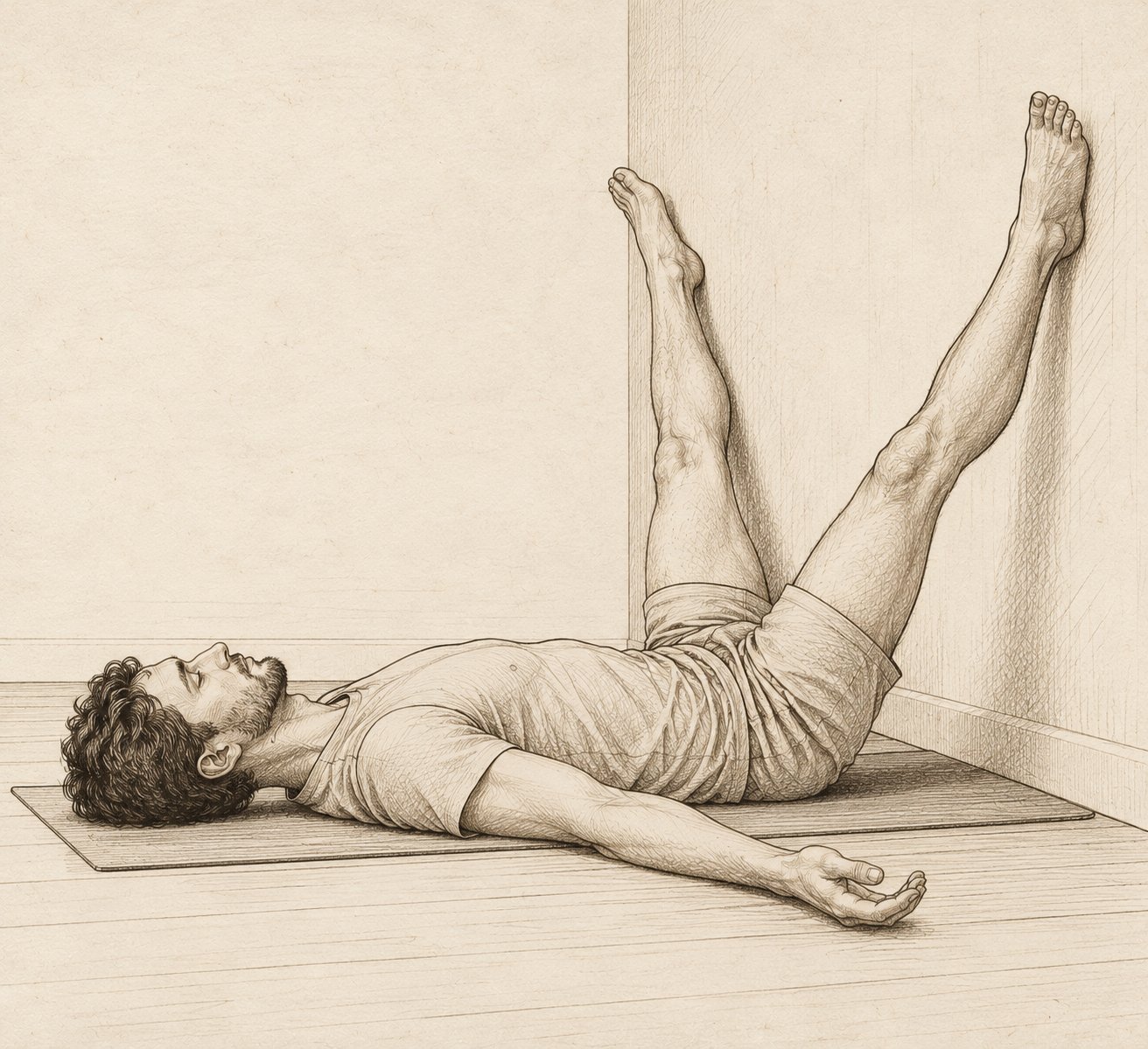
Let’s say I’m trying a wall straddle stretch, allowing gravity to gradually open up my hips and pelvis into a middle split. Towards what I might consider the end range of my flexibility, I experience pain. Sometimes, if I breathe with that pain, I notice the tightness in the surrounding muscle groups. They are in a protective stance. If I breathe them free, I can open up more! What I thought was my end range was not my end range.
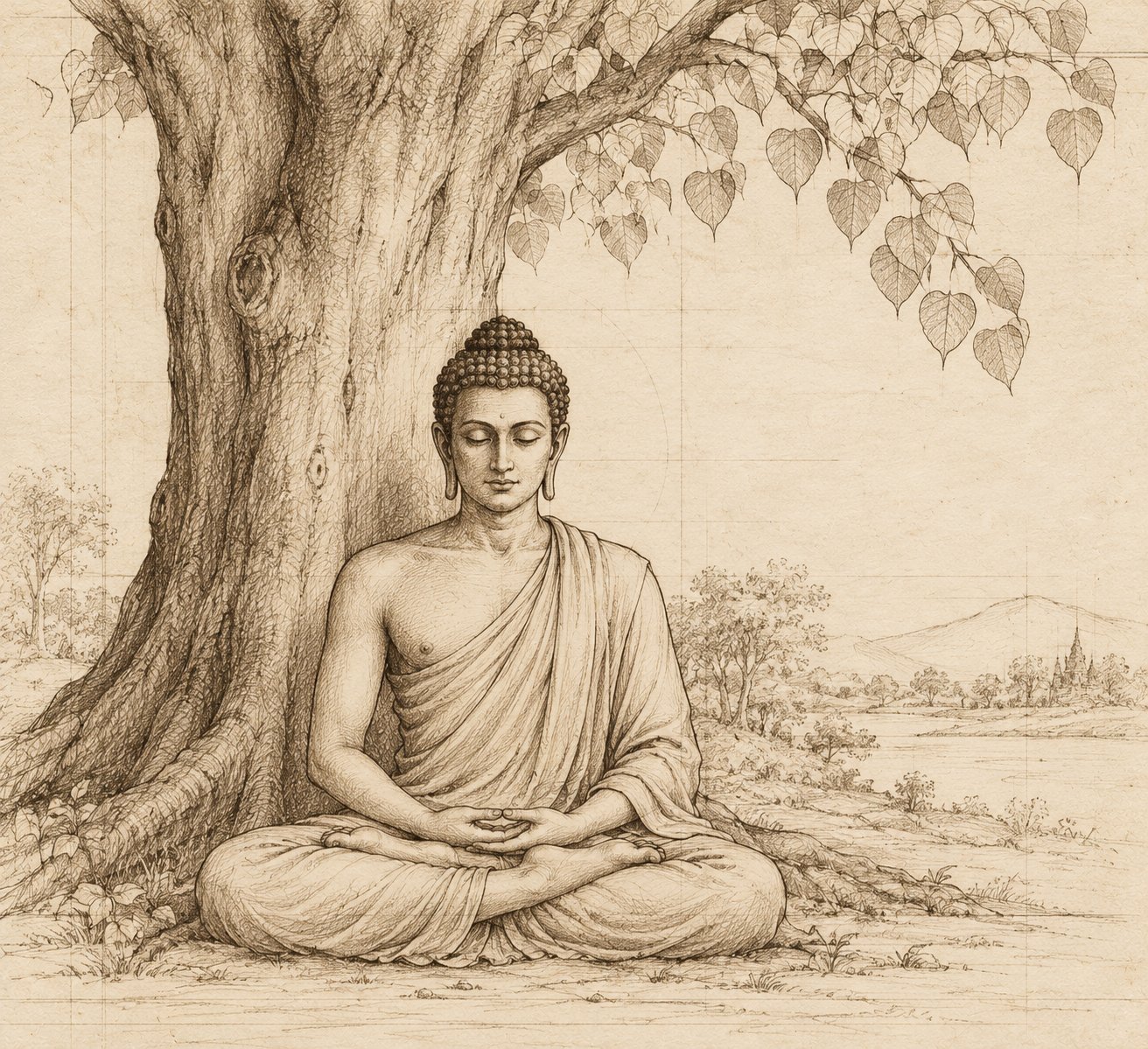
I’ve always been fascinated with the padmasana—the Lotus pose. Back in 2017-18, when I had just done my first Vipassana and the nerd in me was obsessed with finding a pathway to Enlightenment, I had concluded that it is essential to have open hips that would enable one to meditate in padmasana, like the Buddha did.
Since then a question I’ll often ask someone doing a padmasana is: “how did you get to it?”
I’ve heard stories from two men unlocking padmasana at a Vipassana course. One day they made a dhridh nischay (strong intention) to sit in padmasana, wrangled their body into it and just meditated as the pain alchemized. Both told me that later they realized that what they thought was physical pain was actually their mind fighting discomfort of physical change.
So the reactive response I have when I’m lying down in a wall straddle stretch, to pull my legs back together when it hurts, is seemingly because I don’t want to get injured. An intention to preserve my physicality.
But at least in some situations, it is masking the underlying intention to preserve an ego image! The ego image in this situation being “I am someone whose hips are not open”. Or in the case of the brothers who unlocked padmasana, “I am someone who cannot do padmasana”.
This illustrates how the instinct to preserve physical existence can sometimes be a masked form of the instinct to preserve an ego image.
Taking this idea to its extreme form, the instinct to avoid death is a masked form of the instinct to remain identified with your present physical form—one of the biggest and most persistent ego images we hold.
Thus, at the root of what moves us away from discomfort is the fear of death. Being able to acknowledge this creates spaciousness to decide what pain one wants to move through and what pain is best to turn away from.
Once you get over the reactive pushing away of discomfort, you gain victory over the thoughtforms of compulsion. As I have logged some of these victories, I have noticed that often, I was incorrect in my assessment of my physical capacity—which is the physical subset of the fullness of my agency!
Tying back to the thread where we introduced the thoughtforms of compulsion, I have also noticed that often I was incorrect in my assessment of what another individual or “society” expected me to do.
Once you start noticing the gap between what you assume another expects of you and what they are actually wanting from you, you can build a practice to state and check your assumptions. The practice of Circling is a good place to try this out.
So next time you are in a situation where you believe someone else expects you to act a certain way, verify the assumption. “Is this—[describe it]—what you’d like me to do?”
The more I have practiced verifying my assumptions of what others thought of me or expected of me, the more I was able to see how incorrect my assumptions were. I saw the incorrectness of my assumptions enough number of times, that now the assumptions don’t come in as often and instead there is space for genuine curiosity.
Layered on top of this assumption-checking, is the clarity that even if someone else—an individual or “society”—expects me to do something, that doesn’t mean that expectation need be met. Sure, there might be a cost to defying such an expectation. But intriguingly enough, it also opens up room to surpass expectations. Because often when an other expects me to do something, there is an underlying need that they are trying to meet by asking a specific action of me. But because they are not me, they are limited in their understanding of what my full capacity of action is.
Expectations of others are often framed from a space of fear, thereby capturing a limited snapshot of the relational possibility that exists between you and them.
It doesn’t have to be that way though. You could be engaging with someone who is so attuned to your full potential, that lies beyond your fears, that the expectations they present to you, push you to heights that you could not have imagined otherwise. That’s the difference between a normal regular human caught up in their own samsaric prison pulling you down by layering unconscious expectations on you vs. a coach-type figure who has broken through varied ego constructs themselves, enough number of times to be curious about what ego constructs an other is burdened by and then offer them pathways to break themselves out of those constructs, to achieve even greater heights than the coach themself has achieved.
An other’s expectations of you are, intrinsically, a request. It doesn’t matter how threatening their manner of speech is, it is a request. If you don’t allow yourself to be subject to the instinct to self-preserve born out of the fear of death, then you maintain full agency even when confronted with the most compelling of threat-requests.
In the fullness of your agency, you can maneuver in a manner where you dance with the other, meet their underlying needs, meet your own needs and open up relational possibilities that neither of you could have ever imagined on your own, in isolation.
Therein lies the magic of tuning into the heart-thread. When I hold to the heart-thread long enough for another to join me there or vice-versa, we are connected in that magical field where two hearts meet—the field of Love—that is the field of all hearts, that can speak back to you when you speak to it like God. It’s the magic where 1 plus 1 is a lot more than 2, and you open up possibilities for yourself and for an other to step beyond the pitiable limits of egocentric thought into the expansive magic of heart-centered action.
And finally, I am catching glimpses of this capacity with my mother.