Bookish Authority
How religions and nations came to entrust authority to texts
Humans have been together for over 300,000 years but only recently have groups of us decided to hand over authority to a book.
Some of these books are considered to be divinely ordained. Some are human-defined contracts—an attempt to account for the fallible memories and limited lifespans of the parties involved.
What an experiment!
Before we had written language, this experiment was not possible. As literacy spread and then the printing press (invented 1440 CE) got democratized, a variety of groups have hopped onto this experiment.
Religions with their scriptural texts, nation-states with their constitutions, but also say German engineering firms with their emphasis on standardized operating procedures.
A constitution is not required if the King is the divinely ordained regnant whose Will is supreme.
In 1215, a bunch of British barons saw how tyrannical Kings can get and declared the Magna Carta. The King was not above the law.
Fast forward to 1793 and the French executed theirs by guillotine to truly drive this point home. In a span of 500 years or so, humans collectively delivered the message that tyranny is punishable.
As a society, we transitioned from kingdoms to nation-states, necessitating a contract amongst the peoples of how they wish to be governed.
The design of this contract rested upon two key Ideas of the Enlightenment era (1700s).
The Social Contract
Firstly, the notion that the government is, indeed, a contract amongst the peoples—between the rulers and the ruled—thereby subject to change if it doesn’t serve the ruled [Hobbes, Locke, Rousseau]
Separation of Powers
To limit the tyrannical tendencies of rulers, the government needs be split into branches [Montesqueiu]
Put those two together, and you end up with the Constitution. Now, if you have anarchical tendencies, you might question—why should the people be governed at all? Later Enlightenment philosophers like Godwin seemed to have gotten to that but the Americans and the French had already gone to town with the blueprint of a nation-state.
Through revolution, these Ideas became manifest. Both newly minted nation-states quickly adopted written constitutions, but the micro-state of San Marino, landlocked within Italy, beat them to the podium by adopting the first modern written constitution in 1600 CE.
Relying on a single codified written text to coordinate and establish interpersonal and communal norms within the nation-state quickly became the defining criteria for a nation-state.
The Book replaced the Man.
Different religions, too, have played around with the Idea of a Book as an Authority.
Even as the Book rose to an authoritative position, most religions have maintained a hierarchy of human authority figures to interpret it. In some strains, the hierarchy is flatter. For eg. the Protestant sect of Christianity does not have as influential a central human authority figure as the Catholics do. One could say that Protestantism is more decentralized than Catholicism or Orthodoxy.
Sikhism makes for an interesting case study here.
Sikhism, founded in the late 15th century, had a Guru—a spiritual leader—at the top of the hierarchy, who then chose the next Guru. In 1708 CE, the 10th Guru, Gobind Singh ji, ended the succession by declaring their holy text, then called Adi Granth as the eternal guru—the Guru Granth Sahib, thereby abolishing the post of a human authority figure. So radical!
I think the Apostle John would have approved of the move.
In the beginning was the Word, and the Word was with God, and the Word was God.
John 1:1
In practice, the hierarchy of humans still exists in the Akal Takht, but seems relatively weakened. Not unlike how the Protestant Reformation weakened the human hierarchy in Christianity.
There has been a recurrent pattern in human history.
- Humans gather and organize for some purpose
- Hierarchy emerges
- Power concentrates at the top
- Concentrated power abuses
The Sikhs emerged in the frontier region of the Indian subcontinent where Muslims repeatedly invaded to fulfill the Islamic prophecy of Ghazwa-e-Hind.
There are two groups of my Ummah whom Allah will free from the Fire: The group that invades India (Al-Hind), and the group that will be with 'Isa [Jesus] bin Maryam, peace be upon him.
Hadith 3175, Sunan an-Nasa'i 3175
Having seen the excesses of how invading Muslim armies treated kaafirs—the non-believer—and how the Hindu caste system oppressed the commoner, Sikhism came through when a 30y old man born in a Hindu Kshatriya family disappeared riverside for 3 days in Punjab and proclaimed on his emergence—
“There is no Hindu. There is no Mussalman.”
He became Guru Nanak, the first Guru of the Sikhs.
In an attempt to establish the essential falsehood of religious division, another religion was introduced. Oh, the irony of life.

Perhaps this is just the anarchist in me, but it does seem that corruption is inherent in hierarchical authoritarian systems.
Overtly, hierarchical authoritarian systems intend to take care of the laity by interpreting scripture and maintaining ritual procedures, but covertly, they cultivate the Shadow that seeks power above an other.
As the Shadow expresses itself, the priestly class inserts itself as a middleman between human and God. Once fully manifest, it leads to abuse of the commoner.
Correspondingly, the Sikh creed puts a big emphasis on the protection of the innocent. All Sikh men are supposed to carry a ceremonial dagger—the kirpan—which is meant to be used for protection of the innocent, if necessary.
Whether a violent weapon can stop violence is a deeper philosophical inquiry… but the Sikhs deserve credit for this remarkable religious experiment to place complete authority in a book instead of a human, 75 odd years before Americans did.
Let us now analyze an authoritative book and how humans relate to it.
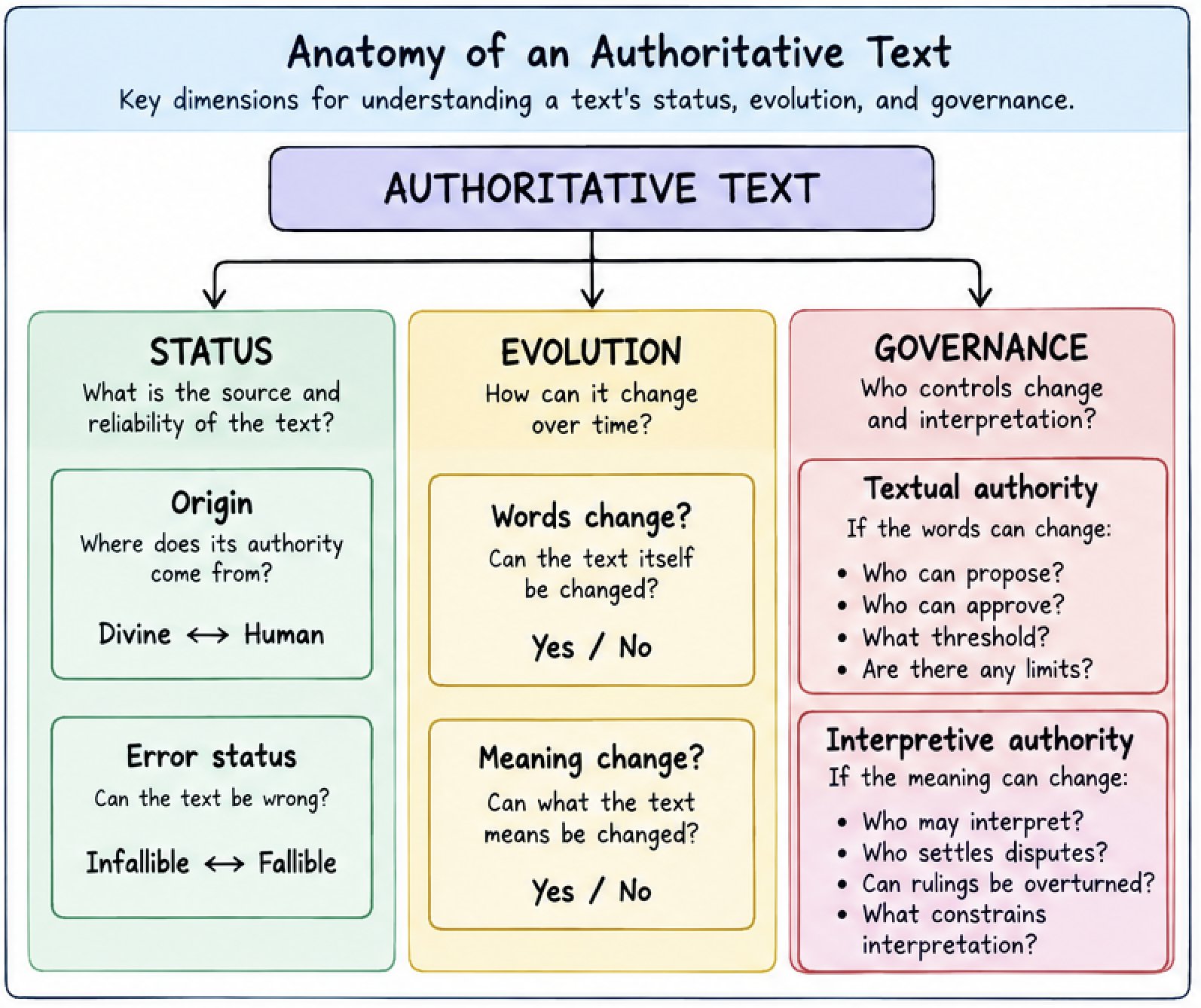
Let’s illustrate with some examples.
The Indian, American, and Swiss constitutions are each a fallible, changeable, human construct with a particular process defined for making amendments and interpreting. Interestingly, if you compare these 3 along the axis of who can propose amendments, you go from most restrictive to least. Changes to the Indian constitution can be proposed by central government representatives, to the American by central (federal) and state, to the Swiss by the average citizen.
The Bible is infallible and divinely ordained. At least to the believers. One might reasonably assume that an infallible text should automatically become unchangeable, but if you closely observe the history of religious texts, including but not limited to the Bible, they walk this (deluded, in my view) line of being infallible and yet changing over the ages. Changing by addition, removal of books. Changing by factions breaking off. Changing via translation. Changing sometimes even in how earlier lines of scripture are interpreted later on in the same book (I’m looking at you, Apostle Paul.)
This delusion is sustained by believers who are unaware of their own subjective perceptions and interpretations of what is written and thereby can’t tolerate alternate interpretations, and often under the guise of restoring the text back to its original divine design.
Classifying the Constitution is infallible is an arguable point. Often in how people speak of it, an action being unconstitutional can be conflated with it being invalid. To give a charged modern day example, consider the action of Donald Trump running for a third term. (Not that I want him to, to be clear, I think 2 terms per President is a pretty good design, if we are to have a government at all.)
If you get incensed at that thought and proclaim the unconstitutional nature of the action, are you aware that in the past, the peoples have exercised agency—which includes your own—to change the Constitution. Now of course, you could be aware that the Constitution can be changed and yet disagree with that action, but then the correct framing would be that “it is an unconstitutional act on a principle that is pretty solid and should not be changed, in my view”, no?
It is quite a fascinating time to be alive while these experiments are so active, and for long have I lived unaware of how potent these experiments are and that their nature is experimental. I think that’s what happens when one lives in a time oblivious to how times were before, taking for granted what is around them.
Books attempting to resolve the tendencies of humans to abuse power.
The problem space—abusive tendencies—is rich.
The particular solution space—books as authority figures—is also pretty rich.
Some open inquiries that call me, and perhaps you, if you’ve enjoyed this essay.
- How did the Magna Carta emerge?
- What life experiences prompted Guru Nanak Ji to take the radical step of elevating the Granth?
- The entirety of the canon of Enlightenment Era philosophy—Kant, Locke, Rousseau, Montesquieu, Hume, Newton. What was Newton the philosopher like even?
- What conversations and debates led to the shaping of the American and Indian constitutions?
- What are alternative designs of government or lack thereof—Anarchism—that could resolve tyranny?