Fuzzy Abstractions
Two ways of imagining the center of the cosmos, two ways of interpreting scripture and two ways of responding to your Green Card getting cancelled
Feb 25, 2026 — Asheville, NC
(A bit after my Green Card got cancelled, but while I’m still thinking I could make it work in the US)
Galileo’s treatise Dialogue Concerning the Two Chief World Systems is a book from an intellectually rich era.
Two seemingly opposite frames of understanding the cosmos battling it out.
Geocentricity vs. Heliocentricity.
Proponents of either side so caught up in their particular frame that they could not hold the expansive possibility for both.
The Yes, And.
Not unlike modern day American political conversations, no?
The battle lines were drawn.
Aristotle and Ptolemy presenting established models for geocentricity.
Copernicus entering the scene with a fresh heliocentric frame.
You know, having grown up in this educational model where only the victors of a scientific battle are presented—totally disconnected from how science pendulates from a victor to their opponent, charting a Hegelian dialectical spiral—I had never had a chance to appreciate the absolute brilliance of the attempt Ptolemy made to explain the complexities of retrograde motion with overlaid spheres.
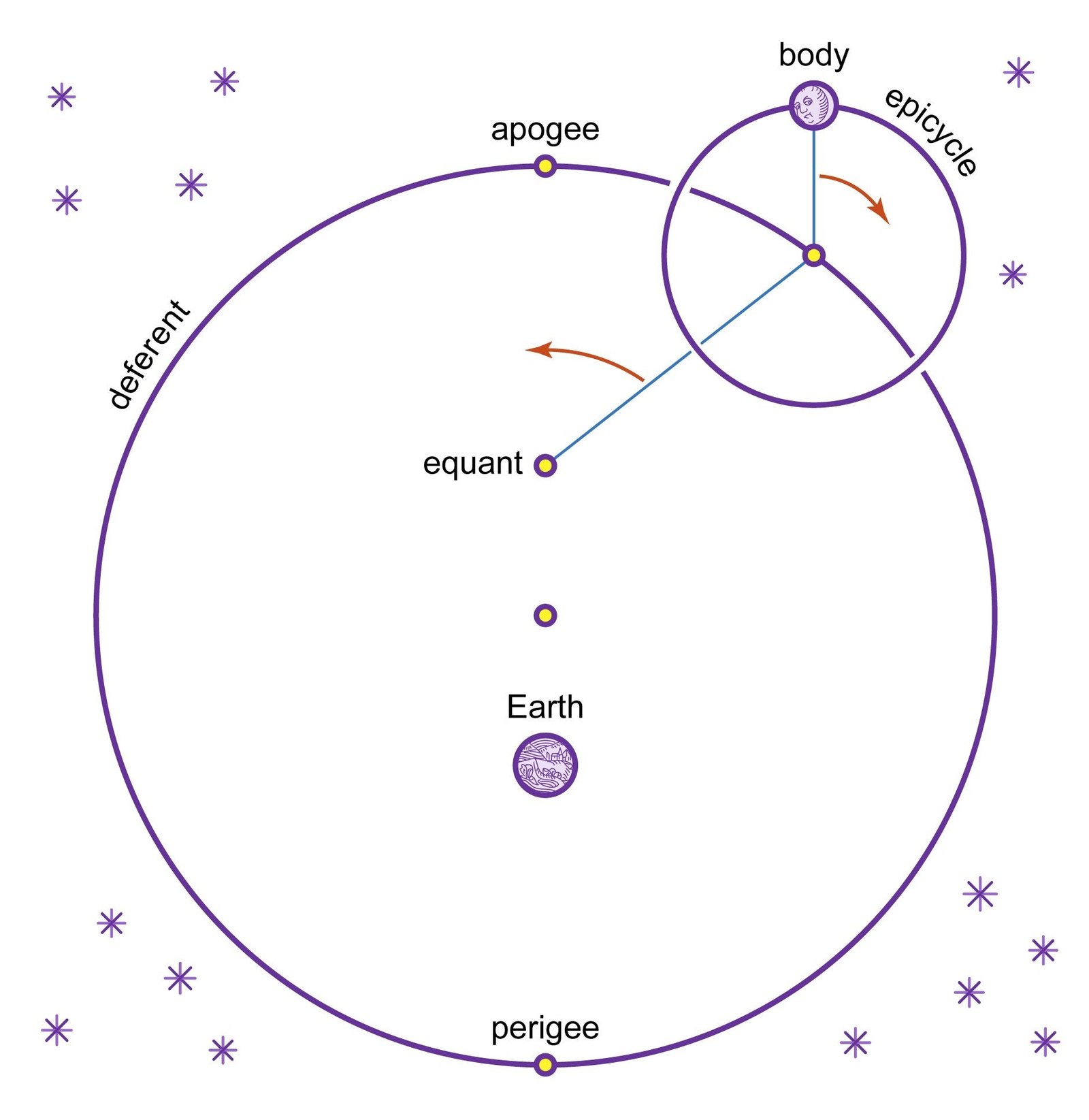
Another side effect of this educational model that presents science and math disconnected from their history is not realizing that its only in recent times that algebra has become the dominant flavor of describing mathematical ideas. For much of mathematical history, geometry was dominant instead.
Symbols to make sense of mathematical entities became mainstream only in the Renaissance era. To hammer home how recent this is, did you know that the cubic equation was solved prior to the introduction of symbols, the solver expressing the solution via poetry?!
In this era Galileo went to town with the newly invented telescope, making observation after observation about the skies—phases of Venus, spots on the Sun and the moons of Jupiter. Gathering empirical evidence for the Copernican model. Gives me goosebumps just imagining him.
While under the tutelage of the Grand Duke of Tuscany in an Italy dominated by the Catholic Church and its scriptural belief in geocentricity. The tender balance of what Galileo was living through—presenting ideas contradicting the powers he was under–is reflected in the unctuous nature of the language he uses in the preface to his treatise.
Makes me want to puke reading the unctuous flavor of his language, but then perhaps if I had adopted his mannerism a teensy weensy bit, I’d not have faced the ostracizing forces of American Liberalism as strongly.
Overall, I feel grateful to be alive at a time where I rarely need to be unctuous in my speech. Even when I write to the US immigration authorities, I can be simply formal.
My spine doesn’t need to collapse in how I write words unlike Galileo who addresses the Grand Duke as Your Most Serene Highness.
🤮
It’s nice to not be subject to the particular ego of a particular person. Most of us are still subject to power systems or abstract rules that we think we can’t break, but we have come such a long way from being subject to the whims and fancies of monarchs and feudal lords.
The Holy Roman Inquisition tried Galileo for defying Scripture with his treatise and the empirical case it presented for the Copernican model.
You see, empiricism wasn’t as accepted a part of science as it is today. The word of God was considered stronger.
Even today, people read the word of God and conflate their interpretation of it for what God says.
Much of religious conflict seems to emerge from folks who don’t understand that while words do carry meaning, there is multiplicity in their capacity for holding meaning. And subjectivity of the reader steps in to pick one of the varied meanings that could be made.
There is a sense of comfort and peace that the mind finds in locking down a particular meaning. There is an expansiveness in allowing and holding space for a variety of meanings, but till one connects to the grounding expansiveness of the breath in the body, breaking through all the varied traumatic kinks that stem its flow. Kinks that are quite scary at first, but in the alchemy of which, there is much pleasure to be found. Till one connects to the expansive joy of that alchemy, it is important™ to pick one meaning and fight all others.
As someone who has been reading Scripture for the past year or so, naturally, I wondered, where does Scripture promote geocentricity?
ChatGPT informed me that certain scriptural verses like—
Psalm 93:1
“The world is established; it shall never be moved.”
Psalm 104:5
“He set the earth on its foundations, so that it should never be moved.”
—were used as the basis for the Catholic Church’s doctrine of geocentricity.
The Book of Psalms is a highly poetic book that is very devotional in nature. Devotion is such an intense heart posture that, as is the case with all intense emotions, words often fail to capture the intensity fully and what emerges is poetry.
How silly that the poetic flavor of these lines was lost on the doctrinal Church which took it literally, no?
There’s two ways of reading and making meaning out of Scripture.
One is where you focus in on specific lines and then adhere to a specific interpretation of those lines.
The other is that you catch onto a thread that weaves through the varied books of the Bible.
To give you an example of what a thread looks like, let us explore two dominant threads that compete with each other on the nature of atonement—making amends for incorrect action (sin).
There is one thread that makes atonement transactional. Either through the specificity of sacrificial blood as described in the Book of Leviticus, that then is also reflected in Christian subcultures like 11th-15th century Catholic practice of indulgences or its modern remnants where the Priests hand out a certain number of Hail Maries for a particular sin.
And there is an other thread that makes atonement free, received by directly asking for forgiveness and changing one’s way of life (repentance).
These two threads meet in the crucifixion of Jesus, where blood is shed willingly by One to pay for all sins and stop the need for transactional, non-consensual, ritual blood-letting.
To catch on to a thread, you have to read and contemplate on multiple parts of the Bible together.
To latch on to a specific interpretation of a particular line(s) of scripture, you don’t need to do that.
In 1 Corinthians 14:34,
Women should remain silent in the churches. They are not allowed to speak, but must be in submission, as the law says
the Apostle Paul asks women to be quiet and submissive in the Church.
This is an instance.
This instance is often paired with a couple of other instances.
Ephesians 5:22 "Wives, submit yourselves to your own husbands as you do to the Lord."
1 Timothy 2:11–12 "A woman should learn in quietness and full submission. I do not permit a woman to teach or to assume authority over a man; she must be quiet."
These 3 instances are similar in that they belong to the same author—Apostle Paul—across the 40 or so authors of the Bible, and different in that the recommendations they place on women differ. For eg. the instance in Corinthians is the only one that speaks about silence in the church. But one could argue that broadly these instances fit under the umbrella idea of subservience of women.
An instance—one human, one idea—differs from a thread.
A thread emerges through a variety of writers, across a variety of scriptural lines. A thread need not be explicitly named in any of the scriptural lines that it emerges through, and yet once those lines are contemplated in their togetherness, the thread may emerge, unmistakably so, to a particular subjective perception.
I used to live in a prison. The prison of my own ego. My own ideas.
My ego was constructed on the basis of ideas. Ideas of internal identity that inevitably tied into Ideas of external doctrine.
My wounding was so painful that my ego couldn’t fully comprehend it. I was utterly powerless—deeply surrendered—in the depths of my wounding.
Surrender is conscious powerlessness.
While I had not fully seen and made peace with the powerlessness of the wounded state, I struggled to surrender in the present. Because outwardly, surrender and wounding carry a similar signature, no?
While imprisoned inside my own ego, I had proclivities to control my environment. I’d look towards the external world and hunt for frameworks of ideas—doctrines—for qualifying right vs wrong.
And then I’d have an experience that’d fracture my current doctrinal classification of right vs wrong, and I’d have to hunt for a modified doctrine.
Inherent in this manner of living—where one relies on a doctrine of ideas that qualify right vs wrong—is imprisonment. Because it seems to really foster the very natural egoic tendency of making value judgments, both for oneself and, by extension, for others.
When one leads with value judgments, it presents hurdles in evaluating alternate value frameworks.
When I lead with judgments, I notice a tendency to elevate or demote others quickly. Once elevated or demoted thusly, the other is reduced into my projection. There isn’t spaciousness then to get to know someone enough to understand what value system they live by.
In this manner of life, one might end up rigidifying, early on, to the first value system they encounter. Then, one might experience an awakening. And a pendulum swing to a seemingly different value system that’s actually the same one in a different guise.
Raised in the Church, leave the Church, and then back into the Church again.
It is quite challenging to consider multiple options for value systems on account of how intertwined the trying-on of a value system is with the part of us that judges.
The claim of the Church that the Cosmos was geocentric and scripturally so, seems to be based on a specific interpretation of a handful of scriptural lines instead of a thread running through the Bible.
Poetry, as with any form of art, exists to be interpreted. That idea seems to have been lost on the Church. No wonder we needed the burgeoning of artistry in the Renaissance to break the exploration of cosmos out of the prison of the Catholic interpretation of scripture.
It is the heart-thread that brings gracious spaciousness to a judgmental perception, imprisoned in an ego. Slowly and patiently saying No to the judgmental evaluations till the heart-thread makes itself evident.
And there’s a sense of wonder and awe that reveals itself when one patiently waits for the heart-thread to reveal itself while facing polarized interpretations.
Such graciousness allows the battle between heliocentricity and geocentricity to be resolved with the concept of frames of reference.
A reasonable compromise.
When one is passionately for a particular pole in a polarity, the middle ground feels like a cop out. In a way, in the middle ground, some of the spark of the stretched polarity diffuses to make way for a stable foundation.
Perhaps you’ve felt that? In a charged relational argument, when things can feel so hot—a compromise takes away the heat. An otherwise deadened, depressed human who is disconnected from the fire of their specific purpose may feel so alive in the heat of a relational argument that they might not want to let that go into the deadening of a compromise. Here they are confusing the steady foundational brick of a middle ground with the dead wood of their depression. And the incendiary spark of relational argument with the life-giving fire of purpose.
Polarities and binaries surround us.
Walk on the footpath, not on the road.
A sign listing a house for sale, subtly implying that a property is owned by a particular entity, and thereby not owned by others.
We live surrounded by these binary doctrines. And, I believe, it has created a very egocentric world.
The Sun represents the Ego in astro-mythology. It makes me curious to see how property ownership as a concept was evolving around the 16th century as we were shifting from a geocentric model of the cosmos to a heliocentric model. Bookmarked as a side quest.
Cultures around the world vary with regards to their egocentricity and how rule-based they are. Amongst egocentric, rule-based cultures, America is probably one of the best implementations.
Which is also why there is so much chaos in the country. Because, deep in our hearts, each of us knows that these egocentric rule-based abstractions are false. And each of us being forged in the Spirit of Truth, Love and Forgiveness, has a distaste for falsehood.
We don’t like being subject to false abstractions.
The experience of having my Green Card being cancelled has really humbled me towards holding onto fuzzy abstractions.
A few months ago, if you had asked me if illegal aliens should be sent back, I’d have agreed. When I got this notice, the end of the notice read—”your Green Card is cancelled”. And I wondered—does this mean I’m illegal now? Is the abstraction of being illegal only relate to the mode of entry? Technically I have begun accruing unlawful presence days. Is that the same as being illegal? Is illegality restricted to the mode of entry? Not literally, in how the word is defined. If I were to pull up the definition of “illegal” in a dictionary, the word won’t have any references to “mode of entry”.
Fuzzy.
What even is a Green Card? What even was that H1B before that? And the OPT before that? And the F1 before that?
Combinations of letters assigned to a human that determine how long they can stay on a certain piece of land.
Abstractions.
Fuzzy abstractions.
Not unlike geocentricity. Or even heliocentricity for that matter.
Holding onto fuzzy abstractions for stability is not a good strategy.
Now of course you are not subject to any of these abstractions, in the truest sense of the word.
You are subject to no one but to the Law of Karma and its designer and executor, God.
These fuzzy abstractions are intentional, punitive agreements. Agreements that intend to punish you if you step outside of what was agreed upon.
If-then statements of a legalist system that let you know the risk of certain actions. Let me elucidate with a strategic pathway I considered for the briefest moment.
I wondered what it might be like for me to establish my own sovereign nation on a piece of land within the native territories inside the United States. I had had this idea before in the vengeance fantasization phase of my healing journey. I had wondered what it might be like for me to establish a sovereign nation somewhere and declare one of my perps as an enemy of the State and take him out in a surgical strike to send a strong message so that no one shall threaten the sovereignty of my nation. I wondered if I could do the same so I don’t have to be subject to the fuzzy abstraction of a Green Card. I concluded that it’d lead to further isolation in an already isolated culture and scratched the idea. But it was a worthy thought exercise because it brought me into an agentic relationship with the fuzzy abstraction.
All these fuzzy abstractions within legalist systems are attempts to incentivize behavior in the physical plane that aligns with the Law of Karma. The Law of Moses as introduced in Exodus and expanded upon—as is often the case with legalist systems—in the remainder of the Pentateuch, is one of the many attempts at creating a physical system that mimics the energetic system established via the Law of Karma.
The Law of Karma itself consists of intentional punitive agreements. When you take an action, you become subject to the returns of the action. The returns could reward you or punish you. What differentiates the Law of Karma from physical legalistic systems is that there is a great emphasis on the intention in the heart. The physical legalistic systems, in their attempts to codify right action clearly in words, tend to drift away from giving import to the posture of the heart. I’m not entirely sure why that’s the case. But that such is the case is evident to me because the Pharisees tried to convict Jesus for healing a man on Sabbath.
In constructing complicated legalist systems, the executors of the system accrue a sense of power. That sense of power is rooted in the normalization of their (fallen) desires to be cruel to their dispossessed brethren.
The cost of a mis-step becomes expensive in such a complicated rule-based legalist system.
Grace exists where the cost of a mis-step is not expensive.
The karmically accrued cost of mis-steps is the burden of sin that the blood of Jesus washed out.
But why did we get to a place where the karmic costs tend to accrue? Why is there a kill line in the most prosperous nation on the planet?
I am not entirely sure.