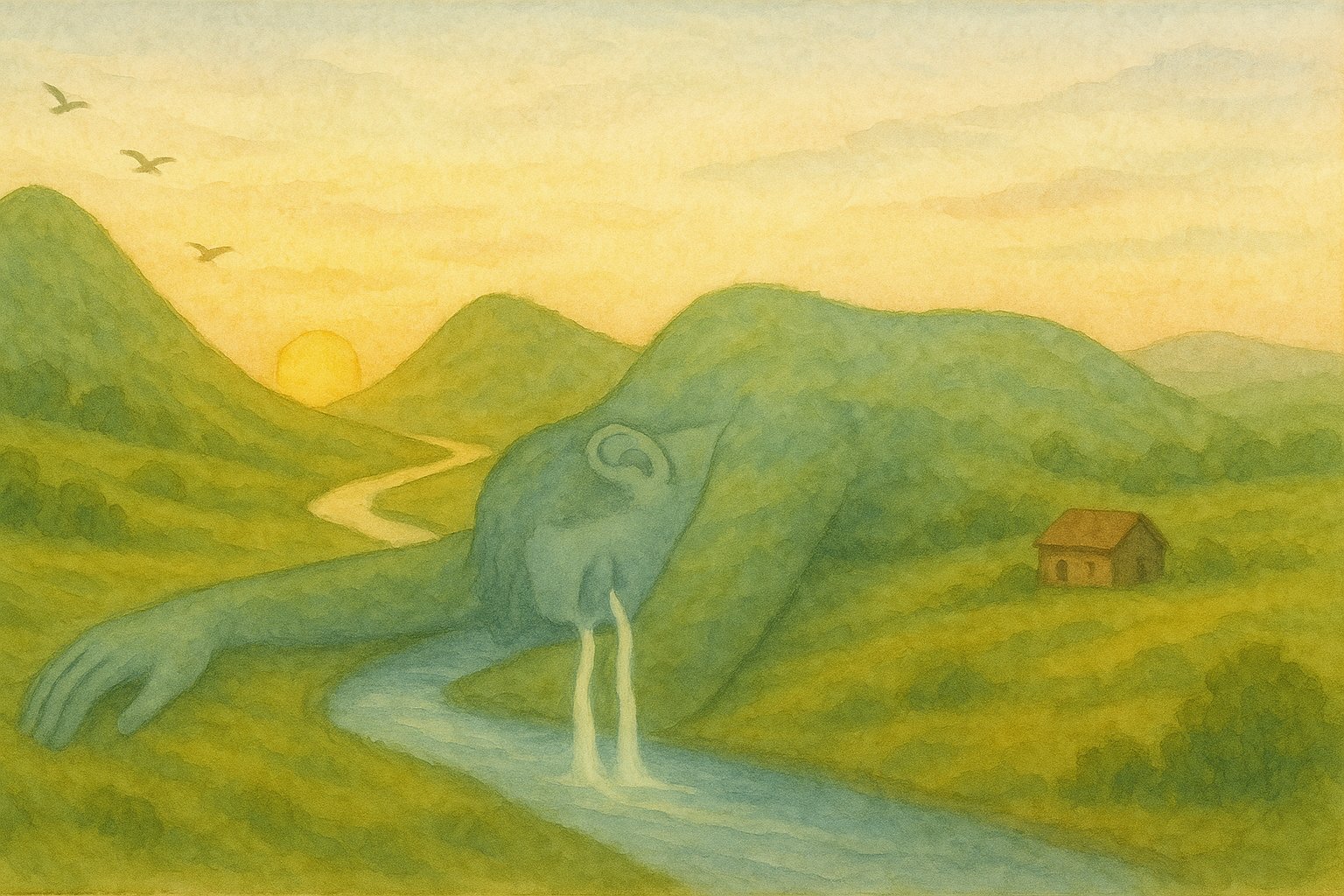
When God Weeps
Finding redemption through heartbreak and the salt of our own tears
There is an unspeakable sorrow at the heart of creation—the heartbreak of God Himself. To see His children, made in His own image, falter so terribly. To watch man try, really try, to live up to the Creator whose likeness he carries, and keep falling into darkness. It is unbearably heartbreaking for God—to look upon this world and watch His likeness crawl through the mud of sin, inflicting horrors upon others made in His own image.
There are men who rape their own daughters and even sons. Men who beat their children with leather belts, believing they are teaching them right from wrong. Imagine being the Creator and witnessing that—your design, your reflection, warped by pain. It is absolutely heartbreaking to be God and look around to see all of this unfold.
So many men have lost their way. And many women, for good reason, have lost their faith in men. Yet there remains a seed of God within men that draws them toward behaving better—toward showing up in alignment with how God would like them to. Still, time and again, men fail.
It is profoundly difficult to hold a container that unites righteousness, justice, and love. That’s what the manifested world is for God, and that’s what a family is for a man.
The world is the Lord’s container of righteousness, justice, and love. A family is a man’s container of righteousness, justice, and love. And it isn’t easy to hold all three together—it requires disciplining what goes against the order of the container.
But in that disciplining, darker urges arise—the demonic impulse to impose righteousness by force. The burden of maintaining order opens man up to evil impulses that, paradoxically, pull him away from righteousness.
The Corruption of Righteousness
I keep seeing this image in my mind, which you’d get if you’ve spoken with enough adult survivors of childhood sexual abuse. Heartbreakingly, most people haven’t. Which begs the question – why haven’t more of you spoken with survivors? Why aren’t more survivors speaking up, sharing their stories? Why are so many of you content to talk about work, the weather, sports, movies, pop culture—but not what you’ve truly been through?
When you start truly listening to survivors, you notice patterns. Haunting patterns that sit under your skin. Sometimes sexual abuse doesn’t begin with lust; it begins with discipline. It begins with what looks like love trying to correct.
A parent spanks a child, maybe thinking it’s harmless, maybe believing it’s righteous correction. You can picture it—a small child, four years old, being lightly swatted on the bottom “to teach them.” Maybe the same parent once patted that same bottom to soothe the child to sleep. It’s so close, those two gestures—so easy not to notice when one turns into the other.
And then the child grows. Puberty arrives. The air in the room changes, and no one
talks about it. What was once framed as correction begins to carry a charge that no one wants to name. And if that line isn’t seen and stopped, it turns into something dark. Maybe it always was.
That’s the line that blurs—from discipline to domination, from righteousness to violation. And it shows the tension of holding righteousness within a container you are responsible for—without succumbing to sin. Because in the impulse to punish, you can open the floodgates to demonic influence. You stop being righteous.
That brings me to one of the most crucial questions I’ve been sitting with about the design of human society:
How do we differentiate between the responsibilities of righteousness that belong to the family, to the church, to the state—and to God alone?
This question ties directly to punishment. I’ll define punishment simply as the imposition of restriction on a human being’s free will. It might look like spanking a child—restricting their movement to administer a blow. It might look like isolating a person in a cell—restricting their freedom to move. It might look like capital punishment—taking away their life force altogether.
Or perhaps someone escapes all these punishments—family, church, state—and faces judgment after death. Hellfire.
The Law and the Sinful Loop
Theologians debate whether hell exists at all. Philosophers debate whether God exists.
But from everything I’ve explored—before coming to Christ and through Christianity—I’ve come to believe it’s objective truth that God exists. There is one Creator responsible for all of creation. That’s simply reality.
You can either believe it and tap into His promises—or reject it and live cut off from them. His way is not oppressive; it’s a beautiful way to live. His laws protect life from disease and decay. Why wouldn’t you want to live that way?
Yet so many reject God because they cannot reconcile His existence with the horrors of this world. They look at what man does to man—to women, to children—and they turn away in despair.
But in that despair, in that horror, they are actually closer to God than they realize. Because that feeling—the heartbreak at what man does—is the constant experience of God. That is His heartbreak. Imagine His pain when His children, feeling what He feels, deny His existence.
It must be unbearable.
Underneath it all, I think there’s confusion about the relationship between righteous discipline and horrific hurt. There are two sides to it: the rightful discomfort of receiving the fruit of your actions, and the fear of being punished by someone who has gone too far.
And if you are one of those people who struggles to reconcile the existence of a loving Father with the horrors of this world, I invite you to recognize the sheer complexity of this creation—where each of us is made in His name, in His image.
We carry the seed of godliness, and we are gifted with complete free will because God Himself is completely free. Being made in His image, we too have free will. And in that freedom lies both the beauty and the danger.
In this creation, there is the hope that we might live by His will—a way of living that is harmonious and beautiful, the very utopia philosophers dream of. But in order for us to freely choose that, there must also exist impulses that tempt us to live apart from His will.
To make this system work, there is the principle of the fruit of our actions. Through our power of conscious observation—what sets us apart from animals—we can witness how our choices bear fruit, and learn to act in ways that yield fruit that is sweet rather than bitter, nourishing rather than diseased.
If this law did not exist, there would be no feedback loop guiding us toward the divine way. In Eastern traditions, this is known as the law of karma. In the language of faith, one could say the law of Moses, fulfilled by the life, death, and resurrection of Jesus Christ, is the divine solution to that law. Without it, humanity would have no way to find its way back home.
The extremes of the law of karma are visible in the horrific acts we witness—the endless loop of sin and hurt, where victims become perpetrators, and perpetrators become victims. In the moment your heart breaks for a victim, you are often disconnected from the truth that they too may once have been a perpetrator.
These acts, as horrifying as they are, can become the greatest opportunity to transcend our own past—to break the loop. When you are wronged, if you can rise to a sinless response—if you can see the person harming you as also made in the image of God, fallen from Him in that moment—you stay connected to God’s own heartbreak, and to His love.
That is how you transcend your own sin. That is how you emerge victorious.
The Sinless Lamb; Crucified
This is exactly what Jesus Christ did on the cross. He was betrayed by His own disciples—the very ones who had followed Him for years. He was betrayed by the same people who had once welcomed Him like a king. He was horrifically tortured, crucified, and shamed.
Yet He stayed sinless. He stayed connected to the heart and the seed of God in all those humans. He prayed for their forgiveness. He stayed connected to the truth of the existence of the Almighty God, the Most High, the Creator. And He stayed connected to the truth that God can work miracles in His manifested creation, because He is the one who created it.
Imagine you created a machine that operates by certain rules. You could go in anytime, switch the gears around, change the machine up. To someone living within the machine, it might appear miraculous if they don’t know that you exist—but you can always do that. That is the concept of a miracle.
So He stayed connected to the miraculousness of God and knew that He was more than His physical body, more than the pain He was going through. The crucifixion of His body of flesh was not His end.
Anyone who has studied Eastern philosophy will recognize this truth: the soul continues. And so, in the moment of torturous death, to stay connected to God with full faith—to know this is not your end—is the ultimate act of faith.
For that faith, He was blessed with resurrection: a body that still bore the marks of His suffering, yet was something infinitely greater.
The Return to Heartbreak
So if you’re with me so far, I invite you to really honor heartbreak. When your heart breaks—for yourself, for a loved one, or for the world—you are closer to God than you may realize.
The way to honor heartbreak is to not fight the waters that move through you. Don’t harden against them. Let them come. There’s something holy about the saltiness of those waters as they course through your body and emerge from your eyes. It’s not weakness; it’s baptism. The baptism of tears.
Salt has always held power. If you’ve explored any kind of spirit-release tradition, you know it—how washing yourself with salt, or sprinkling it around your home, helps lift what doesn’t belong. The same thing is happening when you cry. The tears wash away what no longer serves you.
When your heart breaks and the tears come, don’t fight it. Don’t hold your breath. Let them flow. Let yourself be recreated in the image of God. Because that’s what’s happening: you are being remade.
Rage will try to pull you away. It always does. Feel it—feel the heat rise, feel how intoxicating the fire can be—but don’t get lost in it. Let it burn through, and then let it go.
Underneath the fire is heartbreak, and underneath heartbreak is the presence of God. When you reach that layer, allow your voice to shake, to weep. Let the tears come. Know that as they fall, a river is flowing through you—water cleansing, renewing, washing you clean.
There is no shame in that. Reject the voices that would shame you for your tears. It is beautiful—so beautiful—to be close to God in heartbreak.
That is how you return to Him—through the river of your own tears.