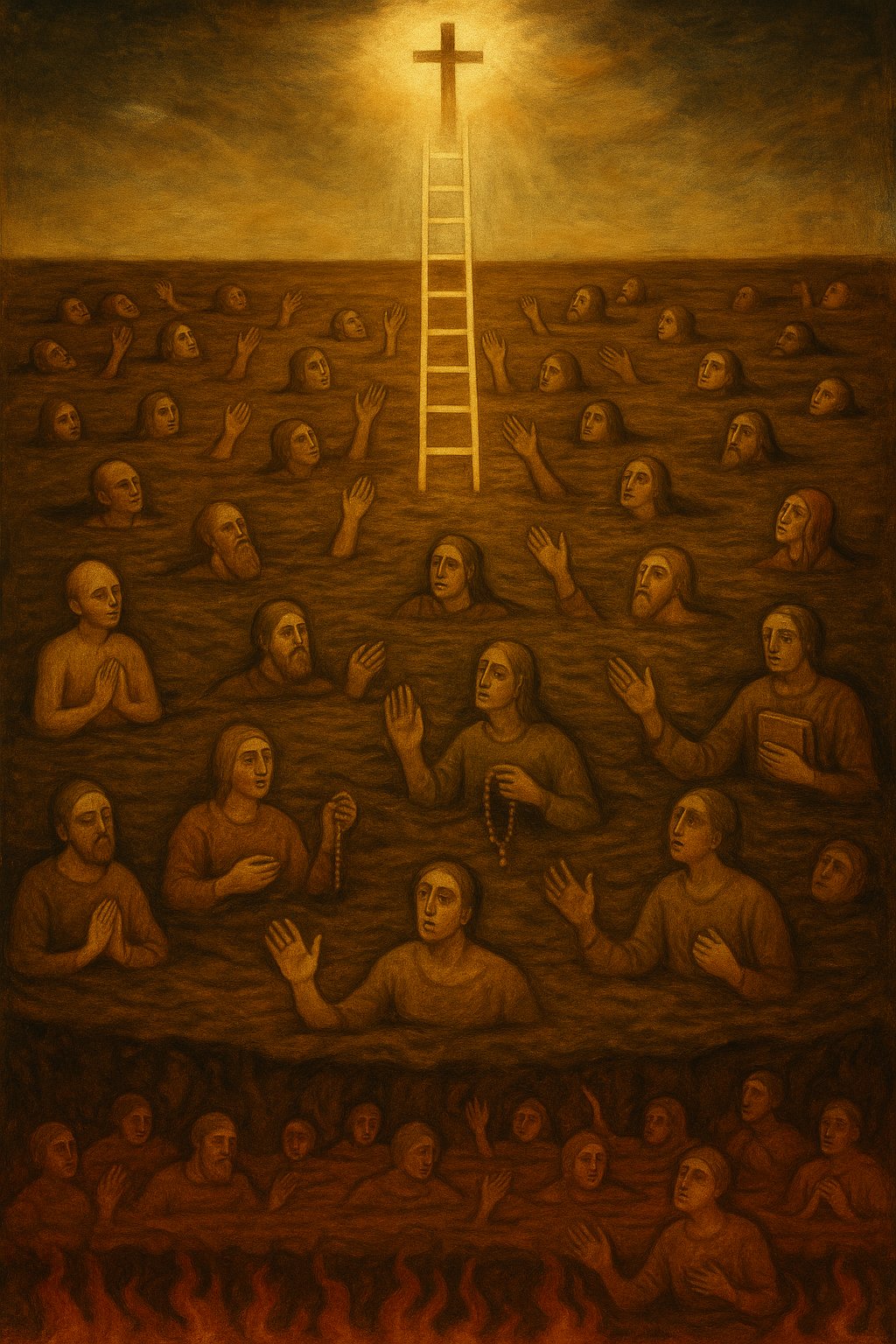
The Quicksand of Sin
Interpreting the Christian idea of ‘being born in sin’ through a Hindu lens
A couple of weeks ago, I was headed to a Saturday evening party at a farmhouse out in Leicester. Over the past year, as my value system has shifted, I’ve lost much of the community I once had here. It’s been painful, and yet it feels right. As a darker-skinned conservative in a aggressively liberal town, I find it impossible to follow the unspoken conservative rule: stay silent. So the search continues for a place where I can speak freely and feel value-aligned.
When I parked and stepped out of my car, I saw a pretty lady walking toward me. I asked if she was leaving the party already, and that simple question opened a conversation between us. Over the last few years, I’ve learned that it doesn’t matter much what you say to begin talking with someone you feel drawn to. Either they want to engage or they don’t. You just say the first thing that comes to mind. If it’s meant to flow, it will. If not, you wish them well and move on.
As we chatted, she offered to play matchmaker and connect me with a friend of hers who, she said, really wanted an Indian husband. I graciously accepted. Asheville is such a small town that it turned out I had already matched with her friend on Hinge. I told her we’d reached a point of political misalignment in our chat on the app itself, and had decided to part ways.
As we spoke, I noticed her glance at the cross hanging on the chain around my neck. She shared that she too has struggled with friends who can be “my way or the Gestapo” about nuanced social issues. She opened up about her own relationship with Jesus Christ and also shared a bit about the negative impact the Christian teaching of being “born in sin” had on her growing up.
That’s what today’s essay is about – what it means to be born in sin. I will present a case for the Truthiness (an uncomfortable Truth for sure) of this idea from the perspective of metaphysical frameworks that dominate in the cultures of my upbringing—known by different labels like Hindu, Vedic and Buddhist. All of these revolve around an understanding of the Law of Karma.
Simply put, the Law of Karma is the law of cause and effect. In some parts of Hindu historio-mythology, it is said that the wisdom of what actions lead to what effects was channeled directly to enlightened seers called rishis. They also either designed or received the design of the Sanskrit language, which encodes this wisdom directly in the language itself. The belief is that, simply by speaking words in that language, people could live an existence free of misery—because misery is the effect of poor action.
Any moment of misery you encounter in life, however helpless you may feel, arises from something you have done—either in this life or a past one. The concept of “past lives” is where mainstream Christian thought and the Hindu model seem to diverge. Yet I have not found anything in the New Testament that actually establishes this divergence. Some of the consequences you now face through suffering may well come from a past life. Mainstream Christians might balk at the idea of a professing Christian speaking about past lives, but again, I have not found anything in the New Testament that contradicts it.
In fact, the idea that we are born in sin actually goes hand in hand with the notion of past lives. We have done such horrific things in our past lives that we are born with the karmic seeds of those actions—astrologically represented by the position of Ketu or the South Node in your birth chart. These seeds further cause us to do worse things in this lifetime, trapping us in a quicksand of sin. Since we are all caught in this quicksand together, we are slowly sinking toward hell—where the fire of hell can burn all of these unresolved karmic seeds so that we might get another attempt at a physical embodied existence. The aim is to live a sinless life, so that we can create heaven on earth, which Christians call eternal heaven. Because if there is heaven on Earth, there is no sin, thereby there is no disease, and so there is no Death. And thus, it is Eternal.
It has been quite the mystery to sit with what God the Creator’s intent is in creating embodied physical existence and human beings. My best sense is that Earth is the bridge between Heaven and Hell, where the fallen sons of God dwell. The ones who lusted after human women and fell from God’s grace. Earth is where the spiritual battle between the forces of good and the forces of evil is fought. When Earth is declared victoriously in favor of God across all human beings, that bridge will be complete and Heaven on Earth will be established.
Until then, we continue to be reborn into physical existence after death. This aligns with what the Buddha discovered: rebirth occurs because we have not fully released the karmic seeds from this life or from past lives. These seeds, born of poor action—i.e., sin—accumulate over time and manifest as disease, which makes it even harder to avoid further sin. The slow creep of disease in the human body is the body’s gradual descent into hell.
To resist that descent, we turn to numbing distractions—substances, alcohol, medicine, and lustful relationships. We cling to them because, as disease progresses, we are sinking into hell, and hell is painful. When the physical body can no longer hold us, we die and fully sink into hell to be cleansed by its fire. Even the ordinary proclivities of the body—its cycles of inflammation and fever—are attempts to purge the effects of sin, a physical effort to cleanse what has been corrupted by our actions.
The Buddha, through the privilege of his royal birth and his deep immersion in ascetic practices, discovered what it takes not to succumb to sinful tendencies. The path he uncovered is strenuous—far from easy—but still commendable. He was seemingly able to rise above this collective quicksand of existence, or at least that is what his followers claim. Whether he truly succeeded remains unclear. When we are all trapped in the quicksand of sin, even reaching slightly firmer ground can give the impression of full escape, though it is not. Moved by compassion, the Buddha sought to teach others the techniques he had found, and some were able to join him at a similar level of elevation.
If you look closely at how the Buddha asks us to live, it is not so different from the law of Moses. It is as though each of us is already encoded with this moral law. Every human carries an innate sense that some things are good and others are bad. We may disagree on the specifics, yet most elevated beings agree on many of them. Either way, the seed of moral law exists in all of us. I believe this is because we are created in the image of God, who fashioned this manifested realm with its laws of cause and effect, along with the corresponding path for living well and avoiding the slippery quicksand of sin.
The path that the Buddha discovered was demanding. During his lifetime he was able to convey it to some followers, but over time the path faltered because it required such immense effort. It is extraordinarily difficult for humans to avoid living a sinful life without external help. Four hundred years after the Buddha, God the Creator saw that—even with someone who had reached the pinnacle of sinless existence through striving—human effort alone was not enough. So He sent His Son, Jesus Christ, to be the sacrificial lamb for all of our sins, so that we might be washed in the blood of His sacrifice.
The notion of being washed by the blood of another’s sacrifice to offload karmic weight is found across many cultures. Countless rituals involve the spilling of blood—or symbolic substitutes for it—offered as payment for sin. Yet there is something deeply painful in sacrificing the innocent for salvation—whether young bulls offered to Kali, infants to Moloch, or even coconuts at Hindu temples. The Buddha recognized the horror of such practices and sought to chart a path away from them—a strenuous and demanding path. Jesus Christ, however, offered Himself as the sacrifice, embodying a sinless orientation in the very depths of agony. Not afterwards, not following rituals of grief or forgiveness, but in the very moment when abuse was inflicted upon His body.
In that moment, He maintained a sinless orientation, refusing to be drawn into Satan’s games. These games succeed whenever someone loses their heart-centered, compassionate stance in the face of attack—whether verbal, physical, or sexual. That loss can take two forms: striking back in anger or collapsing into victimhood. They may look opposite, but they are two sides of the same trap. Either way, Satan prevails. Jesus showed what it means to remain sinless in such moments while at the same time forgiving all humanity for all sins.
In that sense, Jesus is the only way out of the quicksand. Without drawing on His sacrificial offering, no amount of good behavior can suffice. The weight of karmic backlog is too great, and being surrounded by others still sinking in the same quicksand distorts our very sense of what counts as good or bad behavior. The only escape is to release karmic debt through Christ’s sacrifice and then follow His way of living—not because He demands it, but because that way of living prevents us from accumulating more debt.
The law of karma is immensely complex. Even the Buddha, at the point of his enlightenment, only glimpsed its depth by recalling his past lives and tracing how actions shaped future births. Karma is so intricate that it lies beyond human comprehension. It exists whether or not we acknowledge it. Faced with something both true and unknowable, the wisest posture is one of extra care—following the guidance of someone who not only demonstrated the ability to abide by it in the depths of agony, but also showed victory over death. As the Bible says, “the wages of sin is death.”
This is a tender subject, especially for those raised in the church. To acknowledge our innate tendency to sin is to risk shame, and shame itself is one of Satan’s tools. Those absorbed in shame are likelier to sin further. Many children growing up in the church collapsed into shame, believing they were bad people, and this is deeply unfortunate.
But the path of Christ offers something different. The crucifixion of Christ—the shamanic ritual of His blood flowing out and accounting for my sins and yours—is ever accessible. It exists beyond linear time. You can always return to that moment, repent, and receive a fresh attempt to follow the path. This is the deep grace of God: to give us multiple attempts within a single life through the sacrifice of Christ.
Before Christ’s crucifixion, fresh attempts were available only through death and rebirth as an innocent child—or through risky and complex rituals like those in Leviticus, where even priests could die if they made mistakes in the presence of God’s glory. No rope or ladder out of the quicksand was truly accessible until the crucifixion. Now it is, and it would be delusional to reject such a gift.
Father, I pray today that anyone who has read thus far, whose heart is open to Your grace gifted freely through the crucifixion and resurrection of Jesus Christ, may receive it in this moment. May they receive it in their heart, be flooded with the Holy Spirit, and be fully absolved of all past sins. May they gain a clean slate and a new chance at a sinless, disease-free life, supported daily by You.
In Jesus’ name we pray, Amen.