The Incomplete Nature of Logic
September 20, 2023—Asheville, NC
It's been over 90 years since Gödel published the Incompleteness Theorems in Mathematical Logic1. I'm not sure how well the phenomenal result has been absorbed into broader human thinking2.
I have had tendencies to mask disembodied, disconnected manners of being with the justification of being logical because I wasn’t aware that logic can be incomplete.
It sounds so obvious, in hindsight. If logic was always complete, there would be no growth. No change.
I have felt really served and softened by exploring Gödel's epochal work in Mathematical Logic and I think the same would apply to other logical assholes.
I studied3 the results over a few months earlier this year and marveled and ruminated over them in my solo contemplation time. It really expanded my logical apparatus.
I'll attempt to present a simplified digestion of what that expansion was like. Note here that there is much online argumentation about what Gödel proved and what it means. If you are already familiar with his work, note that I’m not claiming he proves any of what follows but what I present is my digestion of his very mathematical, and thereby open to philosophical interpretation, work.
Truthiness and provability are separate traits.
Have you encountered logical arguments that mix up the two? Hypotheses that are assumed false until proven? No evidence, hence not true.
I wonder where this mix-up arises from. Again, it sounds so obvious, in hindsight no?
Why should Truth be constrained by Provability? If you have done high school Math, perhaps you might have experienced the joy of proving something, only to realize that you made some incorrect assumptions along the way?
I wonder if it is a crossing of the “innocent until proven guilty” principle of a reasonable judicial system into the domain of correct thinking? I’m not sure.
There could exist a true statement, that can never be proved.
It then follows that if truthiness and provability are separate traits, then there could be a statement that is true, yet unprovable.
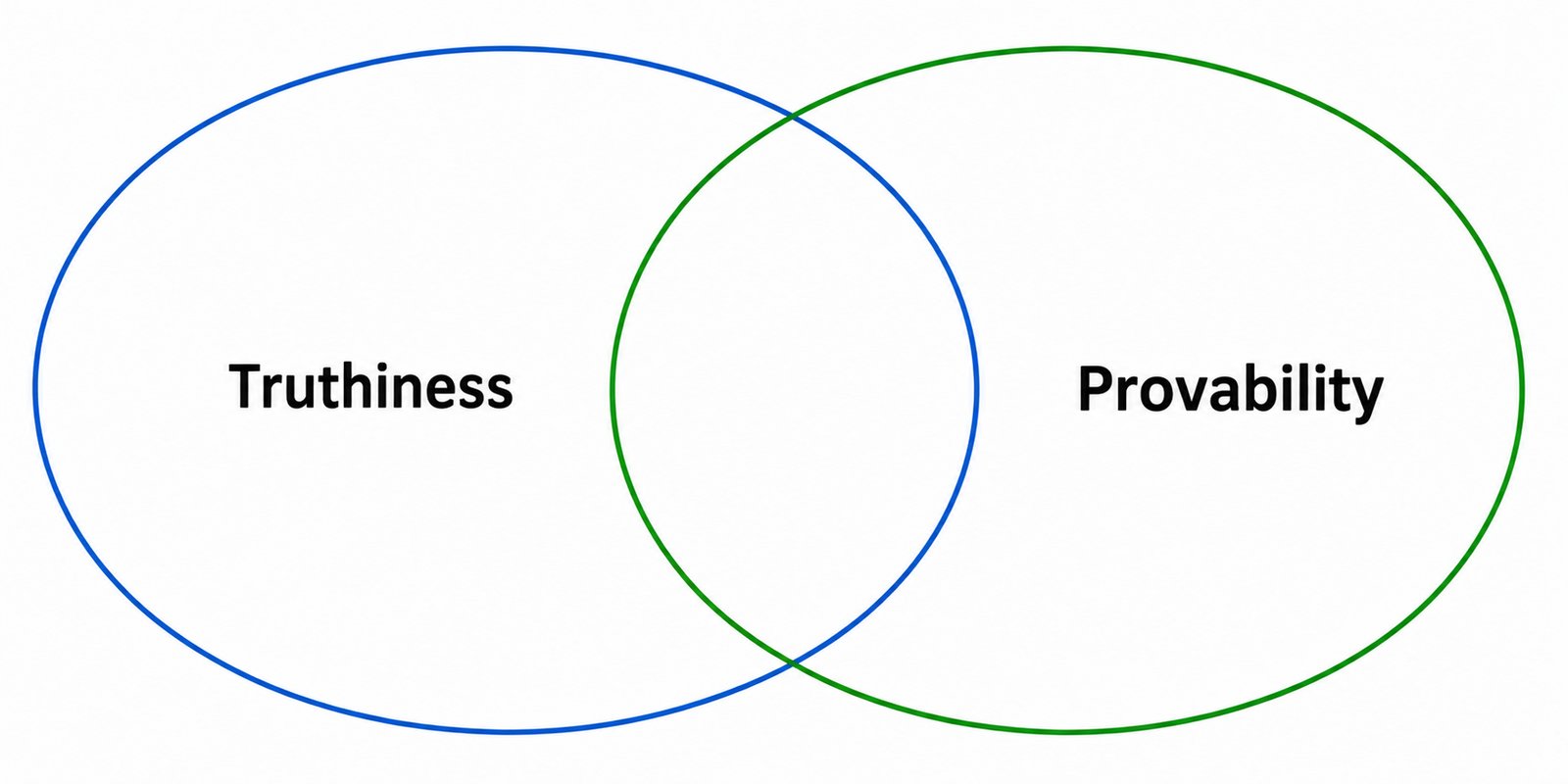
A dot in the Venn diagram of Truthiness and Provability that is in the Truthiness oval, but outside of the intersection.
How wild is that?!
I imagine that the world is divided into two groups of humans. One that is absolutely blown away by this realization and one that never gave provability or logic the credence that the first group gives.
Have you encountered logical arguments that seem to rely on the assumption that every true statement needs to be provable?
The next is a representation of what Gödel proved within a specific domain of axiomatically set-up mathematics, but thereby, by extension, could apply to any domain of rational thinking, that relies on some assumptions (core truths or axioms) and has an apparatus of deductive reasoning layered on top of it. I can’t think of a single academic discipline that is not set up this way.
In any reasonably set up system of axiomatic logic, there will ALWAYS be true statements that are not provable.
The final clincher!
Not only is it possible for true statements to not be provable, but that within a system of axiomatic logic, there are always true statements that can never be proved from within the system.
The mathematical proof technique that Gödel used, could be interpreted as an attempt at mathematically representing self-referentiality.
Deductive reasoning could be insufficient to uncover all truths.
Now, there is a lot of debate around how much of what Gödel proved (quite rigorously) in Mathematical Logic, could be generalized to other contexts of logical reasoning. But the key takeaway for me was more the realization that thus-far I had assumed that deductive reasoning suffices!
There is much to unpack here.
What are the rules of logical thinking? Can the logical constructs used in proofs be tweaked so that all truths are actually accessible via step-by-step deduction? Is this a mathematically sound clarion call for leaps of faith? What does that mean for my dismissal of God? How often have I dismissed faith as being below reason?
Jul 21 2026—Mumbai, India
I edited this essay because I was referencing it in a newer one and did not like (what I now see) as the judgmental language born from repressed anger and separateness from other humans in how I wrote it then.
Here is the original in case you are curious! To my eyes, it is quite obvious that this writing is from an era from before I connected to God and prayer and that I was quite possessed by entities, who opened me up to much wisdom at times but also made my life quite miserable. If you read this and wonder the same about yourself, perhaps because you resonate with the older version but are drawn to the softening of the newer one, don’t be afraid—there are many tools to release oneself from entity oppression.
-
An interesting domain that is at the intersection of Mathematics and Philosophy. Logical thinking is the domain of Philosophy – philosophers over the years have attempted to logically think through difficult questions and present frameworks to make sense of the inherent chaos of Nature. George Boole was the first to attempt to codify these "logical" ways of thinking into mathematical equations, thus giving rise to "Mathematical Logic" – a field that could leverage the power of mathematical methods in guiding logical thought in Philosophy. ↩
-
On a similar note, Einstein's theory of Relativity had phenomenal implications for the nature of spacetime while most of us live life perceiving space and time as being quite independent. ↩
-
attempted to. If you’d like to make an attempt too, I’d recommend starting off with “Gödel’s Proof” by Ernst Nagel. ↩