The Art of Relating
How to gain mastery in the art of relating via body-scan meditation, Nonviolent Communication and Circling
People are inherently good. They would ideally not act in ways that hurt you. However, sometimes their suffering is so deep that they don’t know how not to act in ways that hurt you.
So when you relate to another human, learn to guide them to act in a way that is not hurtful to you, perhaps even pleasing to you. Consider it as a gift to them. The gift of guidance to know how to meet you so you can feel pleased.
You can’t guide someone to relate to you in pleasing ways if you don’t know what pleases you and what bothers you.
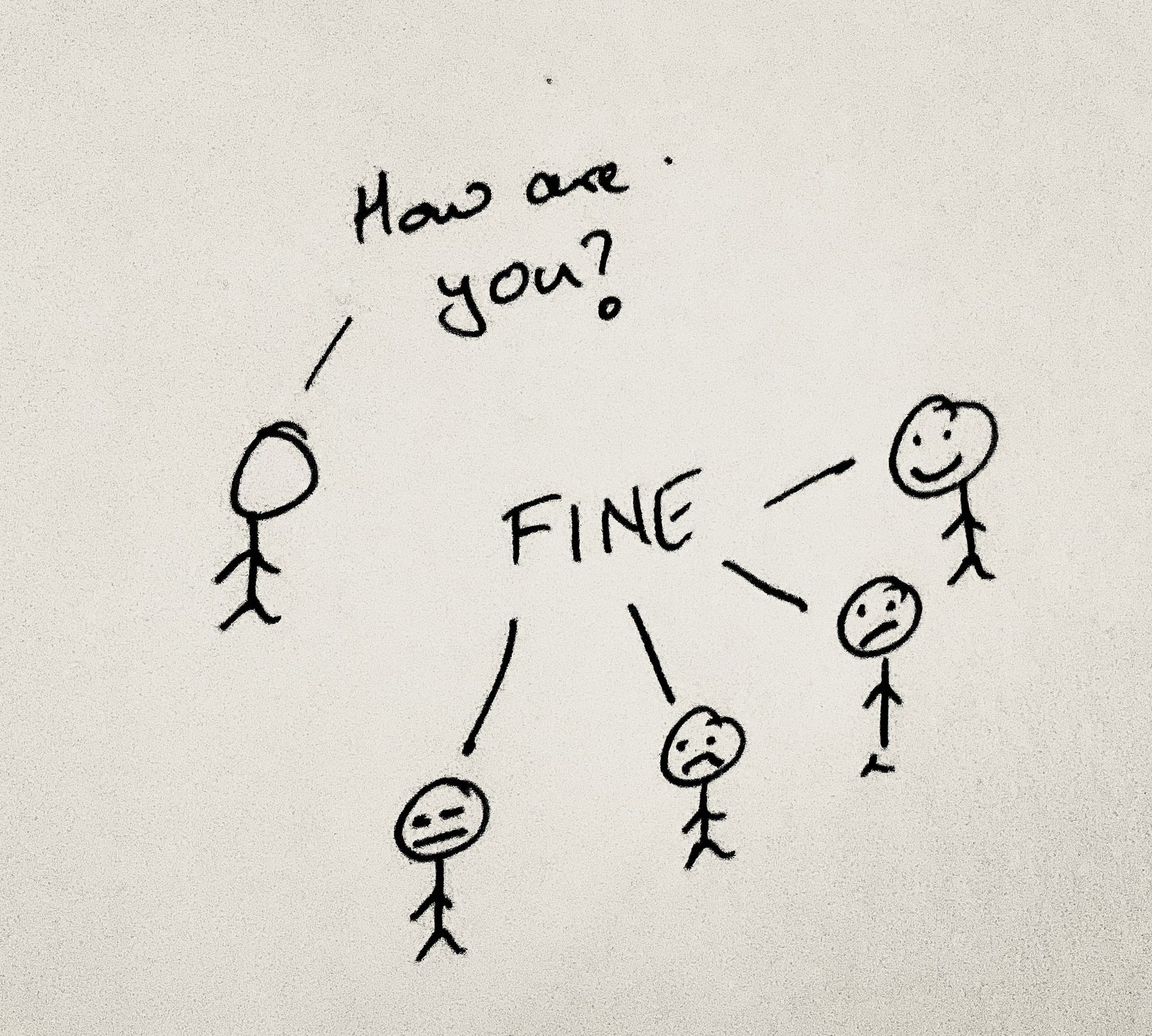
Feelings
Pleasure is a felt sensation. If you live cut off from your feelings and are unable to verbalize those beyond a “fine”, you won’t know what your own body’s pathway to pleasure looks like. It is your body’s pathway because pleasure is felt in the body. Hurt is felt in the body.
So get to know your feelings. Use the Feelings Wheel handy to periodically scan through it and see what feeling word you resonate with in the moment. Sense into your body to feel the resonance.
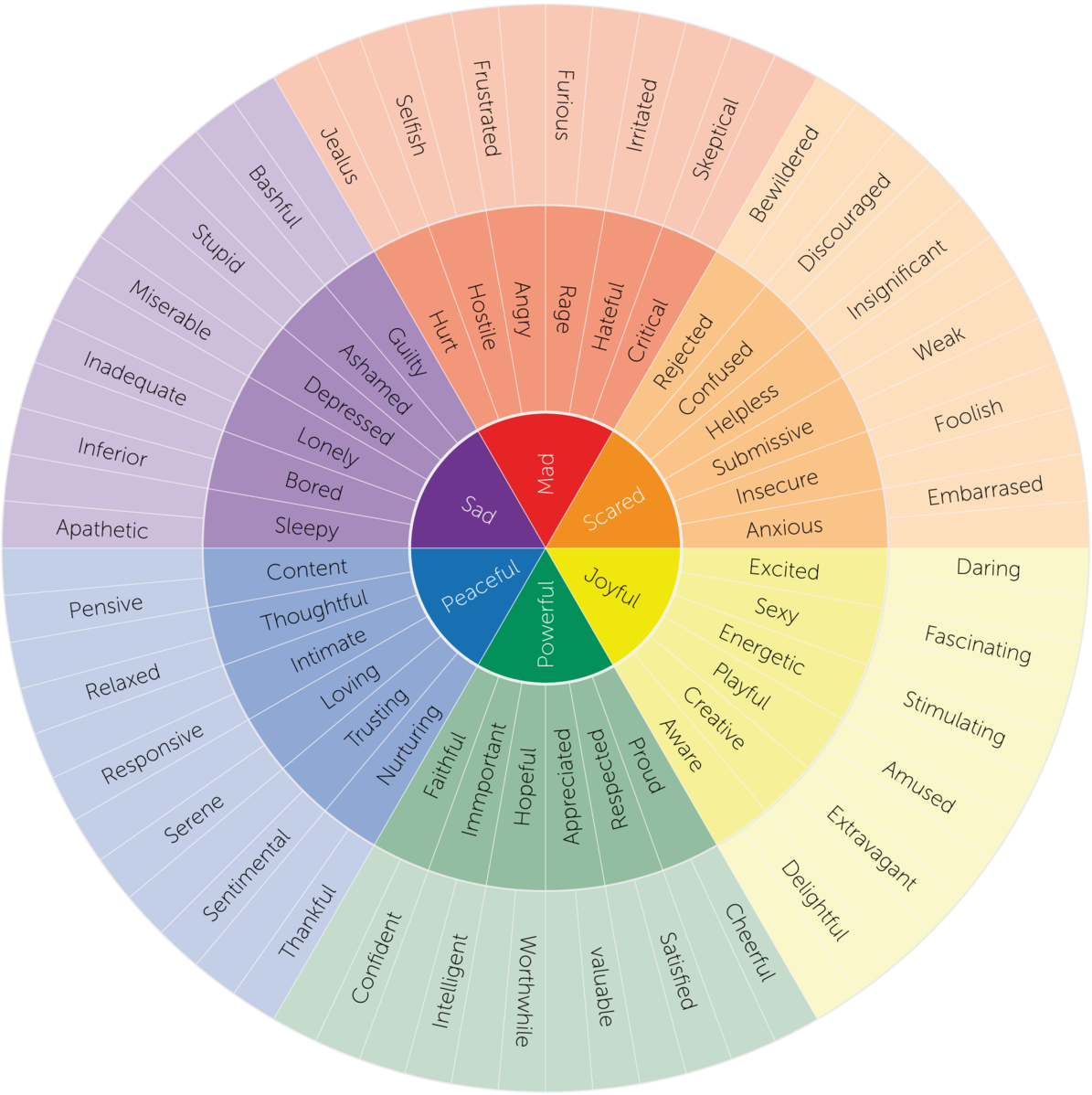
Increase your vocabulary for expressing your feelings. If the chart above feels too complex, just memorize and start working with Glad, Sad, Mad, Bad – part of the Mankind Project quintet1.
Increase your ability to sense into your body to notice the feelings. You can learn to do that with the body-scan technique that Headspace teaches. To up-level on body-scanning, you can choose to attend a Vipassana camp.
Needs
From feelings, onwards to needs. Good feelings arise from met needs. Bad feelings arise from unmet needs. Conflict arises in two humans persist when they skip knowing and expressing their individual needs and jump to strategizing.
Empathy arises once you know the other human’s unmet need. Because you know what it feels like when that need is not met. Because these needs are core human needs, common to all.
Empathy dissolves the tension on conflict and creates fertile grounds for the universe of strategies to meet everyone’s needs. And yes, it might not feel possible in the heat of the argument, but there is always multiple strategies to resolve conflicts. These strategies only reveal themselves to you once you connect to your needs and hear the other human’s needs.
“I know what I need!! I just need my husband to change how he does the dishes!”
Before you roll your eyes at this possibility, note that the way most people use the word “need” is incorrect. Same for “feel”. In the example above, what Maya calls a “need” is actually a “strategy”. Conflicts occur because people are discussing strategies before needs. And (surprise, surprise) the strategies they hone in on focusses on what the other person can change about their behavior.
Prior to doing a course in Nonviolent Communication, I wasn’t aware of my needs. Like I was aware of the word “need” but it was a shocking revelation to me that at various points during the day, I had a wide range of needs that I was hardly ever aware of in the moment.
When you have bad feelings, notice them. Label them. Labeling is extremely powerful. One of the key turning points for me to overcome agonizing (though mostly passive & devoid of actual implementation plans) suicidal phases was realizing that the feeling in me in those activations was “despair”–a complete absence of hope. Thanks to a brother of mine from the Circling community, I was able to label this feeling and it absolutely reduced the weightiness of the experience. Suicidal (a strategy) activation transformed into “I’m feeling despair”. It took the sting out of it. Now it was just another “feeling”. A difficult one for sure, but a feeling that passes just like all feelings do. Labeling is the essence of the Mindfulness-Based Stress Reduction school of psychotherapy. After labeling, you can scan through the Needs Inventory and see which needs resonate. In my example above, it was often one of support, movement, companionship or play. You’d probably only do this when you have a “bad feeling” but it could be fun to do so when you have a “good feeling” too to better get a sense of your pleasure architecture.
Time to practice
Now after practicing sensing your feelings and needs by yourself, you may want to practice with other humans. NVC offers practice groups but I find Circling to be the best playground for improving your ability to communicate your feelings and needs (& more) effectively.
Circling is a group conversation where the ongoing theme is “What is it like to be you right now?”.
What are you feeling? Where are you feeling it in your body? What is going on in you in this moment? What stories or judgments do you have about others in the group that you’d like to check?.
It’s a group relational presence activity. Constantly coming back together as a group to the present moment. Learning how to express the feelings that you typically might not express to a group. Seeing them accept the presence of this feeling in you, thereby increasing your own acceptance that you sometimes feel this way. Learning how to share a judgment or story that you might have about another person and asking them with an open heart if that’s true.
Circling is where I trial run the things I’d almost never say in conversations with humans outside of Circling because I’m afraid of the consequences. I’m afraid of being judged. I’m afraid of being rejected. I’m (evolutionarily speaking) afraid of being abandoned by my tribe and left to fend for myself and protect myself against predators.
In Circling, I say it out and ask for impact. “How does it feel to hear what I just said?”. The other human responds with their truth. Sometimes their acceptance of what I said completely invalidates my fear which then slowly dissipates. Sometimes they react exactly as I feared and I practice being with that reaction, allowing my fear (which is truly speaking my fear of being unable to handle the reaction) to slowly dissipate.
In real life, I often have judgments about other human beings that I don’t reveal because I’m afraid of hurting them (again to be technically correct, I don’t want to feel the awkwardness that I’d feel if they felt sad). Judgments that we have about others are our stories about them. We often don’t know if it’s actually true for them or not.
In Circling, I can tell the other person that I have a story about you and ask them if they’d like to hear it. If they say yes (people often love hearing what others honestly think of them), then I share my story. I could also preface sharing of my story by surfacing that it lives in me as a “negative” judgment and ask for permission again, so that they can brace themselves accordingly for impact. After sharing my story, I ask them if it’s true for them and practice accepting their truth.
The entire relational cosmos began from a Desire to be Seen. So it is truly a primordial gift to receive someone else’s story or judgment about you. Practicing receiving it as a gift and then *honestly* taking a peek inside to check if the judgment is true–to then vulnerably reveal if it is and stating a clear No, if it’s not–goes a long way in your journey towards full self-acceptance and being rooted in your sense of your self.
There are even Circling-based “dojos” emphasizing revealing judgments to foster self-confidence. If you fully love yourself for who you are, nothing anyone else says about you can trigger you. A heard judgment is thus an opportunity for seeing a part of you that you haven’t fully loved yet and showering it with love. Hence, it’s a gift.
Humble Requests
Sufficient practice of Circling combined with an understanding of NVC and even an irregular body-scan meditation practice should get you to a place where you are fairly in tune with your present moment feelings coupled with a sense of your met or unmet needs.
Now once you learn how to express your needs to another human you are relating to, notice your tendency to demand that they respond to fulfill your need. This is a common trap.
Know that every human is a sovereign being.
That includes you. No one can force you to do something you don’t want to do.
That includes the other. No one can force them to do something they don’t want to do.
This is where the humility of a request comes in.
In my experience, one of the hardest things to do is to surface to a person you like2 that you felt hurt by something they did, that these are your needs in similar situations and that you request them to act in a different manner where these needs will be acknowledged. What if they say no? And you lose them? Or even worse, they say yes but don’t put in actual effort? All valid fears to have.
Oh, but the release when they actually do say yes and put in the effort! It’s worth it for the chance to experience that expansive freedom. I learn again and again–not everyone is as bad as the worst human you encountered in your childhood. Obvious when you read it, but difficult to embody.
This is where discretion comes in. Don’t surface every “bad feeling”. Notice patterns and try to address patterns.
This is also where surrender comes in. Surrender to the belief that *every* human is inherently good and *every* human that is choosing to connect with you likes you at some level and is willing to put in effort to please you.
This is also where your self–love comes in. Know that you are whole and complete as you are and that you can create a happy life by yourself without the need for other humans, so you have the right to walk away from any relationship that doesn’t create a safe space for you to thrive3.
Once you make such a request, it’s up to the other sovereign being to accept or decline. To accept in words and yet decline through their actions. Now we enter the domain of relationship therapy where I’ve found “Attachment Theory” to be the most powerful framework thus far. I won’t address that here, but pro-tip, Derek Hart is worth a follow on Facebook. Put your idle scrolling to better use.
This is the beginning.
Beginning to understand who you are, how you truly feel every moment, what your needs are and how to express those. It’s a powerful beginning and I applaud you if you choose to embark on this journey.
I wholeheartedly believe that you will become an artist of relating if you develop proficiency in body-scan meditation, Nonviolent Communication and Circling.
The journey will, without a doubt, be non-linear4. But the nature of progress is always so. Best of luck!
-
I can’t recollect the fifth one because it doesn’t rhyme. Important lesson for mnemonic design ☝🏽 ↩
-
… and want to maintain a connection with. Another common trap in this relational work is attempting to “practice” with everyone and process every “bad” feeling with every human you encounter. If you find yourself doing so, sign up for some Circling groups or NVC practice groups. Trust me, it’s not worth it to expend that energy with every rando. Be selective on where you invest your relational energy and how much you expend when. ↩
-
There’s a lot to unpack here and many valid counterpoints–inherent human need for community, the need to adjust in partnerships and valid criticisms about privilege. However, it’s indisputable that every human has this *right*, in spite of the many valid hurdles one may run into exercising this right. ↩
-
Spiral, most likely ↩