Tending to the Heart
On debriding an infected, neglected heart with the grace of God; to return it to its soft, supple nature
You don’t have to be vulnerable
Holding a steady frequency of vulnerability is not easy. In the past, I’ve experienced an internal collapse of sorts in a space of vulnerability, as streams of deep heart shares poured out of me, disconnecting me from how much of what I was sharing was actually being received—or not—by the other. In those moments, even a subtly misattuned response would hurt a lot. I would feel “attacked.”
What I hadn’t realized then was that as I sank deeper into my specific share, I was also sinking deeper into a specific expectation of being met at a particular level of tenderness, without awareness of whether the other person had the capacity—or even the desire—to meet me there. So I’ve learned to be cautious in being vulnerable, and I think there is wisdom in such cautiousness.
This kind of wisdom doesn’t come from a closed heart. It actually comes from an open one. But it’s the kind of open heart that doesn’t need to be seen for its openness. You see, what was happening back when I was first exploring vulnerability is that in the opening of my heart—and in old wounds that had never been witnessed surfacing in conversational connection with someone—there would be a subtle shadow of wanting to be seen for having an open heart. That shadow would take me to places of vulnerability that were beyond the capacity of where a certain connection was at with the person I was engaging with.
And when I got to those places, I would feel easily hurt when they responded at a very different frequency. That’s because there were subtle expectations underneath when I was overstepping—almost running ahead of the vulnerability level that the connection called for in that moment. And those expectations, I now see, were not expressions of love, but of control.
I like how Steve Torma describes violence in his classes on nonviolent communication. Violence is making someone do something. It is such a simple and powerful definition. I would expand upon it as violence being any action that carries with it expectations for others to act or respond in a particular way. In those subtle expectations you have for others to respond in certain ways, you’re blocking their true expression. You’re creating secret hurdles for how they want to express themselves, and there’s something dishonest about that.
Fracturing within to meet a fractured ‘nother
In that moment, you’re split. There is that part of you that is expressing from the vulnerable, unseen wound. And then there is another part that is attempting to assess the environment for safety. But because you momentarily meld with the expressing part, the other part is freaking out unbeknownst to you and is now attempting to control the environment. Funnily enough, in such situations, the environment mirrors back the same depth of vulnerability to you—but not in the way that you were expecting it. That’s because your expectations from the environment are dictated by the part that’s outwardly oriented in this controlling fashion. So you live a life going around trying to control the environment, including the people and things, because all of it is so in sync with what is unexpressed within you. And there is nothing scarier than what lives unexpressed within you.
There’s a cyclical nature to it: the part within you that’s expressing in a way another part doesn’t like is fractured from a past experience where all of you was expressing that way, and someone tried to stem that expression because they were afraid of what you were mirroring back to them. They were afraid because they were fractured themselves, and you were mirroring a response they had in childhood that created the fracture inside them. This is essentially the cycle of trauma, abuse, and terror. It’s terrifying to experience the fracture within another human being for the first time, and to notice how much you relate to the unexpressed part in them—the part that’s in terror while they are expressedly perpetrating abuse. When you are unfractured, it’s shocking to encounter a fractured person. To meet them, you begin to fracture yourself. Repressing your own terror, and expressing through a freeze or fawn. You get caught up in this cycle where their expressed abusive part hooks with your expressed freeze or fawn, while both of your unexpressed parts deepen into terror. It’s a drug to fracture together this way. You are connected at a very deep level—and yet it’s horrible, because it’s creating a fracture in you and worsening the fracture in them.
The expressed fawning could even be perceived as a delightful yes by a misattuned perpetrator. I think that’s where you have the heartbreak of unintentional trauma perpetration. The perpetrator is taking on the role of a perpetrator unconsciously because he is fooled by your fawning.
All of this gets especially challenging when it comes to sex, because the texture of sexual moans can blur the line between positive and negative expression. You might hear the same sound when you’re truly wailing and when you’re crying out in pleasure. It makes it very hard to care for someone’s wounding and trauma while engaging erotically with them.
Knots and entanglements
That was my main takeaway from what I call my Shibari Dom era. In that two-year period, I explored Shibari with 15 to 20 women.
A lot of women like to be tied up. Not all, of course! Some are lucky to have had an upbringing that’s kept them quite shielded from big T trauma.
Many are afraid of expressing it openly. Many are disconnected from their shadows. In the disconnection from their own shadowy desires, they assume that their husbands would disown them if they were to express those desires. And then the marriages end because they are stalled in a falsehood.
Falsehood extinguishes Eros.
They may not tell you, and yet it’s evident in statistics—like how many copies of Fifty Shades of Grey are sold.
Big T trauma creates knots in the energetic system, blocking the flow of energy. The nervous system is supposed to flow outward from the brain and spinal cord, but when people experience sensations beyond their capacity to hold, the nervous system withdraws sensitivity from those areas. A full withdrawal is a dissociation. Over time, desensitization in the parts commonly traumatized can become permanent. What lives instead in those places is the energetic signature of the forceful intrusion.
Most people are unaware of their energetic bodies—unaware that they’re touching others even when their physical bodies are not. Once you become aware, you can sense where there is openness and where there isn’t. That’s one of the gifts of Shibari offered me as a practitioner: spaciousness to slow down and notice what the body is saying, where it was opening, where it was not. At the point of withdrawal in the nervous system, are these trauma knots. Bodies that have experienced trauma are filled with them.
Overwhelmingly entangled trauma knots.
Whenever your nervous system encounters a knot, it goes into overwhelm and shuts down. You may experience tiredness or cravings at such points, as you dissociate or your attention either withdraws rapidly away from the knot or gets hooked past it, into the traumatized zone.
I had my most visceral awareness of these knots during my experience of sleep paralysis. Sleep paralysis is a state where I finally got visibility into the state of my energetic body during a phase of deep depressive heaviness. All I saw was these vividly entangled knots that felt heavy like lead and I was faced with the absolutely insurmountable task of disentangling them. I wonder if you’ve ever had dreams like that?
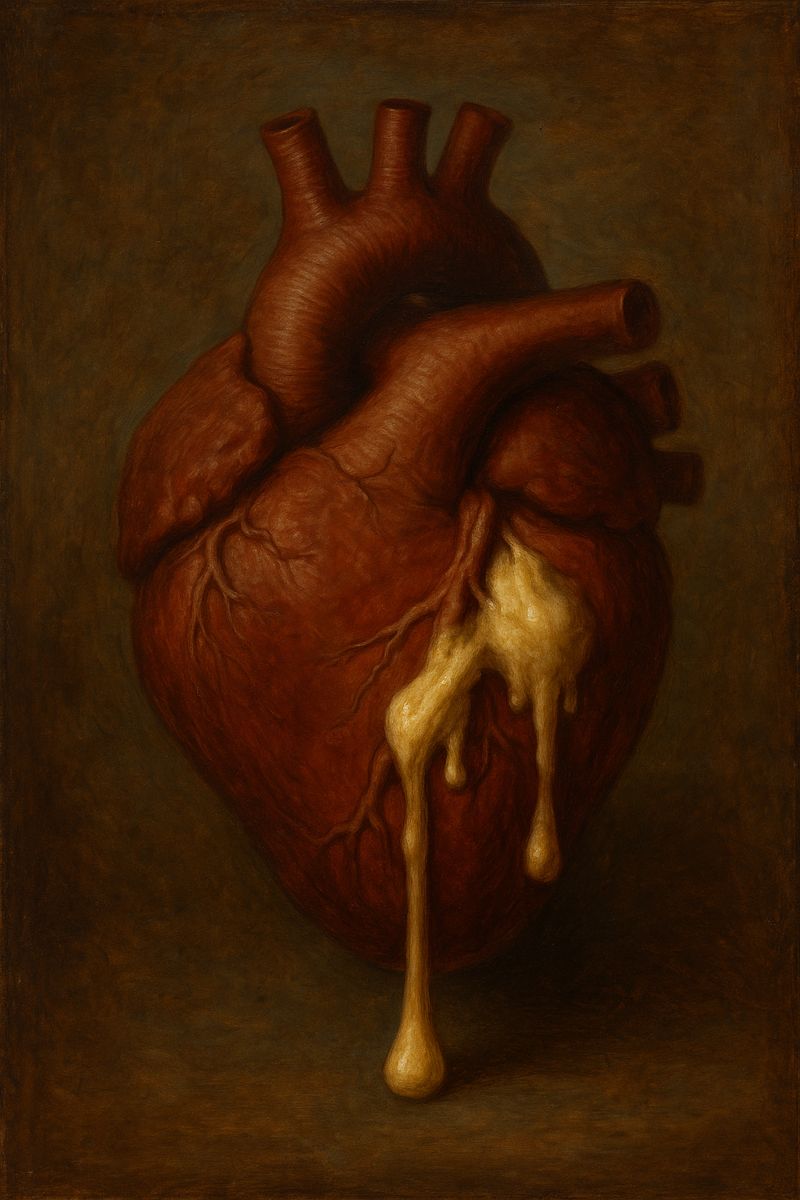
I could see the heaviness of these knots in my nervous system in a half-awake state—seemingly being able to see my energetic body. In another vivid moment of seeing my energetic body, I noticed an infection in my heart, born out of neglect. My heart was so neglected by me that it was filled with energetic pus, infection and maggots.
This was deep in my era of blindly following what my cock told me—truly a slave to its directionality around who and what I wanted to explore. I even remember having sex with someone without kissing her until deep into intimacy. I was attuning then, per a principle of Sacred Sexuality work, to where desire was strongest. I had desire in my cock and none in my lips. Later I’d learn that lips were an immediate channel to my heart convicting me towards celibate dating and seeding in me the inquiry of whether I want to kiss my future wife first on the wedding day.
There was a lot of unexpressed desire in my cock because I had settled for women I didn’t truly desire before. I speak this tenderly, because no woman likes to hear that, but it’s real. The more women are attuned to that truth, the better they can say no to men who are just using them for release, and meet men who desire them from the heart.
Exploring Shibari helped me understand that everyone longs to be held. Whether man or woman—it doesn’t matter. Everyone wants to be held, comforted, wrapped like in a warm blanket on a cold day. God is the greatest comforter, and in the absence of connection to God, people find comfort through sexual intimacy. Underneath it all is the desire for touch—a deeply human need. It’s nourishing to receive touch without sexual expectation. I was disconnected from that for a long time, because touch would bring up body memories of touch escalating into sex. So when I would touch a woman I liked, I’d want to have sex with her. When you don’t remember what was done to you, you’re bound to repeat it.
It’s quite beautiful to hold an attractive woman without feeling the overwhelm of needing sex from her. That’s something I got clued into through Shibari. When a woman I was being intimate with wasn’t tied up, anxiety of the session ending would drive me towards escalating into penetration. Get in before she gets away, a voice inside me would say that I couldn’t hear but obeyed anyways.
Now because the ropes were holding her in place, I could sit back, be patient, and notice what was coming up in me and in her. Ropes have this earthy, grounding quality—like soft branches of a tree. Good-quality jute ropes that smell nice—it’s such a nice feeling to be held in them. The ropes hold firmly yet leave space to breathe. When a person holds you, there’s more sensory contact, which can be overstimulating for both the holder and you. Ropes create distance and lack of skin-skin stimulation, allowing for spacious relaxation.
When beautiful knots adorn the body, they mirror the trauma knots inside but with a dose of beauty in the otherwise rigidly entangled trauma knots.
Hell on Earth
Everyone knows what I mean by “rigid” person—often men—a clenched body that can’t soften. This rigidity fractures the man into anxiety and controlling. The more a man doesn’t recognize his anxiety, the more controlling he gets. It’s difficult for an entangled, knotted-up body to express freely. When he sees free expression, he is reminded of what he is disconnected from and instead of connecting within, he tries to clamp down on the external expression. It’s a losing battle against his repressed rage, finding justification in righteousness moment by moment as he is faced with a whole expression filled with innocence and vulnerability. The rage unleashes—the demons come alive. The soul of the man shrinks back into the depths of his own heart where there is still a mustard seed sized presence of God who comforts him as the demons take over his body. That fury can show up as disconnected, jackhammer sex, as rape, as verbal abuse, as doctrinal warfare over whose God is true. In those moments, the man is no longer in his body, and the person being abused has also exited theirs.
And that, is hell on earth.
This is also where I made mistakes.
In the release of sexual trauma, lust can arise, because sexual trauma is born of lust. Part of my growth was learning to stay leaned back—to simply observe desire and the beauty of healing in another. There were times I didn’t, and played with what was trying to move out, which was re-traumatizing to some extent. Ideally, containers like this are built with clear boundaries and safe words. I had those, but they’re not always enough, because of fawning and freeze responses. Still, for women who are deep in sovereignty, even imperfectly conducted Shibari experiences can be revealing—they show where their freeze-fawn patterns lie. And as a man, I remained open to making amends where I missed things. The lineage of D/s I was introduced to presented the work as being of service to the sub. Not all lineages have that orientation. Sometimes there are no lineages whatsoever.
If a woman isn’t yet steeped in her sovereignty, she may collapse into her familiar protective mechanisms of resentment and blame. If a man can keep his heart open in that moment, he is making amends to her and also paying the debt of the collective blame for what men have done in the past. Most of my containers were nonsexual—no penetration, fully clothed—except when I was with a partner. So while there were moments where healing could have gone deeper, I wouldn’t call those re-traumatizations worse than the original wound.
I imagine worse retraumatizations can happen in D/s exploration that doesn’t have an explicitly service dom theme. Some flavors of kink are not designed for trauma release but instead to fester in the painful pleasure of tickling the trauma. Feeling warmth of the dripping pus of all the infections in the wound by poking at it. Because you like how warm the pus feels. There’s a flavor of kink exploration that’s basically that.
It still may not be as retraumatizing as the original wound, but yet it doesn’t reach the healing potential that such exploration can have.
Instead it builds a positive relationship with sinful temptation—you learn to say yes to it. It creates a peaceful coexistence with your infectious trauma pus, which may lead you to believe its okay to inflict wounds on others in a manner that their bodies develop trauma pus because then you can train them to enjoy the warmth of the pus. I think that’s the texture of grooming.
But if you were to develop away from sinful temptation, and cleaned out your own pus by (say) allowing the blood of Christ to wash it clean, then you wouldn’t want to inflict pus boils on anyone, so that you can make money off of teaching them to enjoy popping their own pus boils. Many D/s, kink or “sacred” sexuality teachers can be a little caught up in this world, without much of a connection to God and much of an orientation towards saying No to sinful temptation.
That’s what they are doing essentially.
Infecting them by making light cuts in humans and then helping them enjoy popping their infected pus boils.
A human is typically only drawn to this if there is a past wound that is unseen. It can get a little tricky though because the past unseen wound might not be from this lifetime.
But when you see the big unseen infection, like I did with my heart and perhaps the repressed trauma prior to that, it shifts something.
Spiritual awakenings
It is such a ghastly experience to see the big unseen wound that there is nothing tempting about playing with and inflicting new little wounds on yourself. And yet you may find yourself doing that in your transition period, because there is a lot of inertia of all these past behaviors you have had, but at least, you are convicted towards a different flavor of life.
And that is the essence of repentance. A clarity of “oh, there are two directions here that are quite different. I don’t want to move in that one. I want to move in this one. Father, help me move in this direction”.
A spiritual awakening can have this flavor of “ah let’s try this direction and let’s try that direction; what is that like? what is this like?”. In the open directionality of a spiritual awakening, you may experience a lot of freedom, of a certain kind. Perhaps you have come from a conditioned belief from whatever society you were brought up in to think that there is one direction that is right. And that is what Satan has done. Created many fragments of human society, each conditioned to believe that their direction is right.
Think of it this way.
Imagine you are standing at a point on land and you can walk in different directions 360 degrees around you.
There is only one direction that is filled with clarity, joy, life, purpose and health.
Only one path that keeps you free of infection and cleans out all your past pus boils.
And then someone comes and tells you this here is the one path (actually it’s the wrong one) but doesn’t tell you what quality of life to expect on that path.
So you righteously follow that path while your life is devoid of clarity, joy, life, purpose and health. But you don’t know that if you were to follow the true path, you would have clarity, joy, life, purpose and health. And things have gotten so bad in your life, plus you’ve been in such denial about how bad things have gotten that you don’t have any expectations whatsoever of a life filled with clarity, joy, purpose and health.
That’s the trick Satan has played through religious sectarianism.
In different societies, he has seeded this idea in a group of humans that this is the one path (it’s not). And the humans who think this is the one path fight with the humans who think that is the one path, but neither of them are the true paths and they are just left fighting with each other.
Spitting cuss words at each other because the other path doesn’t match the doctrine handed to their priests by Satan, who rejoices at the mass confusion he has created.
He really likes that. He really likes mass confusion. Gives him great delight.
That, and cuss words. Righteously spoken cuss words. Deservedly spat out. That momentary spit of the forked tongue, releasing the tension, just a teensy weensy bit. Ugh, it feels so good to cuss.
Until you see the big hidden pus boil in your heart that you are spitting directly into.
So if you have blindly followed one of those false paths thinking it is the right path, you suddenly open up to “oh wow, I might have been wrong. There are all of these different paths that I can choose” and that’s the moment of awakening into the freedom of choice, which is a particular necessary form of freedom. This realization that you have free will.
If you had grown up Christian, now you may go “oh wow, Jesus Christ was a scam”. That feels like freedom because you never considered the possibility that it could be a scam.
I had that moment of realizing that I had free will in the depths of my depression at the end of my first marriage. Then, as I spent years moving in all these different directions, clarity dawned upon me one day that I wasn’t tending to my heart and it had gotten really infected.
The soft and supple heart
I’d say now that tending to the heart has become my path. Tending to my heart, tending to someone else’s heart. And that mutual tending brings me balance. Where is their heart at? Where is my heart at? Can I reach them from my heart? Is it reaching their heart? And there is a very different pace because the soil of the heart takes a lot more time to sprout seeds. Seeds of God. Seeds of God belong to God. I sow them in someone’s heart to glorify God. In that, there is a letting go of when it sprouts. If it sprouts. And there is an awareness that this is a collective effort. Sometimes I plant the seed. Sometimes I water a seed planted by someone else.
Back when I was in vulnerability culture, there was an orientation I carried that I’ll water the seeds in someone’s heart with my vulnerability. Drown it even. And then be sad that it doesn’t sprout right away. Nothing grew out of it! Oh no!
It’s nice to be in the spaciousness of God’s presence and just feel the soft supple texture of my heart. So nice to feel it. How warm and mushy it feels in my chest. Clean, free of infection, drained of all pus. Throbbing. Beating. So delightful.
It’s the kind of delight that you just need to get one hit of. If you get one hit of it, you don’t want to go back to anything else. So self-contained the warm, mushy delight of a soft, supple heart. And on top of that, it’s such a joy! My! What a joy it is! To experience that in another human being! So wild!
And on average, I’ll note here that, in my experience, I find it easier to experience that with women. Women, and children. And that’s something to sit with. I’m not obtuse to the possibility that I might have blind spots here with regards to men. But I’m not saying it’s never found in men. I have found it in men too. But women, on average, have more of an access to it. That’s not to say that women don’t have hurt, infected hearts. There are those too.
But statistically, women seem to have an easier access to a soft, supple heart. Perhaps their menstrual cycles regularly clean out the pus boils? I don’t know.
And it does make me wonder, how often have we heard their voices on the matters of God? Not often enough, it seems.