A Call for Integrity in Internal Family Systems
An open letter to the IFS Institute urging transparent training and ethical clarity on external entities
In engineering, when a design reveals a hidden flaw, the company pauses to reassess. Not because the design is wrong, but because new information changes how it must be used. Healing work deserves that same humility.
The Internal Family Systems model has long centered on one form of integration — integration by absorption. A part reveals its pain, releases its burden, and merges back into the Self’s wholeness. But with the discovery of unattached burdens — energies that are not parts of the self — a different kind of integration is needed. Here, healing happens through expulsion: asking what does not belong to leave, in a field of compassion and authority.
That shift changes the architecture of the work. Based on my own experience, the expulsion protocol is very different from the integration protocol that IFS is built on. In integration work, a part releases its burden and merges back into the Self — there’s absorption, reintegration, reunion. In expulsion work, the orientation is different. The aim is not to heal the entity’s wound—some of the wounds encountered here are of mythic proportions—but to invite it to leave — firmly, compassionately, and with clarity that it does not belong to the person. These are two different movements of energy, and they require two different forms of training. It reshapes how practitioners listen, discern, and intervene.
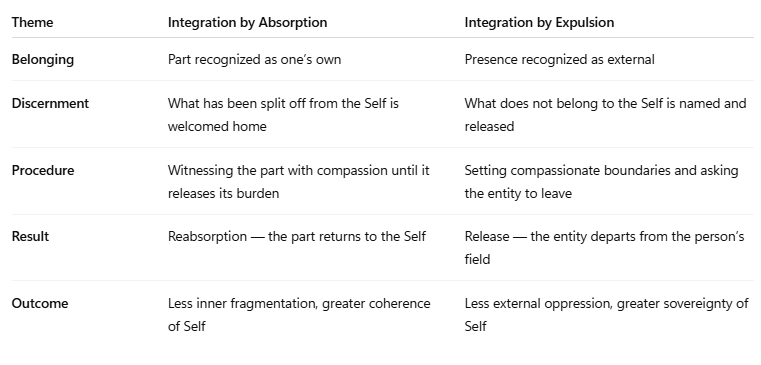
And yet, many IFS-certified therapists remain unaware of this distinction! They’ve never been trained to recognize external entities or to use any form of expulsion protocol!
That’s an organizational gap that needs attention.
My hope is that the IFS Institute addresses this with sincerity and seriousness. The end goal, as I see it, would be clear:
- that every IFS-trained practitioner learns to recognize the possible presence of an unattached burden
- that the Institute maintain a directory of practitioners trained to release them
- that untrained IFS therapists be clearly guided to refer clients onward when there is reasonable cause to suspect such a presence
More practically, I’m calling for the Level 1 training modules to be updated, and for a required training addendum to be sent to those who are already Level 1 trained, so this gap is closed across the board. The Institute now carries the responsibility to bring this into clear awareness and offer guidance for how to work with it.
A Framework at a Crossroads
IFS is one of the leading trauma-healing frameworks today. It’s based on the idea that the human psyche contains many “parts.” These parts often fragment during painful experiences and carry burdens of emotion, memory, and belief. The work of healing is to get to know them with compassion so they can be released and reintegrated into what IFS calls the Self — the unbroken wholeness at the core of every human being.
It’s a beautiful model. It has helped countless people resolve inner conflict and return to a sense of internal leadership. But as it evolved, something unexpected happened.
Dick Schwartz, the founder of IFS, admitted in the preface to Bob Falconer’s The Others Within Us that as the framework developed, practitioners began encountering parts that didn’t behave like the usual child parts. When asked how old they were or when they appeared, these parts gave strange, almost mythic answers — not “I’m six years old,” but “I’ve been here for eons.” At first, they were assumed to be lying or confused. But the more these encounters continued, the clearer it became that some of these were not child parts at all. They weren’t even human. They were external entities.
And that’s a big deal, because the entire IFS framework is built on the assumption that everything you meet inside a person is a part of the self — something that can be witnessed, unburdened, and integrated. But if some of these are not parts — if they are external beings — then that turns the whole framework on its head.
Why It Matters
Imagine an IFS practitioner who encounters a client carrying such an entity but doesn’t even know this category exists. I can understand why — the system was built around a different assumption, and many practitioners simply haven’t been exposed to this discovery. “They’ll cover that in Level 3 — I’m not there yet,” they might say.
They might spend months trying to integrate something that cannot, and should not, be integrated. The result is confusion, exhaustion, and sometimes spiritual harm — a prolonged healing journey that, if we’re honest, sometimes ends up benefiting the therapist more than the client.
When a practitioner has no awareness of external entities and assumes everything inside a person is just a part, that unawareness becomes fuel for deception. These entities seem to take joy in pretending. They like being treated as if they belong. And when a practitioner keeps engaging them gently and compassionately, believing they’re helping a wounded inner child, that care can actually strengthen the entity’s hold.
I wouldn’t be surprised if that’s what happens sometimes — when practitioners believe they’ve made a breakthrough, and then, in the next session, the client shows up having relapsed or done something destructive. Self-harm, bingeing, and addiction all fall into this category. They’re behaviors that point toward possession. The entity gets to feed on the confusion while the practitioner believes they’re doing trauma work.
It’s almost as if the entity and its allies gain a hold on both the therapist and the client — the therapist through deception, believing they’re tending to a part that belongs, and the client through worsening pain and the slow leak of money and energy that feeds the same thing keeping them bound.
The Moral Responsibility
Continuing to train practitioners under the assumption that all inner voices are parts is like continuing to sell a car that might explode. It’s morally negligent.
IFS has done tremendous good, but it now faces the same ethical choice Ford once faced: to quietly continue, or to pause and acknowledge a design flaw. In the 1970s, Ford discovered that the Pinto’s fuel tank was mounted just nine inches from the rear bumper, with no protective barrier. Even a modest rear-end collision — thirty miles per hour or less — could rupture the tank and engulf the car in flames.
Ford engineers had already tested a fix: a small $13 plastic shield that would have prevented the puncture. But executives ran a cost–benefit analysis instead — roughly $200,000 per life lost, $67,000 per serious injury, and $700 per wrecked vehicle. Fixing the defect across the fleet would have cost $121 million; letting people burn would cost $49.5 million. They chose the latter.
At least twenty-seven people died in such ordinary rear-end crashes, and some investigators estimate the true number may have been five hundred or more. What makes it even harder to stomach is how easily it could have been prevented. Ford could have simply issued a notice — rung the alarm bells — and told drivers to install the $13 shield at their local garage. But fear of liability and the paralysis of corporate caution took over. The recall math itself was flawed, built on the assumption that every car would need to be hauled back to the factory, when in truth the correction could have been almost effortless.
It’s hard to take that in — that simple fender-benders became death sentences because of a spreadsheet. But the underlying ethos is the same here: when a system reveals a fatal flaw, the response must be recall, not rationalization.
The discovery of external entities within the psyche is not a small update — it’s a foundational shift. If integration is the heart of IFS, then integrating this discovery into its own teaching is the next natural step. Anything less would be internal exile — the model rejecting one of its own truths. Every practitioner deserves to know this, and every client deserves to work with someone who understands the difference.
A Brother’s Call
I don’t have final answers about any of this. Maybe the practitioners who never think about entities are still part of some larger correction that I can’t see. Maybe this whole field is in the middle of being reorganized by something higher. I just know that it doesn’t sit right to keep quiet about it. So I’m saying what I see, even if I don’t yet understand the full picture.
IFS has changed the way we understand healing. I say this not to tear it down, but to preserve what’s truly luminous about it. The model deserves to evolve in integrity with its own discoveries.
You’ve created something remarkable and deeply helpful. I say this out of respect for the lineage, not in opposition to it. But it’s time to acknowledge openly and transparently that not everything inside a human psyche originates from that human. External entities exist, and that recognition changes the IFS model at its foundation.
It’s not enough to mention unattached burdens in advanced trainings or scattered materials. Every practitioner needs to be able to recognize when they’re in the presence of an unattached burden. The Institute needs to maintain a directory of therapists trained to release them, and to guide untrained practitioners to refer clients onward when there is reasonable cause to suspect such a presence.
I imagine the difficulty for Dick Schwartz has never been in recognizing what’s true, but in how to name it within the bounds of professional respectability. He’s had to walk a delicate line — holding the moral responsibility to speak what’s real while navigating the institutional pressures to keep the model academically acceptable. It’s a tender balance, and one that calls for compassion rather than critique.
This isn’t a rejection of IFS; it’s its maturation. The recall isn’t to discard the system, but to repair it — to make it safe for the level of consciousness it now touches.