Subjectivity & Objectivity in the Journey of Truth
When Truth is repressed, how do I decide what is real and what isn’t
Science understands the significance of verifiability by an independent human being, unlike other attempts to understand nature. The emphasis being on objective verification. Sometimes, scientific attempts get caught up in the objective enough to deny the existence of the subjective. That is scientific fanaticism. The right line to walk seems to be an orientation towards the objective with an acceptance that our experience of the objective itself stems from subjective realms.
I wonder if there has been any adult who has successfully verified from another human being, past recovery of repressed memories of childhood sexual abuse.
Sometimes in conversations with others who possibly have repressed memories themselves, I'll notice that, when I speak about my childhood sexual trauma, or sense thereof if we are going to be precise about it, they seem to start dissociating. This shows up perceptibly in their eyes glazing over with a soft smile on their face. I imagine it feels blissful to them in that moment. And more clearly in their inability to remember what I shared with them. Herein lies my emphasis on speaking clearly and explicitly, (while watching & not succumbing to the thrill-seeking tendencies to shock and sensationalize) about your childhood sexual trauma. The more I have spoken clearly, the more it has released and the more layers have been unearthed. I have, in my journey, met many humans whose own sense is at one of these different layers, often with a sense of protective certainty that that's all there is to it.
“I had the most perfect childhood.”
(Emphasis on most and the dissonance of that statement with the number of sexual challenges faced in adult life)
“I might have been sexually touched as a child, but I don't remember it, and it was probably nothing.”
“I was sexually abused, but don't remember by whom.”
“It was my grandfather and he touched me inappropriately.”
“It was my grandfather and he raped me multiple times.”
“It was also his friend.”
“I vaguely remember it being recorded. I remember it being recorded and that other children might have been involved.”
“I might have done things to other children.”
“My mom is involved in this somehow.”
“My mom masturbated me perceptibly to quell the tremors of sexual trauma arousal.”
“My mom sexually abused me”
(minus the defensive argument in the earlier statement)
Not all of these are my own direct experiences, but I've stitched together, pulling from varied real stories, an example of what successive layers of recovery of repressed childhood sexual trauma might look like along with the corresponding deepening of one's sense of self.
Recently, I shared a piece of my trauma history with a dear friend. I noticed her dissociating as I shared it. I paused and asked her to reflect it back to me. She stumbled and couldn't recall and started collapsing into embarrassment and worries about how I would take it. I knew in that moment that it wasn't about me, but about her. I asked her to breathe and be with the embarrassment, and openheartedly told her it's okay to forget and that I'm not taking it personally.
I read a book once in the first throes of deep depression, the season that ended my first marriage, called The Illicit Happiness of Others by Manu Joseph. It captivated me. This was 2016, when my sense of self was at “I had the most perfect childhood”. I read the book again in 2022 and spotted 6-7 incidents in that 200-page story that directly referenced childhood sexual abuse in an Indian cultural context. I had completely missed all of these on my first read!
I was pretty sure I saw the movie The Monsoon Wedding as a kid. I did not remember the climactic scene that addresses and paints a very real picture—capturing dissociation and collective denial—of childhood sexual abuse. Till in conversation post-recovery in 2022, someone referenced that movie and I went, “Really? That's about childhood sexual abuse?”
Both of these are very real instances of repression at work, where my perception fully filtered out instances of CSA in the outside world, till I was ready to witness the wounding within.
I have entertained theories that none of this is real. And I'm afraid of speaking this out because I know that many in my family would jump on it, out of their inability to be with the guilt of having failed me. I have entertained theories that all of these
recovered memories are hallucinations of some sort induced by psychedelic use. Perhaps the use of psychedelics opens up portals to some archetypal spirit that carries stories of childhood sexual trauma, which then the human self identifies with and projects a reasonable-sounding story from their own history into what the spirit carries. This competing theory is my strongest opposing argument to the realness of what I have experienced. I've had glimpses of the repressed trauma in four different instances of use of psychedelics plus two to three instances where I've felt a physical trauma release without the use of psychedelics. In the four instances, I was with different guides in different locations and on different substances. In many of these, I have felt a significant shift in my physical body, often in terms of loosening of hips and better felt connection to lower abs, which has then reflected in easier muscular gains when I work out. As jarring as this recovery has felt, I have felt more grounded and soft in my being and less prone to compulsive addictions like binge eating and consumption of pornography, both being significant parts of my weekly/daily life pre-recovery and almost absent in the past few months. These are undeniably objective visible shifts that compete with the hallucination theory. I have wondered if this recovery experience was something I went through just so I could learn how to heal from it, so I could help others with “actual” childhood sexual abuse to heal from it. But there is a flimsiness to that wondering in that it comes and dissipates quickly and never really roots itself in my sense of self. This entire ride has been quite a vehicle in broadening my direct understanding of the nuance involved in subjective versus objective truth. Rooting in one's own subjectivity and orienting towards objectivity seems like the correct way of Being. The former is essential for a developed sense of individual self. The latter is necessary for harmony with others. Structurally, this notion feels similar to rooting in Darkness and orienting towards Light. Only when I root in my Darkness is it clear to me where the Light is coming from. Prior to that, there is Light everywhere and the surrounding blaze blinds me to any sense of direction and purpose in life.
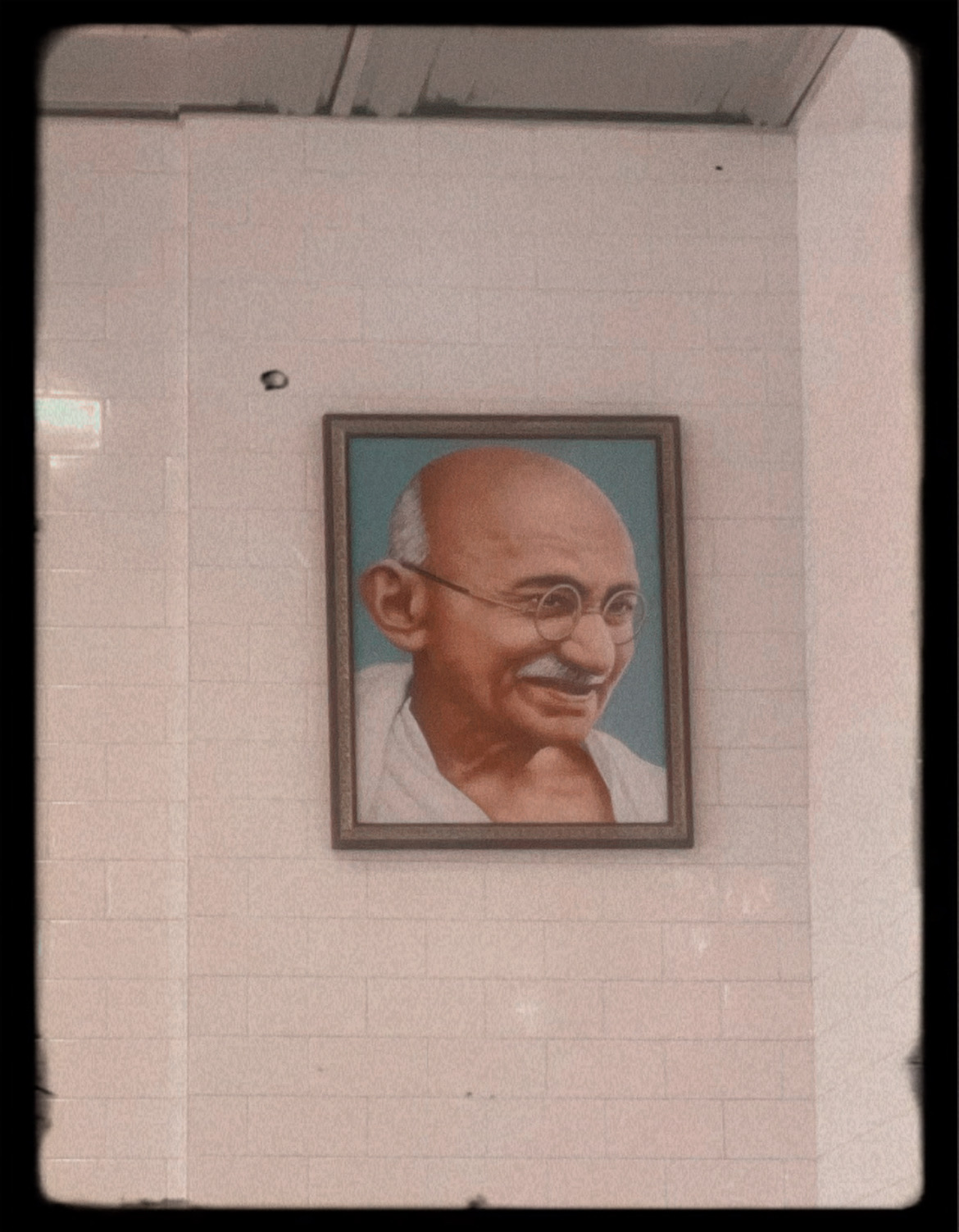
Pictured: A framed image of Gandhi in Botiwalla, Asheville—a person known for his experiments with Truth, some of which involved forcing his teenage nieces to sleep naked with him in his bed just so he could strengthen his celibacy