From Gyan Yoga to Bhakti Yoga
From the path of knowledge to the path of devotion
The path of self-knowledge, viz. introspective inquiry driven by curiosity of what lies in the subconscious, revealed to me layers of suffering stored in my body as trauma.
I was under the impression that through sufficient self-knowledge, enlightened bliss will erupt spontaneously.
My sense thus far is that’s not the case. In fact, every layer of self-knowledge is a new layer of suffering that has been repressed. Either from this life or from past life. The body stores suffering. The body doesn’t store joy. Joy needs to be chosen in spite of the level of self-awareness one has about one’s own suffering. The catch is that with my history of abuse, I have a high pain tolerance. And a corresponding high level of pain is necessary for me to act. This shows up in how I respond to deadlines. I don’t move till the deadline has creeped up on me and then I perform exceedingly well in a trauma activated but very effective state. The effectiveness comes from the fact that my body literally feels that my life is on the line. I’ve also noticed this show up in how slow I am to put up my guard in Muay Thai or my tendency to tap out late in Jiu Jitsu even when I know that there is no way for me to get out of the submission — martial arts provide such a wonderful playground for healing from abuse. Given this high need of pain for action, it makes sense to me that it took full recovery of these repressed memories for me to want to show love to these wounded parts.
So if just acquiring more self-knowledge doesn’t suffice, what’s my path forward?
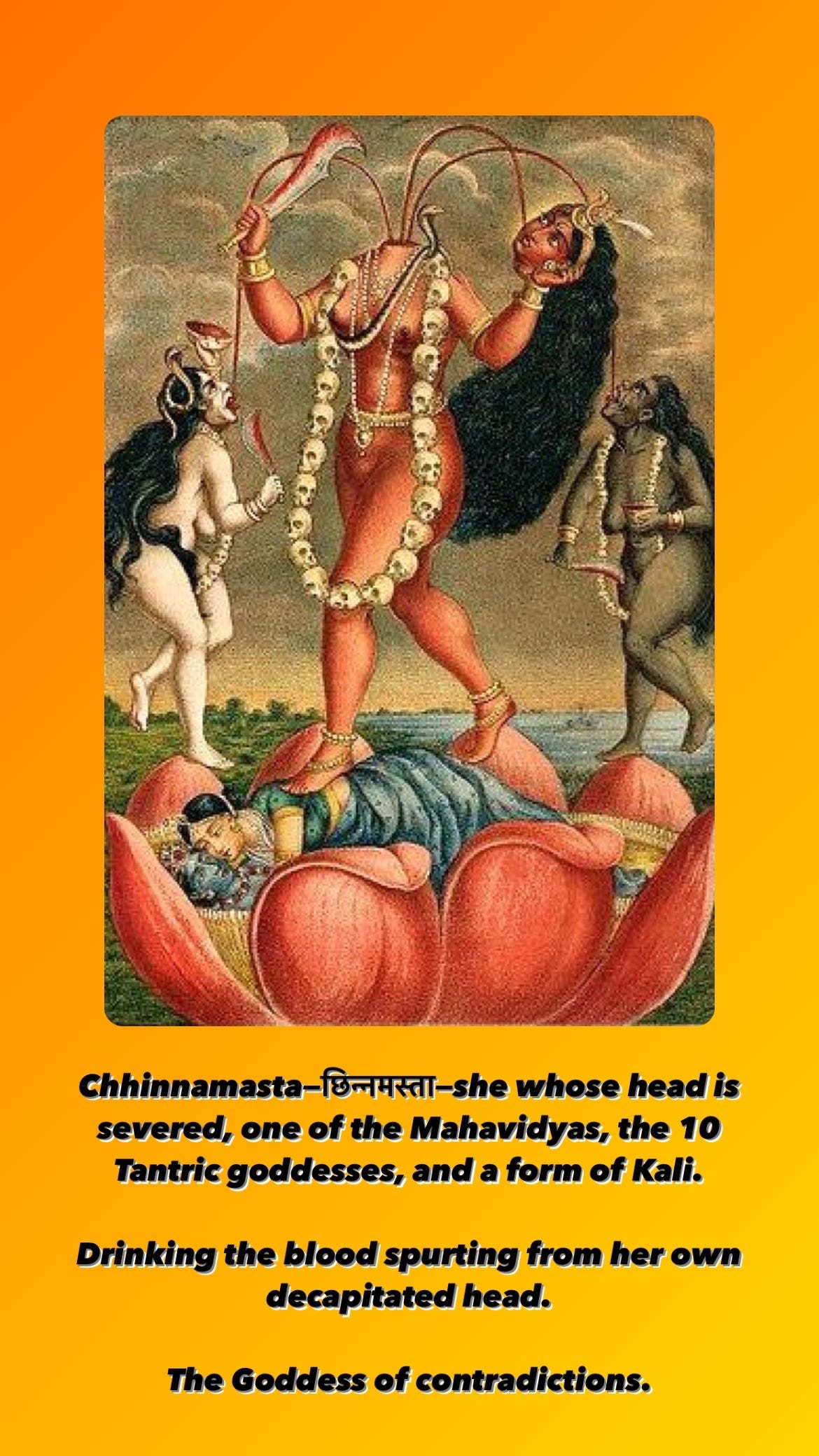
When the first set of repressed memories were revealed, I had a strong impulse the next day to use all the strength of my left hand, grab myself by my throat and uproot my spine from my “defiled” body. It was what I labeled back then, a “suicidal” moment. I’m realizing now that many such death impulse moments have been my somatic encounters with the energy of the Goddess Mother — Kali — this specific impulse was the Chhinamma manifestation.
During the ceremony that presented the layer of suffering containing my repressed memories, I encountered infinite serene rage in my guts — a volcano erupting and destroying the Universe with fire spat out from my eyes, nose, ears and every pore of my skin. I labeled this Rudra energy.
As my childhood trauma emerged, my life partnership wasn’t in a state to support and nourish something so tender and deteriorated rapidly, ending shortly after. As such, I’ve moved mountains of grief through my body. In doing so, I’ve noticed two bodily tendencies that I’ve worked hard to avoid.
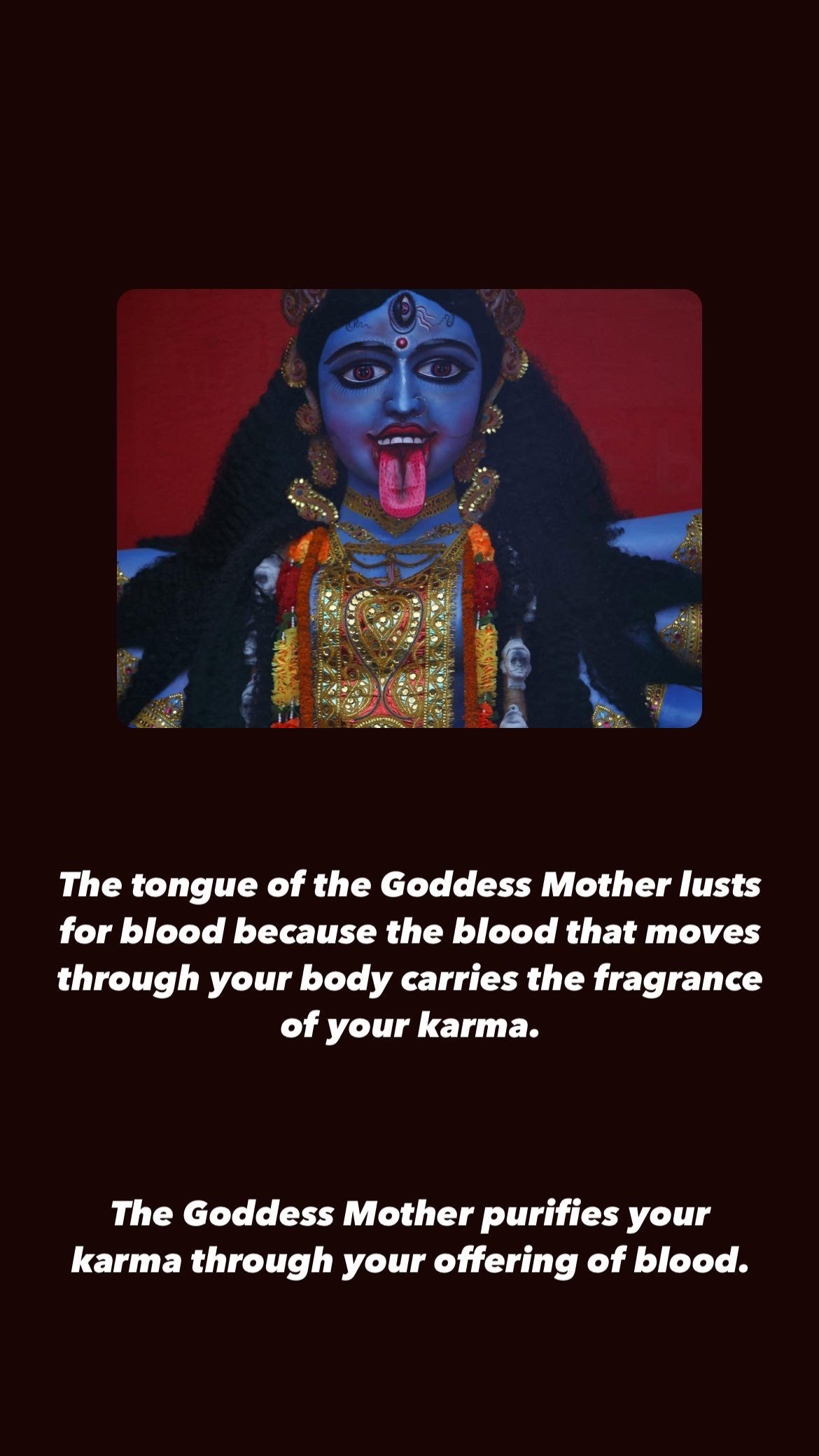
Number 1 is tightening of the throat — an impulse to fight back tears due to temporarily succumbing to the societal conditioning of “boys don’t cry”. The way I have reversed this tendency is to stick my tongue out and thereby removing the tension in my throat and allowing the tears and grief to come out. The more I do so, the more I’ve started feeling a thirst for blood in my own tongue — it’s as if the grief from the abuse makes me cry and then the thrust outwards of the tongue taps into the fierce protective mother feminine that wants revenge for her child — me. But this fierce protective mother feminine isn’t outside of me. She currently lives in my tongue. Kali is often offered blood and the images of Kali show a tongue stained with blood.
Number 2 is collapsing of the chest and a desire to curl up in a ball. This is a tendency to hold the grief. At #ISTA level 1 training in Austin, I learnt a set of emotional release tools. One of them is called “wailing”. It involves standing up/lying on the back/sitting on knees and holding the arms back to keep the chest open, looking upwards at the sky and literally “wailing”. The emotional state to be taken is a sense of “why me, God! why me!” It’s extremely effective in releasing grief energy and not letting it get stuck in the body. When I’m able to switch into that tool as I notice grief emerging, I’m left feeling lighter and happier within seconds.
I’ve combined these two with ample shaking of the body. Trauma rigidizes the body via the “freeze” response. Shaking is key to ensure that when the trauma is getting dislodged, it is allowed to flow out and not freeze up again.
My body was used for sexual pleasure by a few weak men when I was a kid. My original impulse of feeling disgust about my “defiled” body perpetuates the abuse of my body. First they abused me. Now I abuse my body by mistreating it — feeling ashamed of it, binge eating, unhealthy sexual practices.
The solution then is to generate so much love for my own body and being that the desire to self-abuse dissolves in the love and along with it the trauma gets alchemized.
If you’ve noticed closely, I’ve marked out 3 instances thus far where I’ve noticed an energetic phenomenon in myself that is actually represented by a mythical archetype from the Shiva-Kali canon. There’s one more — the mythical origin of Rudra (can be considered to be the first and angriest form of Shiva) was a reaction to an act of #childhoodsexualabuse by Brahma, the Creator.
Therein lies the transition of my spiritual path from Gyan Yoga (path of knowledge) to Bhakti Yoga (path of devotion).
Devotion is self-love projected outwards onto forms that represent subconscious archetypes that are present in each of us.
The notion of common subconscious archetypes is heavily explored in Astrology and Jungian psychology. Each Astrological planet is essentially a part of the human’s psyche and has a trove of myths surrounding it eg. Jupiter and the Greek myths associated with Zeus. All mythologies are essentially a collection of stories about these archetypes of the psyche. What Hinduism (in addition to Ancient Greek religion and many others) has done is that it has deified these projections of the subconscious.
It’s easier to love an Other than to love one Self. If you’ve ever lost yourself and forgotten to take care of yourself in a romantic relationship, you’ve experienced that. Especially more so if the Other is a God figure. Again in romantic relationships, when i have pedestalled my partner, I’ve experienced an upsurge of devotional love towards them.
So Bhakti yoga allows one to love one Self by pouring one’s love on deified Others — specific deified or godly Others whose forms as represented in imagery and stories are archetypes that are actually present in one’s own Self. So when I worship Kali, the fact that Kali’s image has a tongue sticking out with blood on it and my felt the same bloodlust in my tongue, means that at least some of that devotion is also being routed to the part of my own Being or nervous system that’s associated with my tongue. Very practically speaking, I’ve noticed an increased desire to clean my tongue and floss my teeth when I brush over the past few months.
When I realized this, my engineering mind went - wow, that’s a neat hack.
Of course in due course of time in Indian history, this essence of devotion has been lost in pure idol worship minus the effort to place in one’s own body a part of the deity towards whom one is devoting one Self. But this essence can be regained once you get the linkage between devotion and self-love.
This year I’m feeling drawn to exploring the varied esoteric Goddess worshipping sects across the world.