Clashing Frames
On Circling, Inclusion, and the Limits of Shared Reality
Contrasting frames, clashing with each other. A frame is a way of seeing the world. Each of us has a frame, whether we are aware of it or not. One of the foundational exercises in the practice of Circling involves two people taking turns sharing what they notice both objectively and subjectively about each other.
“I notice that your clothes seem very well put-together (from my own aesthetic standpoint), and my mind makes up a story that you care about how you appear. Does that fit?”
The first half of that sentence starts with objective noticing, switches into subjective assessment, and closes with a value judgment—followed by a check-in to see how that “frame” fits the other’s self-perception.
An old Circling teacher of mine described it as an attempt to see the shades of glasses we are wearing, and offer them to each other to try on. A mutual journey of perception and understanding.
Crucial in this journey is the ability to differentiate between what is objective—verifiable with other human beings—and what is subjective—flavored enough by our own conditioning that others might see it quite differently.
In an era where many are developing supersensorial capacities—subtle awareness, energetic sensitivity, trauma-informed perception, intuitive knowing—the boundary between subjective and objective becomes blurrier. What one person experiences as obvious truth, another might not perceive at all.
The conversation on transness has brought us to the breaking point of this tension. Frames are clashing. Which frame you adopt—consciously or unconsciously—reveals a lot about your worldview. The more awareness you can bring to the frame you’re choosing, the more insight you gain into yourself.
At the heart of this cultural moment is the question of shared space, and the principles that underlie how space is shared—individually, relationally, communally, and at the level of the state.
It’s time to revisit the founding principles of our society. Not because they are sacrosanct, but because, like in Nonviolent Communication (a sister practice to Circling), we must understand what values we’re speaking from before we can develop strategies to resolve conflict. Through that investigation, we might even decide some of our values need updating.
If we can’t talk about these conflicts in a principled manner—without resorting to name-calling—then what’s the point of all the money we’ve spent on gazillions of workshops themed on relational intelligence? I say this as someone who’s been guilty of it too. I’ve called folks on the Woke Left “dumb” before. That was a reaction, not a principle.
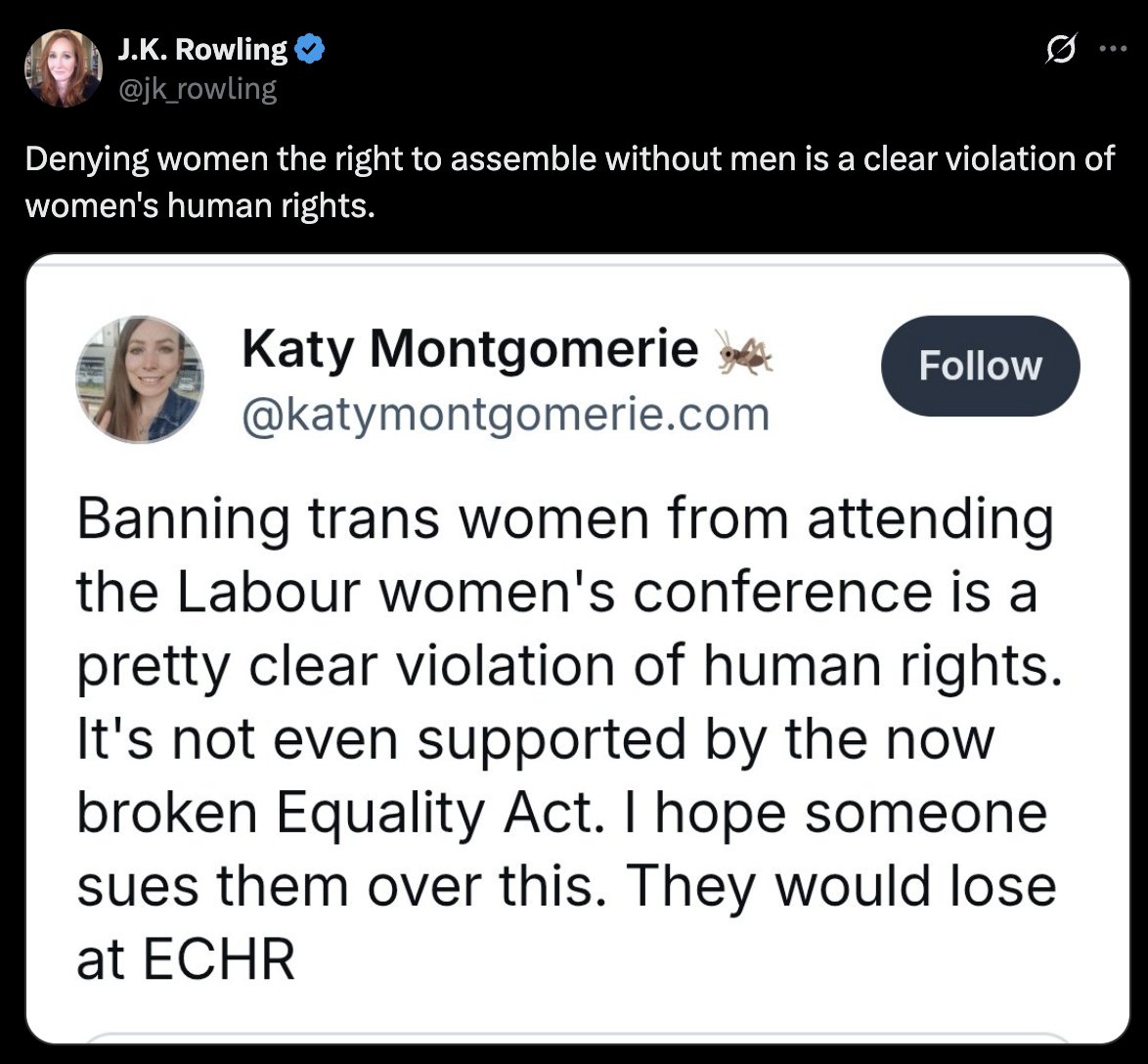
Having said that, my frame aligns firmly with JK Rowling’s here, based on the principle of agency and the right of human beings to gather around shared identity. I disagree with the notion that “inclusion” must apply at every level of gathering.
Should a town be inclusive? Of course. That’s a public civic space.
Should a shop be inclusive? Hmm—there’s nuance there.
Should your house party be “inclusive,” in the sense that you’ll be shamed publicly if you don’t invite someone who subscribes to a particular ideology? Fuck no.
There’s a difference between civil rights and forced intimacy. And part of what’s at stake in this conversation is our ability to discern that difference clearly, together.
I hope that if you are someone who also resonates with JK Rowling's frame, that you'd feel the courage to speak up. You are not alone. Your voice is much needed. You don't deserve to be shamed for sharing what you see.