An Introduction to the Temple Arts
How to worship Desire and cultivate the Fire within your Self
In this essay, I will attempt to put into words a most elusive form of inner work–the Temple Arts. Temple Arts or Temple Culture fits within the realms of Sacred Sexuality. Many forms of spirit work–whether it be within organized religion or outside of it–often neglect, ignore or subjugate the sexual nature of humans. If there's one thing that humans are simultaneously fascinated by and expend tremendous energy ignoring, it is sex. In Sacred Sexuality work, the focus is on cultivating one's relationship to one's sex. In that process, one may find a broadening of one’s conception of what sex is, beyond intercourse.
A core component–the flagship event, if you will–of Sacred Sexuality work is the Temple Night. The participants, Templars. And the culture, Temple Arts. At first glance, a Temple Night can seem like a glorified, fluffed-up orgy or a play party. At some level, that's what it is, a Play Party–a house party where Play is invited, in all its forms. But what distinguishes it, is an emphasis on substance-free culture (no alcohol, drugs), a coterie of humans that are oriented towards exploring their inner connection to spirit, perhaps more so than at the average orgy and an emphasis on consent.
I started exploring Temple Culture a few years ago, primarily through Touch & Play and ISTA. At the beginning, I will sheepishly admit that I was drawn to it for sex. Fresh off the end of a relationship and newly “into spirituality”, an event that dangled the promise of a good fuck while wrapping it under a spiritual cloak, thereby allowing justification against the part of me that held shame about desiring a good fuck (“Hey, I'm doing this for Enlightenment”), felt quite tantalizing.
Any event is a Container, it contains a space for exploration amongst the participants. The flavor of the contained space is determined by the boundaries of the container–by what is permitted and what isn’t–and the rules of engagement–the language and values upheld and promoted by the space holders, colloquially referred to as the hosts or organizers. The Temple Night is a Container where a group of humans attempt to relate to and connect with one another while upholding consent and communication in a space that is rid of typical societal restrictions on what humans can do in social spaces.
What is it that drives a human to connect with another?
What is it that drives a human to move?
It is Desire.
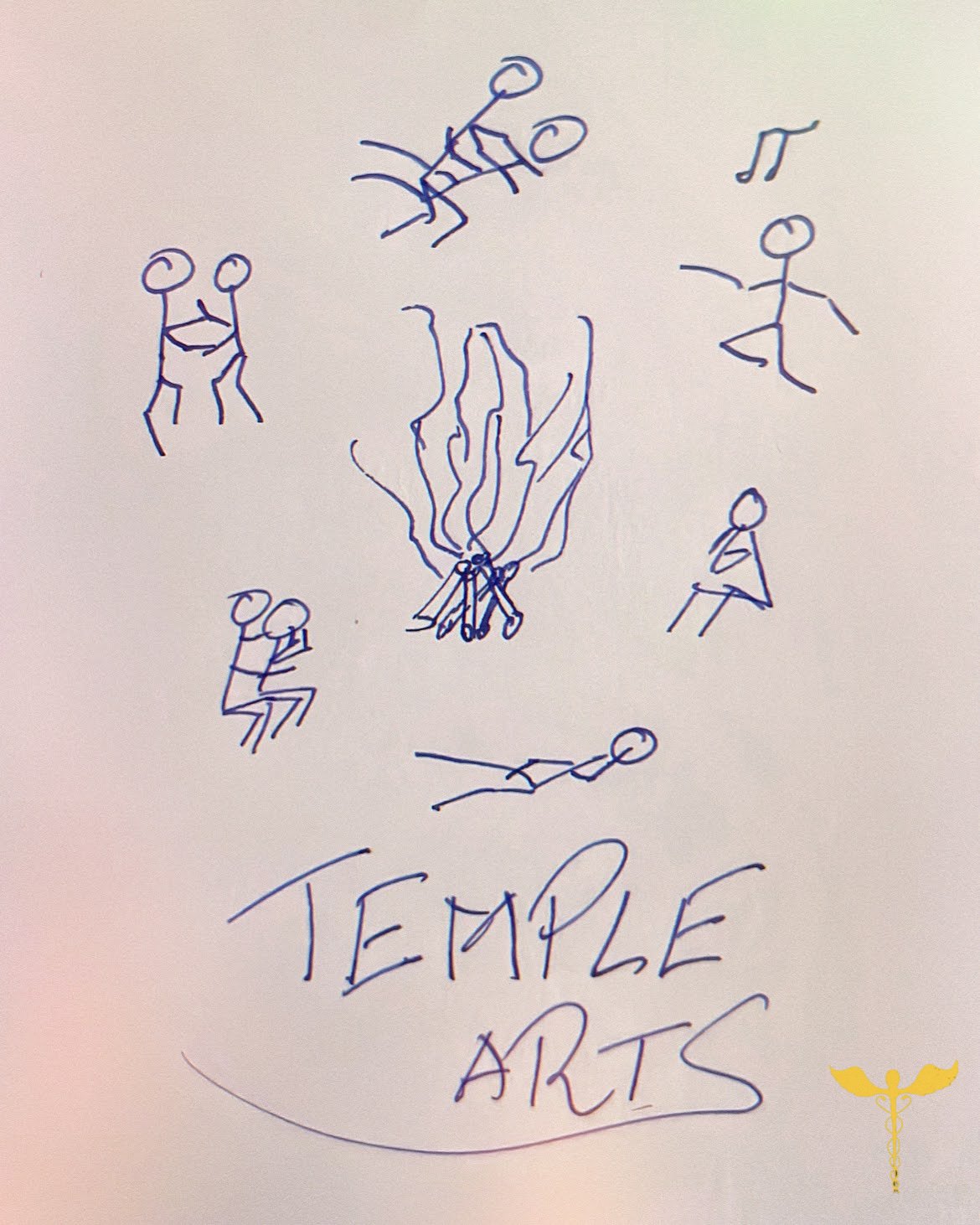
Without Desire, we would each be still. Perhaps like Shiva meditating in a cave or like the mountain that the cave is carved into. But then even mountains are known to move ever so slowly, and Shiva is known to engage in adult sport ever so often.
Desire is our individual connection to the element of Fire within.
In a Temple Night, the invitation is to connect with one's truest Desire and attempt to make it come alive with oneself or others.
In a Temple Night, the typical restrictions that exist in most group spaces are lifted.
Typical restrictions like–thou shalt not have sex with another, or–thou shalt be clothed.
If you were to act regularly without succumbing to these common societal restrictions in most common social places where humans gather–like a pub, a movie theatre, a church or a house party–it would be reasonable for you to either do so in secrecy or be ignored, mocked, jailed, labelled a lunatic, or even worse, stoned to death, depending upon where you attempted this.
Can you imagine what it might be like then to be Witnessed, with reverence, celebrated and offered helpful feedback and reflections? That is what Temple culture attempts to cultivate.
Sex is perhaps the only sport where all the training and performance tends to happen in secrecy. The secretive tendencies around sex are also why sexual abuse is so rampant.
A nerdy side note–for those of us who grew up on WWF/WWE, a metaphor that comes to mind is what the state of martial arts would be if the only martial arts one witnessed was World Wrestling Entertainment where everything is scripted and all martial arts fights happened in secrecy and every Dojo trained individuals 1-1. That is the current state of sex – WWE being equivalent to pornography. It’s entertaining to watch, but it spreads misinformation like the number of punches one can actually take to the face and the false execution likelihood and impact of a move like the People’s Elbow.
The Temple Night is a Sex Dojo.
At a Temple Night, you may notice a lot of erotic exchange or a focus towards creating an erotic exchange, especially so if the participants are newbie Templars, even more so, if you are a newbie introspective who hasn’t yet figured out the distinction between what they see and what they project ;) Leaving your projections aside for now, what else would you expect though when you put a sexual being who spends most of their time in group spaces where sexuality is denied and repressed in a space where it is celebrated instead? But after the newness of it wears out, one may realize that a Temple Night is about Connection, in all its forms. For an experienced templar, a Temple Night might feel like an extension of a house party with close friends and community members, where Erotic Play is one of the offerings at the Buffet of Connection. Meditation, dance (solo or partnered), play wrestling, Shibari, flogging, singing, massage, cuddled conversations, eye–gazing, and anything that You, connected to the Fire of your Desire, dreams of–being the other offerings.
One might slowly find one's way to ritualizing connection – creating small rituals to connect with another human being and through that develop a new relationship with the concept of Ritual itself. In this journey of feeling the pulse of Desire in one's own body and heart, one might find oneself in reverence of one's own Body. The Body being the Temple of one's Consciousness. This journey of building reverence to the Body, one's own and thereby another's, is the essence of what Temple Culture is all about.
The Shadows
The Mahabharata is one of the two main epics of Hindu culture. It is a royal family drama for succession to the throne between two sets of brothers, Pandavas, the heroes and the Kauravas, the anti-heroes. Arjuna, of the Pandavas, is the greatest Warrior who has ever lived. At the start of the great battle between the Pandavas and the Kauravas, he is in a chariot steered by Shri Krishna, an incarnation of the Vishnu, God Himself on Earth. Arjuna looks across the battlefield towards his cousins, uncles, grandfathers, great grandfathers, teachers and lays down his arms. Lamenting about having to kill his family and for what?
In that moment, Shri Krishna exhorts him with a poem–the Bhagavad Gita–the Song of God–that as heartbreaking as it may be, it is his duty in this moment as a Warrior to bear arms–his Dharma to do so. It is quite an unusual text as far as religious texts are concerned, quite complex, nuanced and prone to misinterpretation.
There is a poem from the Tao I Ching which elucidates what it means to be a heart-open Warrior, in a vein similar to that of the Gita.
Weapons are the tools of fear
A decent man will avoid them
Except in the direst necessity
And if compelled will use them only with the utmost restraint
He enters a battle gravely, with sorrow and with great compassion
As if he were attending a funeral
Many have attempted to understand and felt inspired by the Bhagavad Gita. Some, like the SS leader Heinrich Himmler, who used the Gita to exhort Nazi soldiers and who was the chief architect of concentration camps, failed miserably to grasp its essence.
Such is the power of the Shadow. If one is closed in one's heart and untrue to oneself, the Shadows of one’s Self can twist and contort any wisdom for heinous evil.
In the first half of this essay, I waxed eloquent about Temple Culture. What is the shadow side of it?
It is the dilution of ancient wisdom in service of perpetual succumbing to the Desires of the flesh, thereby disconnecting one from the deep profundity that the wisdom offers.
In the Lam Rim Chen Mo, the ancient Tibetan Buddhist classic, Je Tsongkhapa talks about the trap of the realm of Pleasurely Heaven that the Gods inhabit. In this realm, there is so much constant access to Pleasure that one gets lost and disoriented in it, losing all direction for life. Over time, the pleasure doesn't feel as good, and the complete absence of Suffering removes all incentives for inner work. The inner work needed to alchemize one's karmas. After one's time in the Heavenly realm is over, one descends back into the lower realms that are full of horrific misery.
In a nutshell, that would be the Shadow side of Temple Culture. People bouncing around from one glorified fuck-fest to another, fooling themselves that they are working with their spirit, while being completely disconnected from the longing of their hearts. That doesn't have to be your experience, but it could be.
That's all today on the Temple Arts.
I would recommend Touch and Play and ISTA to get a flavor of it, or perhaps your local “tantra festival”.