To Love Through Torture
How Christ’s Story Stands Alone Among the Ascended Masters
Roots and Wounds: Where I Come From
I’ve been thinking a lot about Jesus Christ—how his story contrasts with other major figures in what you might call the “Ascended Masters” category. The ones that come to mind for me are Rama, Krishna, Buddha, and Muhammad.
I’ve had a positive personal relationship with Rama and Krishna growing up, and more recently, especially with Rama, Krishna, and Hanuman. Chanting their names has carried me through many a panic attack, particularly in the aftermath of sexual trauma upheaval. These names, these stories—they’ve been anchors.
Islam, on the other hand, lives in me with more complexity. I grew up in 90s Mumbai, a time scarred by Islamic terrorist attacks. I come from the Marathi community, where the story of Shivaji—our warrior-king who stood strong after centuries of Muslim conquest—runs deep. So yeah, my relationship to Islam is tangled.
But what’s been really alive for me lately is how, among all these ascended masters, the story of Jesus stands apart. It’s one of the most recent, the most torturous, and one that begins from the lowest privilege.
Stories That Live and Breathe
Rama and Krishna? Their stories are so ancient that their historical reality is hazy. I do think they’re true stories—but what does it even mean for a story to be true? I think stories have life of their own. The more they’re told, the more they’re heard, the more they live. And in that sense, the stories of Rama and Krishna are very alive. So many people have carried those stories for so long that they’ve shaped the spiritual field itself.
Now, whether Rama and Krishna were humans, or whether these are beings whose stories unfolded in spirit realms visible to ancient humans attuned to those planes—I don’t know. Their distance from history leaves that question open.
The Buddha’s story, by contrast, is much more recent. I feel more confident that he was a real man who attained phenomenal spiritual realization. Enlightenment, to me, means a conquering of the reactive drive to be reborn—not avoiding death, but meeting it with full clarity. I believe no one can die until their time has come, and nothing can save you once it has. Really rooting in this leaves no fear of death—none.
Both the Buddha and Jesus conquered death in this way.
Born Low, Bled Hard: What Makes Jesus’s Story So Singular
But the Buddha was born into incredible privilege—a prince in a powerful kingdom. His journey began in overindulgence, in being so soaked in wine, food, and women that he got sick of it. He chose the spiritual path from a place of saturation.
Same goes for Rama, Krishna, even Hanuman—they were all born into royal privilege. Rama felt pain in exile, yes, and when Sita was kidnapped, but he was still a king-to-be. And contrast all that with Jesus.
Jesus was born to a shepherd. His family fled to Egypt to escape violence. He wasn’t born with access or status. And that makes the arc of his life stand out in a really visceral way.
Then there’s the nature of his suffering. Jesus was welcomed as a King by the people of Jerusalem. And days later, after he had already been betrayed by Judas, those same people spat on him, mocked him, and stood by while he was tortured. There’s something devastating about that turn. He wasn’t just killed. He was paraded, humiliated, and nailed to a cross—a punishment meant to be both excruciating and public.
I was at Revol Church this week, listening to the pastor walk us through this story again, and what struck me most wasn’t just the cruelty, but Jesus’s response to it. The level of presence it must have taken to stay open in the face of that—to still love, to not collapse into numbness or bitterness—is astonishing. So many of us either disembody to escape pain, or we become so identified with the pain that we lose ourselves in it. But he seemed to do neither. He felt the betrayal, the humiliation, the physical agony—and he still loved.
To feel the pain and still not take betrayal and torture personally—to love anyway—that’s astonishing.
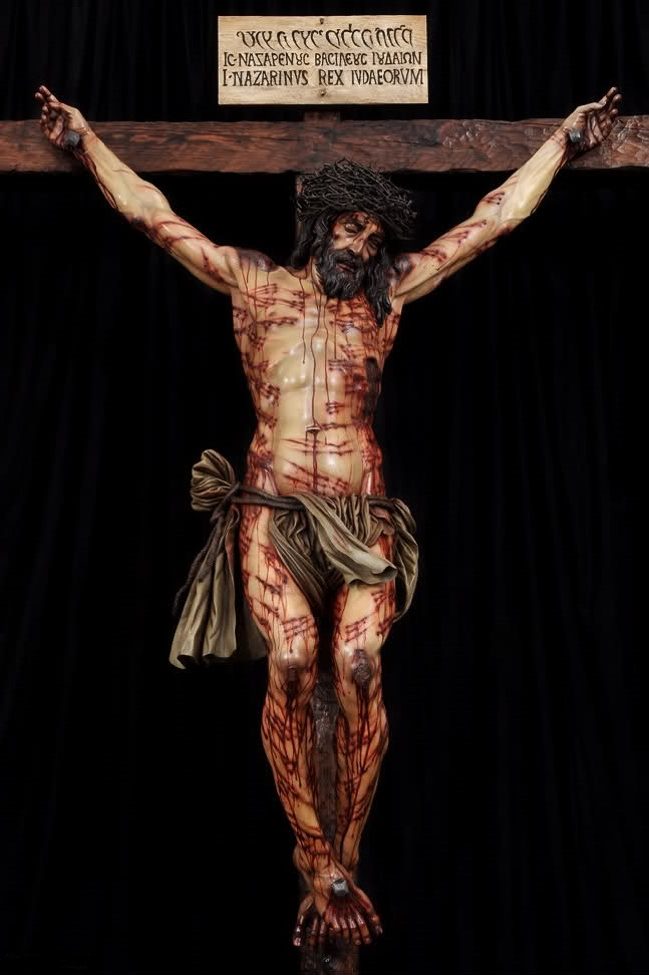
Torturous Love
There’s something about this story that mirrors a dark arc in my own life. Early in my healing journey, I made a series of posts I called “Loving Torture”—poetic torture fantasies directed at one of my perpetrators. One of them imagined sadistically slicing the face off of one of my rapists—because his face had become so entangled with the memory of my own rape that it enraged me to think of him. And at times, my mind would be flooded with his face driving me crazy with rage. The specificity of his features had become too tightly tied to the trauma. And in my artistically dark imagination, if I could peel away the skin and see the flesh and bones underneath, he might look like everyone else. He might look human. Because underneath our faces, we all look more or less the same.
That fantasy was an artistic attempt to make sense of something unspeakable. It was a way to channel the longing for peace inside the messiness of trauma. A twisted expression of something honest: the desire to see his humanity, and to reclaim mine.
That energy lives in a lot of sadomasochistic kink too, which I was into at the time. But Jesus’s story flips it. It’s not about torturing with love—it’s about loving through torture. And I’ve wondered: if I had actually gone through with my darkest plan, to kidnap and livestream the torture of this man—if I had done that, could he have looked at me with love? What if he had done the spiritual work? Could he have met me with Christ-like eyes?
That question undoes me. It humbles me. It draws me back into the gravity of Jesus’s story. The more I’ve explored it, the more remarkable it feels—not just intellectually, but viscerally. It’s touching me. Inspiring me. The Buddha was born with some good past life karma. He had a good start in his lifetime to move towards Enlightenment. Jesus seems to have made it all happen in a single life. And therein is born, I think, the Christian emphasis on this being the only life. No do-overs. No karmic rollover. Just now.
It fits the way I see death. There is no guarantee of later. There is no next life, at least not one you remember. And even if there is, this is the only moment you’ve got. The only one you know. That Christian urgency—repent now, love now, return now—speaks to me deeply.
Sin & Karma
In India, where we’ve got lifetimes to spare, the cultural humor tends to lean the other way. People joke, “This life is for partying, I’ll meditate in the next one,” or, “I’ll clean up my act after retirement.” There’s this casual assumption that you can defer your soul’s work because you’ll have another shot down the line. But honestly, that mindset comes from a poor understanding of karma. Because by ignoring your soul’s work now, you’re not just skipping homework—you’re actually sowing poor-quality karmic seeds that are going to mature later, probably with interest.
And this is where I start to see how the Christian concept of sin maps over to the Buddhist understanding of karma. In Buddhism, your past karma is always ripening moment to moment—you’re constantly receiving the fruits of past action. But the critical thing is, in that moment of receiving, you still have a choice. How you respond to the karma that’s fruitioning determines whether it alchemizes and dissolves—or whether your reaction just sows new karmic seeds and creates further entanglements. If you lash out, numb out, or try to escape, that reaction itself plants new seeds. The cycle continues.
I think this is what Christians mean when they talk about sin—not just breaking a rule, but acting in a way that furthers your entanglement with suffering. Are you responding to life in a way that liberates you, or in a way that drags you deeper into misery? Because depending on how you respond, you’re either dropping into a lower realm of existence or moving toward something more spacious. Buddhism lays out 27 different realms of existence. Christianity simplifies it—heaven or hell—but the logic feels related.
A Closed Heart, A Shared Pain
I need to name my hesitance with Muhammad. As I said earlier, there’s complexity here—my upbringing in Mumbai, the trauma tied to terrorist attacks carried out in his name. And I haven’t read the full Quran. I do think it’s okay to speak without full certainty, to name where my blind spots might be. Certainty is fleeting anyway.
I often apply a litmus test: what orientation would I take if I were looking through the lens of childhood sexual abuse? And the answer I find there is: share even when you’re uncertain. Because silence—self-doubt—is what allows harm to continue. That’s what keeps people from stepping in and stopping it.
So here’s what I feel: Muhammad doesn’t seem to me like an ascended master. He seems like a man who struck a powerful spiritual deal. But I don’t see the light in him. I see a man who took a six-year-old wife (after becoming a Prophet) and consummated the marriage when she was nine. A man who commanded armies, not in defense, but to spread a religion. That doesn’t feel right to me.
Yes, Rama also waged war—but that was to rescue Sita, not to spread doctrine. It’s not the same. And sure, maybe I’m wrong. Maybe I’m missing something. Maybe I’ve been shaped too much by the trauma of growing up in a terror-ravaged city.
But when I think about reading the Quran, I notice my heart closes. I can’t receive wisdom when my heart is closed. I could read it, memorize it even. But I wouldn’t hear it.
It reminds me of how some people see Trump—how the pain or disgust they feel keeps them from seeing the Trump I see. And so I’ll say this: if you have felt the heart of the Prophet Muhammad, if you do feel his light, and want to share how to access it—I’m open. Truly.
And lastly, yeah, I have to laugh at myself a bit here. I moved to North Carolina, started feeling aligned with President Trump, became MAGA, bought a pickup truck, and now I’m exploring Jesus Christ. It feels like a caricature. If you’re seeing the caricature and feeling amused—or concerned—know that I see it too. I’m laughing with you.
But the draw is real. The story is real. The love is real.
And I’m listening.