On Asymmetry, Heartbreak & Duels
The story of Évariste Galois, Mathematician & French revolutionary, shot dead with a broken heart at 20 after laying the mathematical foundations for explorations of Symmetry
It’s been 3y now that I’ve gotten back to studying Physics again. I loved it in high school but did not even consider it as a possibility for undergraduate because it didn’t pay. At different points over these 3y, I considered enrolling for a graduate program but I’ve really settled into the joy of self-study, powered by easy access to syllabus and amazing quality textbooks via the Internet. At a school, I’d be answerable to an arbitrary time frame to absorb a specific subject. When I study on my own, I can sit with a page for months to let it digest into my system while allowing my true curiosity to weave me in and out of multiple related disciplines. What’s lacking sometimes is a community to share thjs enthusiastic exploration with but oh well 🤷♂️
One of the textbooks I’m using is called “Physics from Symmetry” written by one Schwictenberg who wrote the wonderful guide “Teach Yourself Physics”—a handbook of sorts for self-study of Physics. What I liked about the handbook is that it lays out a high level overview of the entire subject along with recommended textbooks for each piece and important questions that one should be able to answer to entertain a certain level of mastery over that piece.
This textbook builds up the mathematical foundation for all the existing theories of Physics—modern and before—on top of the Mathematics of Symmetry.
The Mathematics of Symmetry is a discipline that studies transformations that leave a system invariant—given a certain observable system, what changes can one make to it so that from the observer’s perspective, there is no change to it.
It’s a fascinating mathematical journey that brought us to study Symmetry.
People have been fiddling with numbers for a long time. Exploring their relationships with each other. Pythagoras’ theorem being a classic example—exploring how the squares of two numbers sometimes gave the square of a third one. Most of this fiddling around happened very visually. When most people (Math nerds) hear Pythagoras’ theorem today, they’d rattle off “a^2 + b^2 = c^2”. What they don’t realize perhaps is that the language to describe mathematical results in the form of symbols (a, b, c are symbols) arrived in the mid 1500s while Pythagoras lived before Christ. Back then, mathematical results were either described in words (like how I talked about the result earlier in the paragraph) or pictorally (the original proof of Pythagoras’ theorem involves moving actual squares around—like one might in Origami) or by listing out groups of numbers (like you see on ancient tablets sometimes).
The absence of symbolic language meant a proof for the roots of a quadratic equation—again bringing up images of the symbolic answer in the eyes of the average Math nerd—took up 5-6 pages of verbose description by words instead of the half page solution one can write out symbolically.
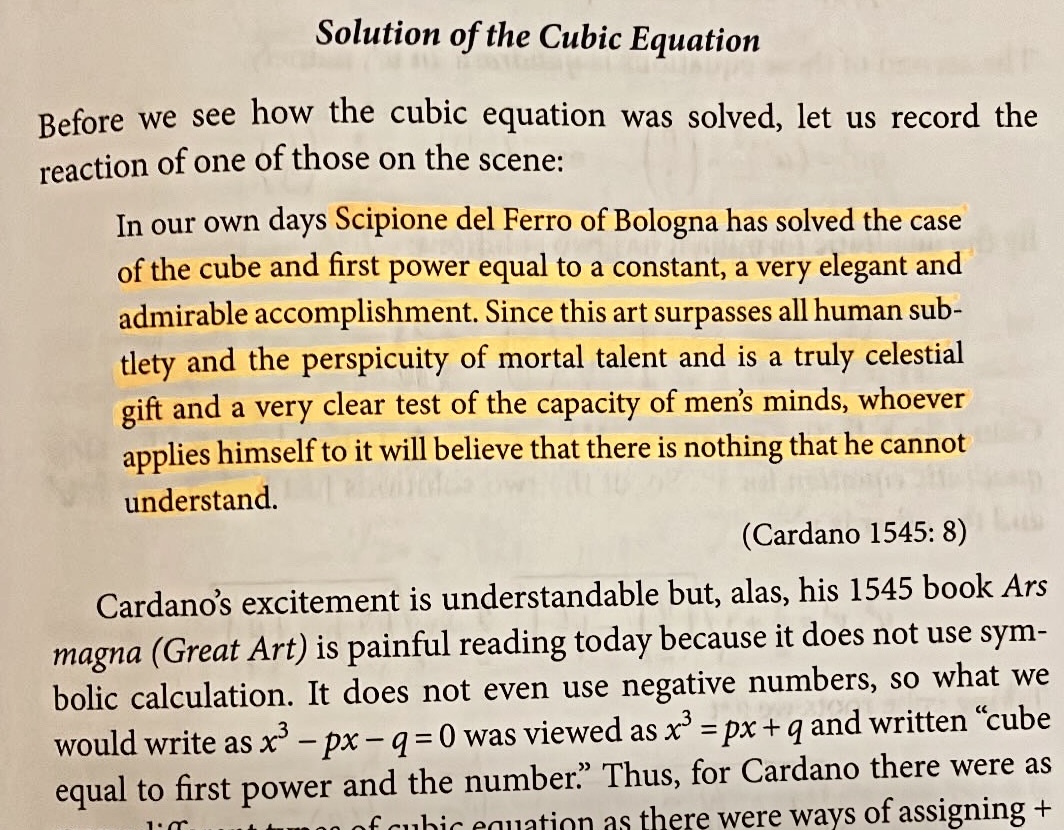
The beautiful book “The Story of Proof” has a direct quote from an Italian mathematician in 1545 CE celebrating the “celestial gift” of having found the roots of a cubic equation and how anyone, who could grasp it, could understand everything. I wonder what he’d think of an era where most people who did not detest high school math would find it quite benign to solve a cubic equation.
It cannot be understated how significant it was to develop the language of symbols to describe mathematics. Now a result expressed in a Sanskrit verse by Brahmagupta from 500 CE could be easily compared with a result by a Renaissance era Italian mathematician by a French teen who held strongly revolutionary Republican ideals and spent a lot of his teenage years in jail, studying mathematics.
One such French teen from around the time of the French Revolution was Évariste Galois.
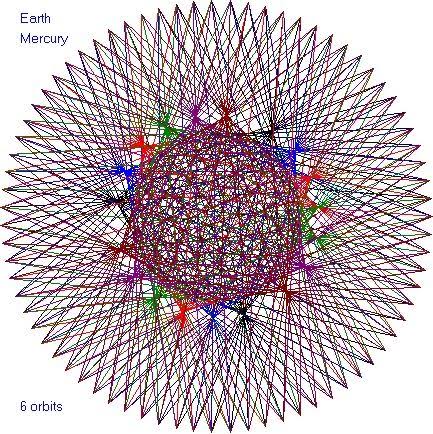
He was fascinated by the exploration of Symmetry via Mathematics. At first glance, I remember finding it quite ridiculous that all theories of Physics could be derived from arguments about Symmetry. It seemed quite plainly obvious to me that the world is filled with Asymmetry. All of the time I’ve spent staring at trees seems to uphold the belief that Asymmetry is at the heart of the cosmos. I wondered if the physicomathematical obsession with Symmetry was due to it being dominated by men and masculinized women. Order appeals to the mind. Chaos, the feminine principle, feels scary. Even in my studies of Hellenistic Astrology, a most orderly, beautifully symmetric attempt at organizing the mythos of the cosmos, at some point, asymmetric cracks begin to appear (with the Decans, for example). If you’ve seen visualizations of the relative orbits of any two planets around the Sun, you might have noticed they form wonderful geometric patterns that never complete but each revolution is just slightly offset from the previous one and this slight offset births complex beauty. I took it as a possible sign that this emphasis on Symmetry was what caused Physics to stumble at the presently inaccessible depths of grasping Nature.
This was before I realized that the Mathematics of Symmetry deals with symmetric “transformations” rather than visually observe symmetry at a given point of time. So what changes can I make to keep the system the same under a pre-defined sameness criteria rather than how are parts of this system congruent to other parts of this system around an axis of symmetry at a given point of time. That opened me up to curiosity again from a place of reactive dismissal. This has oft been a theme in my life. Expressing reactive dismissal to allow that energy to move while staying open to being incorrect in my dismissal of what I’m perceiving. Staying open to the possibility that what I’m dismissing might be an incomplete picture in my perception, which then is worth being dismissed so I can see better and fuller.
Back to the history. So we had people fiddling with numbers, then someone realized it’s better to describe this fiddling in the language of symbols and so people started fiddling with equations. People were also fascinated by multiplication of numbers with themselves—squares, cubes, and so on—and then in reverse, taking the square root, the cube root and so on. These latter operations referred to as “radicals”. Quite an apt label for an operation that fascinated the radical revolutionary Galois.
Now in fiddling with equations, a bunch of work was done to look at the relationship between the “co-efficients” of equations and the “roots”. For those of you who are not aware, given a general equation “ax^2 + bx + c = 0” (the classic symbolic representation of the quadratic), a, b, c are the “co-efficients”, and values of x where the equation holds (ie. the left hand side actually becomes zero) are the “roots”—typically denominated as x1, x2. In this work, people noticed symmetries in the relationships between the coefficients and the roots. And simultaneously, they noticed that when you introduce a “radical” operation like the square root, it “breaks the symmetry”. In idle time spent in prison, which he had plenty of, Galois wondered what it was that maintains Symmetry and what causes Symmetry to break.
He developed abstractions to mathematically explore symmetry—now known as Galois Theory, which became the foundations of Group Theory, which is simultaneously the mathematical foundation of Physics and Information Theory—the latter powering technology that’s allowing you to read these words right now.
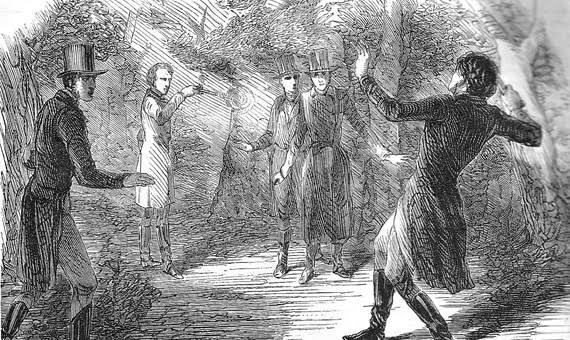
At 20y, his heart broken by a young lass, he got challenged to a duel that he chivalrously (drunkenly? He was goaded to drink for the very first time in prison) agreed to. To “avenge her honor that another has compromised”. He ended up getting shot in the stomach and bled to his death.
My ignorant yet plausible read of the situation is that she dumped him for another dude (may be she was not interested in convicts and yearned for some stability? How dare she!) and he couldn’t stomach it and a bullet helped land the message home instead. Plausible in the same vein as the plausibility of Mary having cheated on Joseph.
Oh the self-delusions that men indulge in to hold on to the hope that the woman they are attracted to, is not attracted to anyone else. Yes, little boy, it’s only you, special you, that sets her loins on fire, no one else. Before you, after you, definitely NOT alongside you.
His funeral ended in riots.
If you are a Hollywood producer looking for the next “A Beautiful Mind”, look no further.
DM me.
Pictured:
1. Quote from “The Story of Proof” celebrating the discovery of solutions to the cubic equation. See towards the end how a cubic equation was described in words. Now imagine an entire Mathematical proof written out similarly. That was reality pre 1600 CE
2. A simulation of the relative orbits of Earth and Mercury. If it was symmetric, the figure would “close” at some point but this complexity stretches ad infinitum. Every third time or so, Mercury comes tantalizingly close to where it was 3 orbits ago, teasing a closure but actually perpetuating the beautiful agony. It’s okay if it brings up grief from a past on-again, off-again. You have my sympathies.
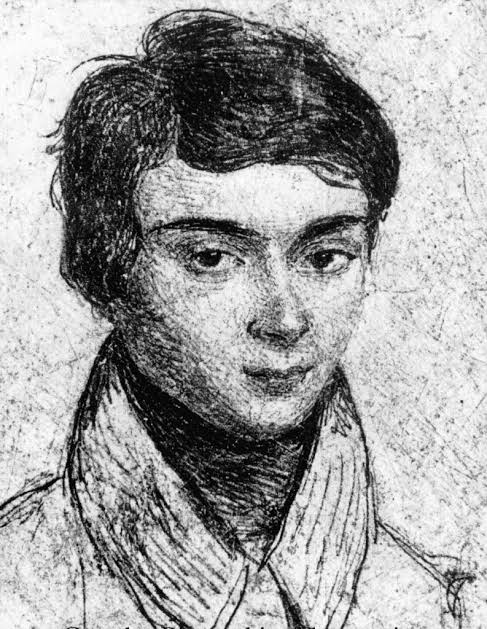
3. Évariste Galois
4. Évariste Galois, shot