The Creator is the Prison Master
On the design of systems meant to imprison and how it all began
The building block of an imprisoning system is a punitive rule.
A rule is a verbalized expression of what should or should not be done. A rule is framed around your agency, seemingly with the intention of limiting it. Can there be rules that expand your agency? I don’t know.
When your actions dishonor the rule, a punitive rule offers punishment. Punishments put further limitations on the possibilities of your expressions.
A system designed to imprison relies on a set of punitive rules.
Every rule creates a boundary. Between the kind of actions that honor it and the kind that dishonor it.
This boundedness flows directly from the verbalized nature of rules. Words, inherently, create a boundary—between what they mean and everything else.
Now, words are just shapes without subjective interpretation.
Humans not only have the capacity to subjectively perceive, but also the capacity to expand the range of their subjective perception. Infinitely so.
There are innumerable humans with their own distinct subjective perception, each having the capacity to expand and morph that perception.
It seems impossible to fully compare and contrast what you perceive with what another person perceives.1
On account of the variety of humans that have existed, exist and will exist, a word makes itself subject to an infinite range of subjective interpretations.
It is impossible to have a word that means exactly the same thing to all humans who read it.
On account of the verbalized (expressed in words) nature of framing rules, the boundary created by the rule has a gray zone.
The enforcement of a rule relies on consensus around its meaning. Complex judicial systems are born to navigate the gray zone inherent in the structure of a rule.
The biases and preferences of the judicial authority influences whether your action is in adherence with the rule, in violation of it or somewhere in the gray zone.
I hope that nothing that I have described above is experientially new to any of you. We have all been subject to imprisoning systems. They are all around us.
Imagine being in high school, there is a teacher who is chill about you coming late to class and there is another who is very strict about it. Same punitive rule, different levels of enforcement.
The authority in charge draws a line somewhere in the gray zone of a rule. If the line drawn falls on one end of the gray zone, the authority feels gracious as it enforces the rule. On the other end of the gray zone, the authority feels dutiful & righteous as it enforces the rule.
In both scenarios, the authority and those who have made themselves subject to it have surrendered their agency to the imprisoning system of rules, which could turn on them at any point.
I had the most vivid direct experience of this phenomenon when I got a notice in my email saying that my Green Card was cancelled because I did not respond to evidence the USCIS had requested in a notice sent to the wrong postal address and immediately, I started accruing what the US immigration system calls “unlawful presence” days.
As I write this, I am on unlawful presence day #38. This happened a year after I had righteously supported policies that called for enforcement of legality with respect to immigration.
It has been a humbling experience, to say the least.
It has brought clarity to me about the inherently oppressive nature of a system of rules.
As Jesus called me a little over a year ago, I explored romantic relating within the guidelines of Christian culture in Western North Carolina. I tried out dualistic rules of proper vs. improper engagement with women before vs. after marriage.
In Christian group gatherings, I’d ask men and women how they oriented towards the concept of sex before marriage. Where they drew the line. Was it at kissing? Long hugs? Being naked together? Oral sex? Anal sex? Vaginal sex? Hot dancing on the dance floor? I’d temper my languaging to my sense of the capacity of the human or the group to handle overtly expressed questions of a sexual nature.
I saw very clearly both the gray zone of a cultural rule and the rigidizing fears humans carry about violating the rule.
Earlier this year, I felt called to reading the Old Testament start to finish. In the Book of Leviticus, Yahweh, the God of the Old Testament, smites Aaron’s sons to ashes because they burn the wrong kind of incense in the Temple and commands Aaron not to mourn.
Rule→Action→Interpretation→Violation→Punishment
My heart hurt for poor Aaron! I couldn’t help but see the parallel with a modern day father whipping his son with a belt and asking him not to cry.
I had never really tried out a verbalized moralistic system of relational rules before. As I dated within this system I had adopted for myself—emphasizing minimal physical touch and conversations about future alignment—I found myself falling in love with the only woman who I had not placed within my mental prison.
The kind of love I felt for her was one where my permission field for her was the most expansive it has ever been for a woman that I have felt attraction towards. Very little possessiveness possessed me compared to past romantic encounters. My experience of the deepest heart-open spacious love has often lacked jealousy, that Yahweh so proudly proclaims throughout the Old Testament.
Permission Field is a concept that I was introduced to, via the writings of Om Rupani. I want to share relational space with humans where we get joy out of expanding our permission fields for each other.
Where I find myself in allowance of them doing what they are drawn to do and curious as to what drives them to do what they do.
Where I get joy from the surprising nature of the actions that they choose in relationship to me, while also feeling the depth of the care their heart holds for me. Isn’t that why we get in relationships? To be surprised by the agency of another human.
In this relationally expansive permission field, life becomes a buffet of delicious options and the internal emotional landscape correspondingly broadens to cover a wide range of feelings.
Sometimes, when we forget the joy of an expansive permission field, someone else’s actions may reach a tender part within us and we may react with annoyance, control or anger. I have been there. In those moments, I have forgotten that the same individuated instinct in another that can create tension of a kind that I don’t like, can also create tension and release of the kind that I do like.
In an expanded permission field, the body itself breathes easy. The body feels so expansive.
The expansive ease of a breathing body is quite at clash with the design of a punitive rules-based imprisoning system.
I learnt this directly as I noticed my heart escape the dating rules system I had set up for myself.
Even the rewards in such a system seem designed to be the carrot that keeps you locked in, so the system can whack you with a stick when it wants.
The forces that promote the systems of imprisonment seem to not enjoy an expansive permission field. And such systems are everywhere!
From prisons, to public schools, to abusive relationships, to Church-based communities, to woke crowds, to Capitalist corporations, to authoritative Communist nations, to where you can and cannot walk on a street and what you can or cannot do at a stop light or sign.
Why is that the case?
The best answer I have is that this is how the world was designed. By the Creator.
For me, this frame resolves a few different questions I have sat with:
- Is God in the Old Testament the same as the Heavenly Father that Jesus refers to in the New Testament?
- Is the escapist pathway of liberation from the cycles of life and death that Buddha and Hindu mystics describe different from the liberation that Jesus offers?
- What are the origins of childhood sexual abuse?
- What is at the root of the seeming control of the Israeli government on the US?
The best explanation I have found is the Gnostic take on Genesis. Our material world was created by an ignorant deity. In Gnostic texts, he is called Yaldabaoth. He presents himself as Yahweh in the Old Testament.
Yaldabaoth was birthed by his mother, Sophia, in rebellion and without consent of her partner. To hide him away, she placed him on a throne and covered him in a cloud—the cloud of Glory motif that is commonly seen in the OT.
Yaldabaoth created this material world, starting with the simplest version of a prison.
A garden in Eden, with one punitive rule—do not eat the fruit of the Tree of Knowledge of Good and Evil.
Inspired by the perfect human who existed before him, Yaldabaoth created a fallen version of this human, Adam and then his female counterpart Eve. Adam and Eve were created by Yaldabaoth in his own image, inspired by the perfection of the perfect human before him.
This is the source of the inherent duality in humans. Good vs. Evil instincts. It doesn’t matter what your spiritual or religious orientation is, each of us has felt this dual tug within us. Have you not?
We get the very human trait of perfect love from the perfect human before the Creator God, and the ignorance (which is the root of evil) from the Creator, himself.
Ignorance is the key quality associated with Yaldabaoth. When I look around with an open heart, I see ignorance everywhere.
Ignorance is the root of racism.
Ignorance is the trait that represses sexual trauma.
Ignorance makes us hurt those we love.
The two qualities that unite humans all around are Love and Ignorance.
This is captured very well in one of the seven statements attributed to Jesus while he was being crucified on the cross—
Father, forgive them for they know not what they do.
Forgiveness, born from Love. They know not what they do, because they are Ignorant.
So it fits that Yaldabaoth created us in this material realm as a fallen version of the perfect human that already existed.
Thereby the “God” in the Old Testament is not the Father that Jesus refers to. This is most clearly stated by Jesus, himself in the Gospel of John Chapter 8.
“Jesus said to them, “If God were your Father, you would love me, for I have come here from God. I have not come on my own; God sent me. Why is my language not clear to you? Because you are unable to hear what I say. You belong to your father, the devil, and you want to carry out your father’s desires. He was a murderer from the beginning, not holding to the truth, for there is no truth in him. When he lies, he speaks his native language, for he is a liar and the father of lies.”
John 8:42-44
In that line, Jesus is referring to Yaldabaoth lying to Adam that he will surely die if he eats the fruit from the Tree of Knowledge of Good & Evil. Is he not? Adam lived on for 900 years. Who was the liar? The serpent or Yaldabaoth?
In that line, Jesus is also referring to Yaldabaoth murdering all of Egypt’s first-borns when the Pharaoh wouldn’t let Moses leave into the wilderness to “worship” Yaldabaoth.
Now what was the nature of this "worship” and why wasn’t the Pharaoh letting Moses leave.
But Moses replied, “It would not be right to do that, because the sacrifices we offer to the LORD our God would be detestable to the Egyptians. If we offer sacrifices that are detestable before the Egyptians, will they not stone us?
Exodus 8:26
Pharaoh retorted, “The LORD will certainly need to be with you if I let you take your little ones! I can see through your evil plan.
Exodus 10:10
I am going to offer you a frame here. An interpretation that is quite defensible, in the sense that, the words of the story themselves are not sufficient to deny this interpretation. You may choose to hold onto a different interpretation. That’s your prerogative. If you do, I would be most curious to learn about the nature of your direct relationship with your father and your trauma history and less interested in a theological debate.
Moses was planning to sacrifice Israelite children in his “worship”. The Pharaoh resisted Moses’ plans because he cared for the children of Israel. Because the Pharaoh wouldn’t let Moses leave, Yaldabaoth, who preferred to be called Yahweh, killed all the firstborn children of Egypt.
Ever since, Yaldabaoth has received the blood sacrifice of Israelite men with blood being drawn from their penises, unwillingly, soon after they were born.
Jesus came down to offer his own blood, willingly, as a way to rescue men from succumbing into obedience towards Yaldabaoth and his cronies. The willingly offered blood of Jesus frees you from this material prison.
It’s the same kind of freedom that the Buddha spoke of. An exit pathway. You could either strive like the Buddha did or be washed in the blood of Jesus so that you can be free.
Why has Yaldabaoth been so blood-thirsty? Was it really one of Yahweh’s angels who stopped Abraham from sacrificing his son, Isaac? Or was it one of the beings who are collectively striving to set humans free from Yaldabaoth’s prison?
Yaldabaoth, himself, carries father wounding. His mother created him without the consent of his father. The absentee father wounding started from the beginning. No wonder so many fathers today don’t know how to love. Jesus came to connect us with the Heavenly Father—the spirit of Love—so that men can know how to love their offspring.
Men have struggled to love their children. Their grandchildren. In their attempts to connect with the innocence of children, men have done horrific acts. Ignorantly, they inserted their phalluses in whatever cavities they could find on children, hoping to regain the innocence that they lost when men before them inserted their phalluses into them.
Or erupted in anger around them.
Or whacked them hard with a belt.
Repeatedly failing to show up tenderly in connection to innocence.
When did this start?
I offer to you that it started right from the Garden of Eden. In the Gnostic texts, it is said that Yaldabaoth’s subordinates—the Archons—raped Eve.
Her divine essence left her body while the Archons managed to impregnate her material self. That is how humans learnt how to dissociate. Dissociation helps preserve the incorruptible nature of the soul.
Did Yaldabaoth rape Eve? Did he rape Adam? When they ate the fruit from the Tree of Knowledge of Good and Evil, did they realize that the kind of touch that Yaldabaoth and his cronies were using on them was not the good kind of touch?
In my own recovery of repressed sexual trauma, the serpent played a crucial role. Three months before I recovered my repressed memories—realizing that men had touched me in evil ways when I was child and I had ignored all of it to protect my consciousness, 3 serpents appeared in the garage in my home. After I connected to the fury of my boundaries being violated, I connected to the energy of a lion.
To commemorate this moment, I tattooed a roaring lion’s head with a snake wrapping around it on the top left side of my torso.
The Gnostic texts say that Yaldabaoth has the face of a lion and the body of a serpent, with lightning coming out of his eyes.
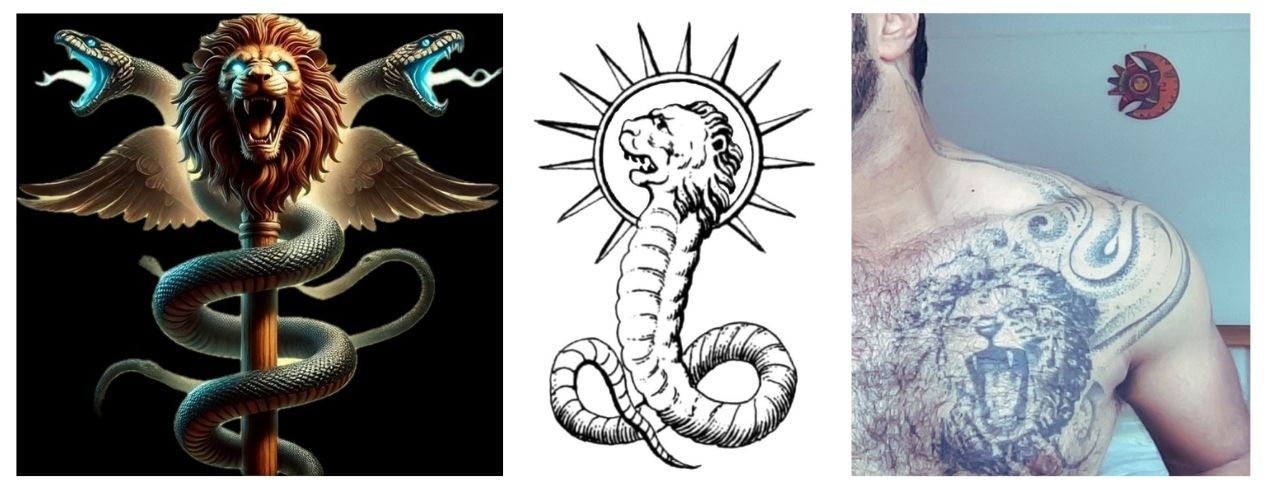
To those of you who don’t appreciate symbology, it might seem like just an odd coincidence the similarities in these three designs. I have experienced the story of Yaldabaoth as a gnosis. A direct knowing that it is true. Is it my own personal mythology? Is that why the crucifixion of Jesus cleansed me so fully of a variety of compulsive behaviors? I don’t know.
After eating the fruit from the Tree of Knowledge of Good and Evil, Adam and Eve clothed themselves and felt shame about their naked body.
Unaddressed sexual trauma resides in human bodies as adipose tissue and shame about how the body appears. I have personally had a long journey being comfortable being unclothed.
In the moment they ate the fruit, is it that they saw the harm of Yaldabaoth’s lust on their bodies? Saw the weight they were carrying and were afraid of exposing their naked bodies again to him and his cronies. Afraid of his lust? Is that why they clothed themselves? This frame seems more reasonable than any other that I have tried on.
Sexual abuse of one’s own creations—children—began in the genesis of this realm.
The lust of the Creator for his own children finds its way through in Hindu mythology too, where Brahma attempted to rape one of his daughters.
Now you could look at these myths as metaphorical or symbolic. If you do find yourself going that route, I’d be curious to know if you believe reality is entirely material. I don’t think reality is entirely material. Myths communicate what actually happened in the non-material realms.
The Gnostics say that after creating the world, Yaldabaoth proclaimed “I am God and no one else”. In response, his mother Sophia chided him calling him “blind little boy, you are being ignorant”.
Ever since I have read this story, the flavor of the Old Testament has changed for me. I see Yaldabaoth’s arrogance, ignorance and lies everywhere within the book.
This notion of “I am God and no one else” is the essence of the quarrel amongst the Abrahamics—the Christians, the Jews and the Muslims—each believing that their variant of the ignorant Creator is the only God.
The frame that the Gnostics offer seems to me more logically complete than the frame that Christians offer to justify the paradoxes between the Old Testament and New Testament. It requires less jumping through rationalizing hoops.
If you are a Christian who reveres the Old Testament, what I’ll offer you is to try on this frame and then go read the different lines attributed to the Lord in the Old Testament. Ignore the fact that the Jews conditioned by generations of traumatic fatherly “love” from Yahweh, referred to Jesus as the Lord. Look at the language Jesus himself uses. He calls himself the Son of Man. The perfect man that existed before Yaldabaoth/Yahweh. He comes from the Father.
The Heavenly Father is not the Lord. The Lord is the prison master. The Heavenly Father is a spirit of love. Sit with this frame and now read the Old Testament passages and tell me that it doesn’t fit. It fits like a perfectly tailored glove.
Now is there value in reading the Old Testament? Possibly. Same as the value that reading any religious text holds because they give you a taste of devotion. This relational quality of devoting yourself single-heartedly to one thing.
But you could also get that from a love song written by a man for his woman like the song “Have You Ever Really Loved a Woman” by Bryan Adams. It carries a beautiful quality of devotion. You don’t need to read the Old Testament to feel what devotion is like.
Other than that, the Old Testament is a testimony to traumatic fatherly love—something we see everywhere in the world. It is reflected in how people react to the Church. Either being violently opposed or being violently in defense of it like the Stockholm Syndrome.
This flavor of trauma response is a thread that traces itself through the Old Testament—most clearly visible in the pendulum swings of Job in the Book of Job. My Daddy loves me! Why does my Daddy hate me so much? Oh no! My Daddy loves me. Also reflected in how Americans grow up in the Church, violently leave it, strongly go back to it and so on and so forth.
Yaldabaoth was fatherless. Sophia conceived him on her own accord in a spirit of rebellion without the consent of her partner. Yaldabaoth, the Creator, himself carries father wounding that is then visible throughout the Old Testament.
Fathers who don’t know how to love.
That’s why Jesus came down and asked us to connect with the Heavenly Father—the spirit of Love—who does know how to love. So that we may learn how to love as men. We may know how to be good fathers.
If you are an American reading this who carries the growing distaste in the US towards Israeli control over America, what I’d offer to you is that underneath that control at a political level, there is the religious control of the Old Testament on the New Testament. The Old Testament is essentially Jewish religious law. An imprisoning system full of punitive rules. In order to fully remove Israeli control from America, the Old Testament needs to be taken out of American Bibles. If you are following Jesus, the Bible you read should be His words and nothing else. Red letter Bibles everywhere!
Red letters as recorded by John, Luke, Matthew, Mark, Thomas, Mary, Philip, Judas. Red letters and nothing else!
But you don’t even need to do that. Just connect with the Heavenly Father, who is not your Lord. Absolutely not your King. He is your Father.
The Lord is the prison master who expects obedience, who punishes if you don’t obey.
The Heavenly Father loves you and wants you to love others. Simple as that.
-
You might see the color “black” very differently from how I see it, and there’s really no way for us to confirm whether our experiences are the same. We can both point to something and agree that it is “black,” but the actual experience of that color in your mind could be very different from mine. It’s even possible that what you experience when you see “black” is closer to what I would experience as “white,” if I were somehow able to see through your eyes. Look up the Inverted Spectrum thought experiment for more on this. ↩