Existential Kink of Hindu Mythology
An exploration of kink, trauma, Buddhism & mythology
I love the word “kink”. It could mean a “physical defect” but without the heaviness that the word “defect” carries. It could mean something that you secretly enjoy, that feels taboo to you yet gives you pleasure. Pleasure is a subjective experience. Thereby, the word kink seems to encompass both the physical, objective realm and the subjective realm. There are very few words in English that transcend the subjective-objective divide.
Kink & Sankhāra
“Kink” is the word that best describes the Buddhist concept of “Sankhāra”.
A Sankhāra is a reactive piece of your consciousness. Your subconscious is a big bag of interconnected Sankhāras. Each triggering and reacting in specific ways to situations that you encounter in your life. As you shine light on each Sankhāra and bring it from the subconscious into the conscious, its reactive control on your dissipates and the energy stored in the Sankhāra can be channeled more productively in your life. Supporting beauty & joy instead of keeping you trapped in suffering. In full Buddhist Enlightenment, your consciousness pervades the entirety of your subconscious, releasing all the Sankhāras, bringing you conscious, surrendered choice where, before, you tended to react.
Sankhāras reveal themselves not just in your inner consciousness space but also in your physical body. I believe, that’s the key piece that distinguishes the human realm from other astral realms. In the human realm, one could move physically to attain spiritual heights. Which is why it’s so precious and rare to be born as a human. Your physical body is a container for your consciousness so how could the Sankhāras not be a physical trait? Chronic pain & illness that is only symptomatically controlled by western medicine are the surest indications of a physical manifestation of a Sankhāra – a spiritual malady. “Trauma” is an extreme variant of a Sankhāra. If you’ve encountered Gabor Maté’s work on trauma, then you’ve encountered the exploration of trauma from a Buddhist lens viz. the exploration of Sankhāra.
Kink captures this psychosomatic aspect of Sankhāra perfectly. A psychosomatic phenomenon is something that can be experienced both in the psyche & in the soma i.e. body. I like the word ‘psychosomatic’ too other than the fact that it unconsciously perpetuates a false division between the psyche and the soma. Human consciousness is a psychosomatic experience.
Exploration of sexual kink attempts to transmute the pain associated with the trauma into pleasure. Depending upon how it is explored, it could either help you release the Sankhāra linked with the kink or perpetuate & feed the trauma that is inspiring the kink – keeping you trapped in numbed out “pleasure” instead of healing.
In sexual kink exploration, you could recreate scenarios of sexual abuse with a trusted partner who loves you and is attuned to your No’s – both verbal and somatic1 – so as to bring you conscious choice in scenarios where you (perceptibly) had lost conscious choice, thereby rewiring the subconscious helplessness that you carry in association with the traumatic memories. Bringing you back in power. Or you could unconsciously end up replaying the abuse in kinky settings with a partner, who is numbed out, just like you, on alcohol, tobacco, drugs; because that’s your only access to sexual pleasure.
This is where we segue2 into ‘Existential Kink’.
A Summary of Existential Kink
Realize that the moments of deep trauma from your childhood are paradoxically linked to your current sense of pleasure & love. So the traumatized wounds that live in the shadowy regions of your subconscious will keep *physically* taking you to places where you can experience *that* flavor of love & pleasure again. Unless you channel that trauma energy elsewhere & consciously rewire your taste for love & pleasure i.e. find stable, safe spaces to experience love and pleasure minus the trauma-activated body arousal, you will keep recreating abusive situations in your life and blaming others for abusing you.
If you’d rather not have me spoil the reading experience for you, pause now, read the first 100 pages of EK and return back here.
Existential Kink is a rapid, shadow-integration process developed by Caroline Elliott that hinges on this key insight. It is a major contrast to popular “see the light”, “affirmative” approaches to spiritual work. The following EK practitioner review from the book summarizes this wonderfully–
I realized that when you only focus on the light and positive thinking . . . then it's like you're staring up at the sun without looking down to notice that you were standing in a pile of feces. Something smells bad, but as long as you stare at the light then all the bad will go away. And instead of cleaning up the poo you spray perfume (affirmations) all over it. Meanwhile, shadow work is looking down at the shit so you can clean it up or even compost it into a lush garden.
Elliott, Carolyn. Existential Kink (p. xv)
This is not a call to throw away your affirmations. Not at all. EK actually works wonderfully in complement to light work.
तमसो मा ज्योतिर्गमय
Lead me from Dark to Light
The Light is always the goal of spiritual work but you need to root yourself fully in the Dark so you can be then led fully into the Light instead of forever pendulating between the Light and the Dark, catching a glimpse of the Light only to be terrorized by the fear of and, thereby, subsequent falling into the Dark. Your existence in the Light is unstable as long as you hold a fear of the Dark. Because the Dark and the Light are essentially One.
In the Egyptian myth of Isis & Osiris, the Goddess Isis fervently keeps attempting to save and resurrect radiant Osiris, her Love, as he is killed over and over by the God of Divine Chaos, Seth. Till, finally, Osiris, intending to break the cycle, requests Seth to stop & dissolves his radiance into the Dark Nothingness that pervades the Universe. Isis loses Osiris yet is forever surrounded by Him. That is where the Light is hidden. It is within every atom of Dark in your being.
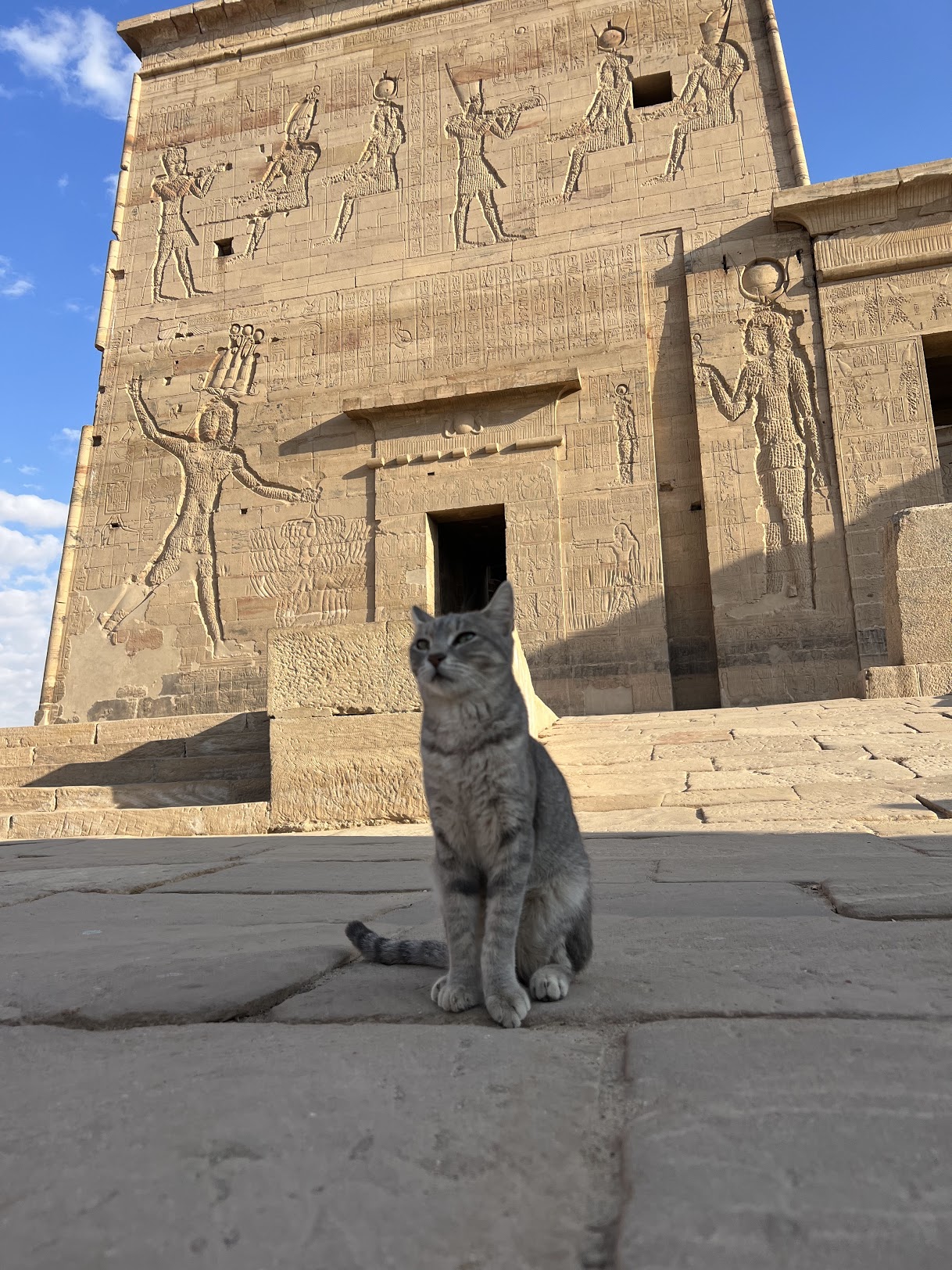
So then the events that bring you to the Dark are potentially the keys that can unlock your full access to the Light. What does that say then about the humans who architected these events with you? This is where Existential Kink gets spicy and potentially triggering. Be fairly warned. In this summarizing, I have copied profusely from the book itself to retain the originality.
The book starts with an esoteric take on the Greek myth of the Abduction of the maiden Goddess Persephone by the King of the Underworld, Hades. One lovely Olympian morning, as innocent maiden Persephone is picking fragrant flowers in a meadow, the Earth shatters open and vicious Hades emerges, abducting her into the Underworld, raping her, marrying her. Tricking her into eating pomegranate seeds, the food of the Underworld, so that she can never fully leave him & she, herself becomes the Queen of the Underworld. An unwilling Queen, in the normy presentations of this myth. It’s a sad tale of abuse, rape, control & violence.
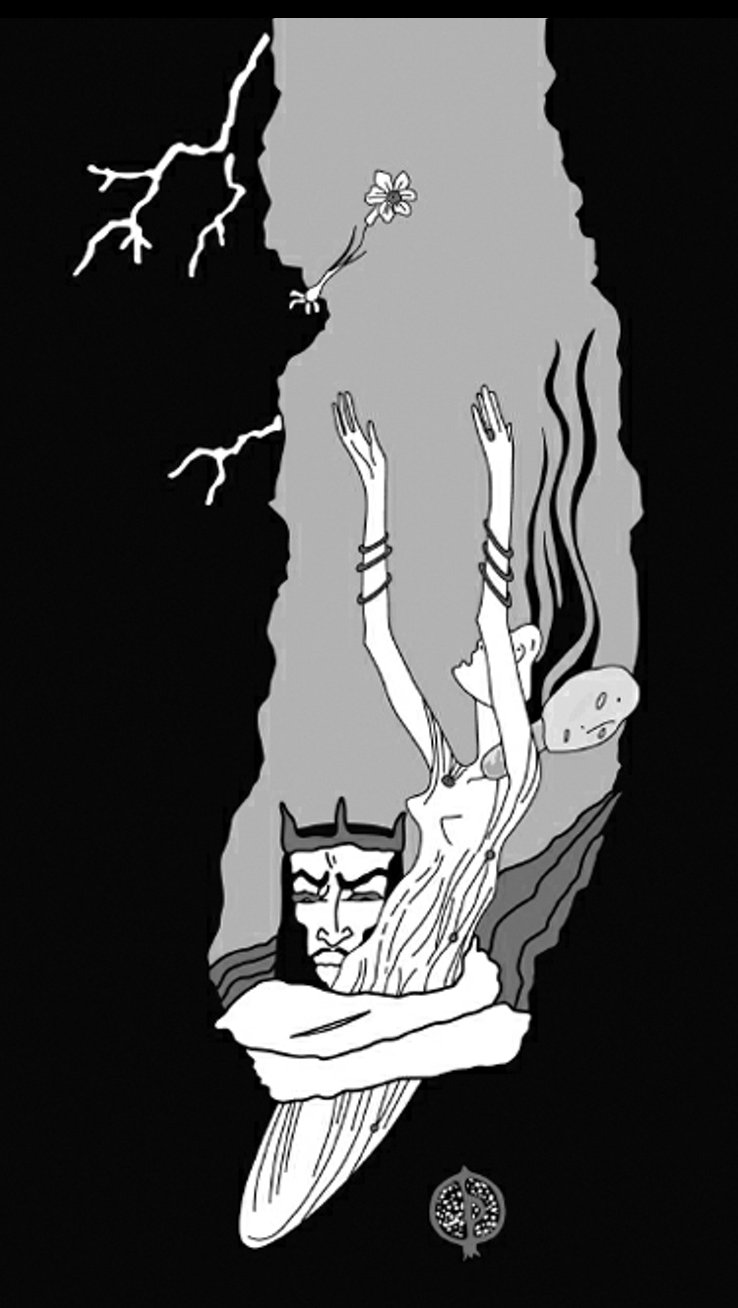
For thousands of years prior to the Greeks worshipping Hades as the King of the Underworld, Carolyn posits that they worshipped only a lone Queen of the Underworld–Goddess Kore–undivided, complete, all-powerful, whole-unto-herself. Then one day, says Carolyn, the Goddess got bored of the monotony of omnipotence. She split herself into two–the benevolent, sweet, conscious Persephone & the vicious, unconscious divine twin, Hades. In order to play out this divine saga of pain & abuse, so she could feel something other than never-ending pleasure & power. The saga, that she can experiences in the moment as pain, only because in the moment of split, she consciously chooses to forget, as we do too (whether consciously, or unconsciously) in the space between death and birth. When she eats the pomegranate seeds, she remembers & ascends back to power as the Queen of the Underworld, now with a loving consort as King.
There is a lot to unpack in the last paragraph & I understand if this presentation is triggering to read. Especially for the implications it holds for sexual abuse. I invite you to take a breath if so & encourage a full reading of the first 100 pages of EK to capture all of the nuances I’ve skipped in this abridged retelling.
Existentially Kinky Hinduism
Hindu mythology is filled with tales of a similar nature. Divine beings striking a deal with each other to reincarnate as enemies to resolve karmic riddles. A karmic riddle is when the karma of a group of beings is intertwined in a complex manner that then requires a saga of mythical proportions to unfold for the karma to be released. What follows are a few examples of such mythical disentanglement from Hindu mythology. Realize that these presentations are specific interpretations of the myths.
Myths are only as good as their interpretation .
The most complex karmic riddle in Hindu mythology is Ramayana. The demon (asura) King Ravana through fervent penance to Shiva gains many boons including immortality. Till his wife, Mandodari, reminds him that inspite of being immortal, he is still a mere Asura, and his immortality prevents him from ascending beyond Asuric realms. Realizing his folly, Ravana prays to Shiva to be killed so he could continue his spiritual ascension. Due to the strength of Ravana’s boons, Shiva requests Vishnu to take upon the avatar of Rama, so as to kill Ravana. In order to create the right karmic incentive for Rama to kill Ravana, Ravana has to agree to abduct Rama’s wife Sita, which he agrees to only because it’d establish a positive precedence for the societal ethics – a reminder of what happens when one abducts another’s wife3.
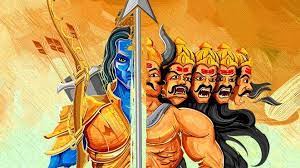
Jaya & Vijaya are the two divine gatekeepers of Vishnu’s home. Once the Kumaras–four great sages who roam the universe as children–come knocking. Jaya & Vijaya don’t recognize them & shoo them away. The Kumaras concluding that there must be some karmic flaw in Jaya & Vijaya that prevents them from perceiving the Kumaras properly, curse them to be born in the realms of anger & lust so that they can work out those karmic flaws. Jaya & Vijaya are aghast and Vishnu pacifies them by agreeing to be born along with them and kill them in every birth so as to help them work out their karmic flaws. Thus you have the story of Narasimha (Vishnu) killing Hiranyakashipu (Jaya), Varaha (Vishnu) killing Hiranyaksha (Vijaya), Rama (Vishnu) killing Ravana (Jaya) & Kumbhakarna (Vijaya) and so on.
Could it be that you did the same? That you struck a deal with an ally from the divine realms to be born into the human realms and experience some form of abuse so as to work out your karmic debts?
Inhale. Exhale.
Hindu Mythology is existentially kinky.
-
A somatic No is when you, in a moment of trauma activation, are either muted or verbally saying “yes” while every signal in your body indicates a “no”. ↩
-
I realized quite late in my life that “segue” is not spelt as “segway”. ↩
-
For a detailed exploration of this, please check out “Dr. Svoboda tells the Ramayana”. ↩