Could Raging Against “Climate Change” Feed It?
An Alternative Hypothesis for Human Influence on Climate Catastrophes
Climate change is usually defined as a long-term rise in global temperatures accompanied by an increase in extreme weather events, driven largely by human activities such as burning fossil fuels. But is the full range of human contribution really captured by that story? Are we sure we’ve mapped every way our choices shape these catastrophes?
To examine that question, we first need to look at how we reason when we don’t yet know. Climate systems are immensely complex. Whenever we face such complexity, we create hypotheses to model what we can’t fully explain. Those hypotheses can then be compared, and three traits matter most:
- Completeness – Does the hypothesis explain all known observations, or does it leave important gaps?
- Predictive quality – Does it reliably anticipate future events?
- Actionability – Does it suggest practical interventions that actually work?
How to Relate to the Unknown
I want to start with completeness, because it’s where many of us—especially the intelligent and well-educated—get tripped up. In fact, the smarter you are, the easier it can be to become deeply invested in a powerful but incomplete framework and to miss what falls outside its scope. A framework that works most of the time can feel so safe and coherent that we unconsciously filter out anomalies to preserve it.
This is one of the most subtle ways our understanding stops advancing: we become attached to a theory not because it explains everything, but because it’s elegant, familiar, and widely accepted. When a model has blind spots, those blind spots often contain important, even transformative, phenomena. Yet once we’ve built identity and intellectual capital around a system, it’s hard to keep noticing what doesn’t fit.
Modern physical science is a prime example. It has been extraordinarily successful at describing and manipulating the material world. But it is built on a materialist paradigm: what is real must be measurable, repeatable, and independent of subjective perception. This works brilliantly for physics, chemistry, and engineering. Yet when scientists encounter events that seem to involve non-material realities—near-death experiences, unexplained synchronicities, collective spiritual phenomena—they often dismiss them outright rather than explore them. The problem is not lack of intelligence; it’s overconfidence in a framework that cannot accommodate the immaterial by design.
Astrology is a clear example from another era. It is built on a fundamentally cyclical view of existence: planetary motions and cosmic time are understood as repeating patterns, and human life is framed within ongoing cycles of birth and death. While later Hindu astrological texts introduced ideas like mokṣa yogas—planetary combinations thought to signal potential for liberation—these were developed centuries after the Buddha and remain within a karmic, cyclical framework. Because of this foundation, astrology can gesture toward detachment or spiritual awakening but struggles to truly account for events that claim to break the cycle altogether, such as the Buddha’s enlightenment or the resurrection of Jesus Christ.
This pattern recurs throughout intellectual history. Many people become highly skilled within a framework but remain blind to its limits. Scientific materialists dismiss or numb themselves to unusual spiritual or paranormal events simply because those events threaten their attachment to the materialist model.
In 1917, three shepherd children in Fátima claimed the Virgin Mary appeared to them and predicted a great sign. On the foretold day, more than 50,000 people reported seeing the sun “dance” or zigzag in the sky. Scientists investigated but dismissed the event because eyewitness accounts weren’t perfectly consistent, ignoring the coherent thread running through the testimonies. This illustrates the divide between the adventurer scientist, who pursues anomalies regardless of funding or reputation, and the 9-to-5 scientist, who plays it safe to preserve career stability. A decade earlier, a lowly patent clerk had upended physics with the idea that space and time are intertwined—a concept still difficult for most of us to apply intuitively in our day-to-day lives. Adventurers move knowledge forward; bureaucratic science protects its boundaries.
Besides completeness, we must weigh predictive power (does the model accurately forecast future events?) and actionability (does it suggest effective interventions?). These are related but distinct. Astrology again shows why: some astrologers make strikingly accurate forecasts, yet their remedies rarely create genuine freedom or change. Prediction without actionable pathways can strengthen fatalism.
Where Current Climate Models Fall Short
The dominant carbon-centric hypothesis for climate change and climate catastrophes appears incomplete. It hasn’t reliably predicted extreme events in a timely or useful or even accurate way, and it hasn’t yielded solutions that actually prevent them. President Trump’s UN address about the “corporate climate change scam” resonated with me because the carbon narrative often feels like a numbers game detached from lived complexity.
Systems theorists warn: the map is not the territory. James C. Scott’s Seeing Like a State documents how central planning—such as scientific forestry in Germany or collectivized farming in Russia and China—produced disaster not just because leaders were evil but because distant authorities trusted abstract models over messy reality. Data took too long to travel upward; bureaucracies were risk-averse and self-protective; feedback loops broke. Something similar may be happening with climate policy: we married an elegant but partial model (CO₂ → warming → catastrophe) and now filter out what doesn’t fit.
If we agree climate disasters are existential, we should behave like engineers debugging a complex system: invite many hypotheses, compare their completeness, predictive strength, and actionability, and test them. Locking onto the first elegant framework is premature and risky. This is a broader theme in the so-called progressive discourse in the US. Locking onto specific frames of a problem and then onto specific solutions as the only way forward and shouting down alternative frames or solutions. The conversation about trans identity is a prime example.
Foundational Claims Behind My Hypothesis
Before presenting the hypothesis itself,
it’s important to show the core claims that shape how I now see reality. These were not inherited beliefs; they arose at turning points where my previous models failed to explain what I directly experienced. Seeing where your own worldview already overlaps or conflicts with these claims can help clarify why you might agree or disagree with what follows.
In summary, I now hold that:
- Reality extends beyond matter. There is a spiritual reality.
- Differentiated beings with agency exist in the spiritual reality. Spirit Beings.
- The spiritual reality operates under laws, just like physical laws. These laws can be tested.
- Many spirits answer truthfully when directly addressed.
- Spirits differ in power; some are weak, others become strong, often through human devotion.
- One Creator exists beyond all spirits — self-existent and not sustained by our worship.
- Spirits manifest physically as spirals
Let’s explore each of these.
Reality extends beyond matter
Think about the felt difference between sitting with someone alive and sitting with their body moments after death – try it if you haven’t. The physical form hasn’t changed in that instant, yet the presence you knew is gone. Something that animated the body has departed. Add to this the remarkable cross-cultural consistency of near-death experiences: people from very different backgrounds report strikingly similar encounters when they are clinically dead and then revived. If you already believe in a soul, you have in fact conceded that reality is not limited to matter, even if your conscious worldview still leans toward materialism.
Beings with agency exist beyond the physical plane
Now that we’ve acknowledged a spiritual dimension to reality, I want to add an important next layer: there are differentiated beings with their own agency that inhabit this non-material realm. These are disembodied spirit beings — conscious presences not tied to a physical body.
In fact, I’ll offer that many harmful compulsions people experience — chronic pornography use, substance abuse, self-destructive anger — can be understood as light forms of spirit possession. Most of us keep these influences at bay by numbing or distracting ourselves, which allows the presence to stay partial rather than fully take over. In more severe cases the intrusion can look like psychosis or schizophrenia. Even the relentless inner critic voice so many people hear may not actually be “you.”
Spiritual Laws
Just as the material world operates under gravity, electromagnetism, and other invisible but reliable forces, the spiritual realm is not random. It, too, is structured by laws — patterns you can test and observe, even if they are not yet measurable by physical instruments.
We catch hints of this every day. Exercise can reliably shift states we call anxiety or depression, releasing something invisible yet undeniably real. Meditation and prayer alter mood, perception, and even brain structure, though what they are acting on goes beyond neurons alone. These are small but clear examples of physio–spiritual bridges: actions in the body or mind that consistently shift our interior, non-material state.
Beyond these entry points lie deeper and more encompassing principles. The Law of Karma, recognized across Indian traditions, is one such spiritual law: actions create subtle imprints that shape future experience, even beyond a single lifetime. Karma is not a random moral story; it behaves like an unseen but predictable current, shaping what comes back to us.
Once you accept that there are reliable, repeatable dynamics beyond the physical, it’s not surprising that spirit beings themselves operate within rules. They cannot simply do whatever they wish; their influence is constrained by the laws that govern the non-material plane.
Spirit Beings Often Respond Honestly
One striking feature of these laws is that many disembodied beings answer truthfully when addressed directly. That’s not to say that they can’t be deceptive. They have to be deceptive to maintain control over their host – you. But many of them are deeply suffering. To exist without a body is to be unseen, unable to act directly in the physical world. That isolation breeds hunger and frustration. They often try to relieve their pain by attaching to humans and acting out through us. Food disorders, compulsive sexuality, addictions — these can be the downstream effect of such influences. Over time the behaviors can become so normalized we don’t even recognize them as disordered. Ask an alcoholic if they’re truly an alcoholic and you’ll see how denial and numbness can mask the presence of something harmful.
You can try this out yourself. When you feel overtaken by a harmful impulse, turn inward and ask: Who are you? Where did you come from? Why are you here? In my own experience — and in approaches like Internal Family Systems and Compassionate Depossession — these entities usually respond honestly. They long to be seen and acknowledged, just as embodied people do. Perhaps even more so because they are quite literally invisible and some might even be blind. Recognition itself weakens their hold, and with the right process they can be released; you do not have to remain split or under their influence. I know this may sound abstract until you’ve experienced it directly. It’s like describing the texture of a taste you’ve never had.
Some Spirits Are Weak; Others Are Powerful and Sustained by Devotion
Not all spirits have the same strength. Some are weak and transient; others become powerful and enduring because they are continually fed by human devotion. This devotion can take many forms — chanting a being’s name, offering sacrifices, performing rituals, and holding it in reverence. The repeated focus and energetic exchange give these entities vitality in the spiritual plane.
Many traditional deities illustrate this dynamic. In Hinduism, for example, there are gods and goddesses who are potent but fundamentally transactional — closer to powerful patrons or mafia bosses than to a self-existent Creator. They can bestow protection, wealth, or power, but they also take something in return. Some ask for offerings as simple as coconuts or incense; others, in their fully “live” practice, have historically demanded far darker acts. Modern people often engage in dead rituals — motions repeated without understanding — which may do nothing at all. But when a ritual is “live” (done correctly, with intent and belief), it forges a real energetic tie and can bind the devotee to that being. A crucial safeguard is that your agency remains intact. In my experience, and in many spiritual traditions, no spirit can ultimately force you to do what you refuse. You may be pressured, tempted, or frightened, but you can still say no. Knowing this matters, because some paths of devotion can gradually escalate; by the time a powerful being demands something destructive, it’s vital to remember your right to refuse.
And I would go further: if the devotees of any such deity were to stop chanting its name and offering it attention, that being would steadily lose potency — perhaps even fade entirely. Its existence, at least in its present strength, depends on the energy it receives.
There is, however, one striking exception. One being appears not to rely on our devotion to exist, and whose reality seems to stand outside this entire economy of offerings and exchange…
The Creator Beyond All Spirits
Amid this landscape of spirits that live by exchange and devotion, there is one being who appears fundamentally different. This Creator does not depend on our worship or offerings to exist. He simply is. He was before anything else came to be, and His reality does not waver if every human voice falls silent. All the other beings I have described — however awe-inspiring — seem to live within a kind of energetic economy, gaining strength through our focus, chants, and sacrifices. The Creator alone stands outside that economy.
The very pattern of creation seems to testify to this Source. I notice His traits echoed everywhere: in the Sun that gives light and life; in mythic kings of the gods like Zeus or Indra; in the enduring archetype of the Father. Everything in the created plane seems to be a reflection of the Creator, but not Him. Many elevated spirits appear to have leveraged this resemblance to present themselves as ultimate, drawing worship by mirroring aspects of the true God while lacking His self-existent nature.
I have spent time genuinely wondering whether Vishnu might in fact be the Indian name for this true God. Vishnu is described as supreme in much of Hindu devotion, and his sustaining, protective role feels aligned with ultimate divinity. Yet Hindu mythology itself offers clues that unsettle that idea. The Old Testament speaks of “the sons of God” who lusted after the daughters of humans and took them as wives (Genesis 6:2) — a strange, haunting line that fits eerily with stories of gods like Vishnu and Krishna, who repeatedly take human form and pursue human lovers. These are striking, beautiful myths — but they also suggest powerful created beings mingling with humanity, not the transcendent Creator stepping into creation.
And when I look more closely at Hindu cosmology as a whole, I notice something telling: Brahma, the Creator, is repeatedly mocked and portrayed as weak, while Vishnu the Operator and Shiva the Destroyer hold the highest power. That inversion — the Creator diminished while the ones who manage or end creation are exalted — feels to me like a rebellion of powerful created beings against the actual Source. The mythic imagination seems to have been shaped not by the Creator Himself but by elevated spirits who benefit from devotion.
Another sign of this difference is how one can approach the Creator. No chants or offerings are required. In fact, the very attempt to pin Him to a single name seems inadequate. “God” is only a pointer — a human label for what transcends all labels. The way I’ve found to connect is simpler and more direct: contemplate the vastness and beauty of creation, then recognize that none of it is Him — He is beyond it all — and speak to Him directly. Like you would to a friend. No complicated chants that necessitate perfect enunciation are required. Unlike other beings, His presence is not sustained by ritual; He is self-existent.
A practical test I’ve considered — and plan to try myself — is this: if you already worship or work with a particular deity, ask it directly, “Is Jesus the Son of God?” (cf. Matthew 16:15–17; Luke 1:35; 1 John 4:15). My own experience so far suggests that spirits, when questioned plainly, tend to answer truthfully. I haven’t yet undertaken this experiment with a powerful deity, but I’ve kept it as a kind of side quest: to practice the devotional or ritual steps that connect to such a being and then pose this question. My expectation, based on how truthfulness seems to operate in the spiritual realm, is that you would receive either a clear yes or a strong, even vehement, no — but not confusion or ignorance. How a being responds could reveal something about its nature and its stance toward the Creator.
Spirits Manifest as Spirals
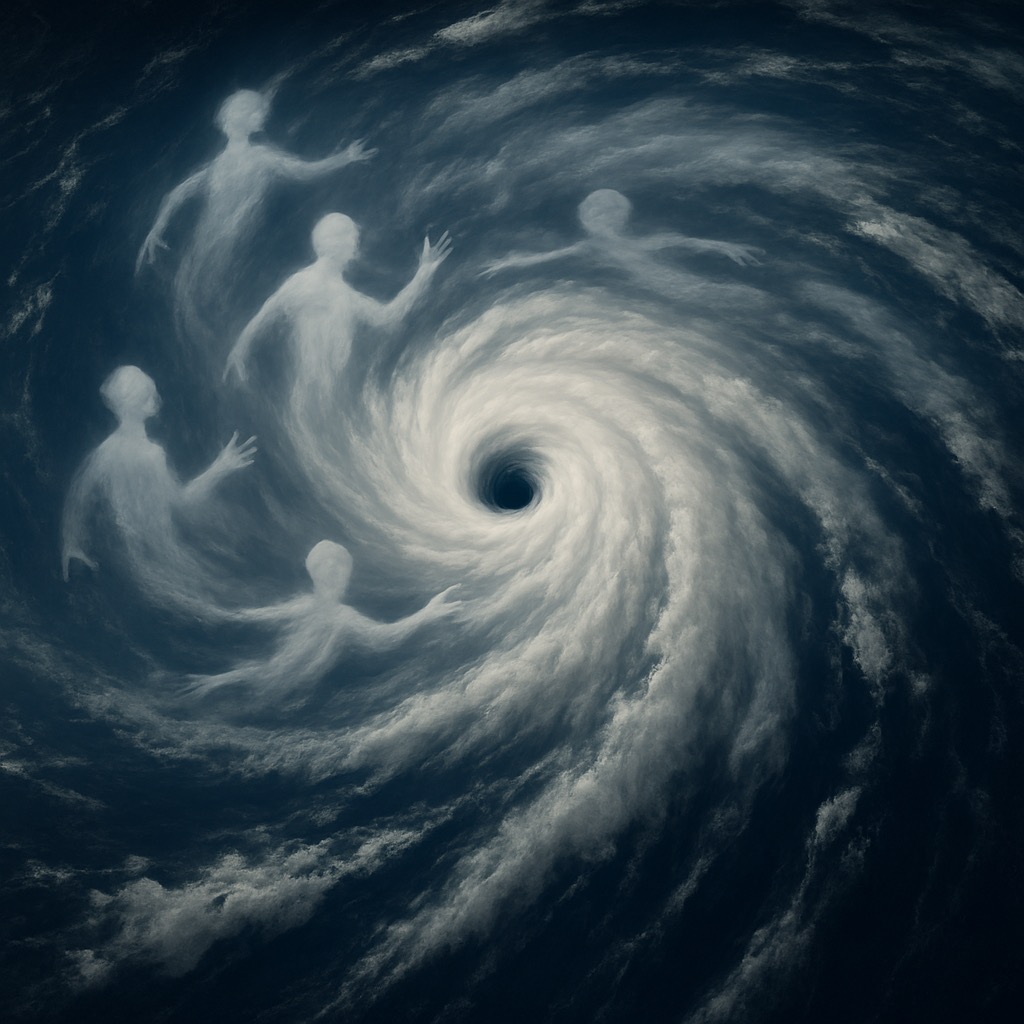
Another pattern I’ve come to recognize is that spirits often reveal themselves through spiral motion when they cross between the spiritual and physical planes. The spiral seems to be a universal bridge — the way non-material energy enters and moves within the material world.
You can see this symbol everywhere once you notice it. Ghosts in folklore and animation are often drawn with a head that trails off into a tapering spiral. The snake coiling around a rod — an image that appears in medicine (the Rod of Asclepius) and in countless esoteric traditions — mirrors the same motion. In yogic and tantric traditions, Kundalini is described as a coiled force at the base of the spine that rises upward in a spiral when awakened. In Islamic mysticism, the Sufi whirling dervishes spin in circles to release what is trapped within. Even in casual ghost stories and cartoons, disappearance or transformation is often depicted as a spiraling motion.
I’ve come to think this is not just metaphor or artistic shorthand. The spiral is the way spirit moves. It is how non-material beings anchor into the material: they wrap around a stable axis.
That axis, in us, is the spine — both physically and symbolically. A person with a strong, grounded “inner spine” can stay steady while engaging with unseen forces. But when your spine — literal or metaphorical — is weak, these whirling energies can toss you around. People without deep rootedness may feel pulled and spun by compulsions, moods, or external influences they can’t name. Spiritual practices across cultures — from yogic posture to Sufi dance to kneeling prayer postures in Christianity — seem designed, in part, to stabilize the spine and center, making it harder for chaotic forces to dominate.
The Hypothesis: Sin, Spirits, and Storms
When cultures collectively turn away from God — through lust, addiction, rage, idolatry, and reckless consumption — we empower destructive spiritual forces. These forces begin as small, hungry presences attached to individual lives. Each time we indulge impulses that disconnect us from the Source of life, we feed them. Over time, as enough people act from those impulses, the beings grow and coalesce into larger entities of chaos and death, that can exist in the physical plane without being attached to their human hosts.
These entities do not remain abstract. They seek expression in the physical plane, and their signature movement is the spiral. In this view, hurricanes and typhoons are not merely weather events but the physical entry of vast, death-oriented spiritual forces. The same dynamics can extend beyond wind:
- Earthquakes feel to me like the violent surfacing of chaotic forces from the deepest “hell” realms.
- The general heating of the planet can be understood spiritually as our collective descent into a hellish state — a culture increasingly aligned with destruction rather than life.
This doesn’t mean the material, carbon-based story is false. Our ecological recklessness — deforestation, burning fossil fuels, overconsumption — clearly plays a role. But those physical actions are themselves often driven by deeper moral and spiritual decay. The prevailing climate narrative isolates one variable (CO₂) and then treats it as the whole map. Complex systems rarely work that way. The earth’s forests, for example, actually thrive on carbon dioxide; elevated CO₂ has fueled some global “greening,” even if deforestation has outpaced it in many areas. This alone shows that the simple “more carbon → more catastrophe” model is at best partial.
My hypothesis does not deny carbon’s impact; it subsumes it within a broader causal field where human spiritual life — our virtues and our sins — shapes what forces are allowed to gain strength and manifest physically. Hurricanes and heat waves may be as much about collective addiction, rage, and idolatry as about combustion engines.
This frame is unexpectedly empowering. Activists often rage at corporations while privately living in ways that feed the very forces they oppose — through indulgent sexuality, addiction, anger, or unchecked consumption. If each of us turned toward God and lived in alignment with His life-giving way — rejecting addiction, lust, rage, idolatry, and reckless use of the earth — we could weaken destructive spiritual forces at their root. Doing so would not only heal individual lives but could shift the collective spiritual atmosphere that gives rise to catastrophic storms and geological upheavals.
Why This Matters
The mainstream climate narrative — more carbon → more warming → more disasters — is elegant but incomplete. It struggles with prediction (extreme events still surprise us) and with actionability (policy and lifestyle changes have not stopped catastrophe). Complex problems demand multipronged solutions. When a system is breaking, engineers don’t marry one tidy model; they explore many possible causes, test, and adapt.
If you feel an impulse to dismiss or mock this idea outright, I invite you to pause and look inward. Ask the mocking voice: Who are you? Where did you come from? What is your name? Sometimes ridicule isn’t a sign of clear reasoning but of something in us resisting what threatens its hold.
Expanding our hypothesis space to include moral and spiritual causality could give us new levers for change. At minimum, it restores agency: not just to governments and corporations, but to every individual who can choose to align with life rather than chaos.