America's Culture
It exists. It does not exist.
I am beginning to get a hang of American culture.
It’s been close to 16 years that I have lived in this country and in the last year, I have finally begun to get a hang of American culture.
In parts of American society, there is this humorous punchline that self-deprecatory Americans share claiming that America has no culture (ha, ha, ha). For a long time, I thought that was true.
Having been bullied in school, I have really enjoyed the fleeting experience of throwing a jab at the top bully every now and then. The US of America is the apex bully. Laughing about how America has no culture (ha, ha, ha) gives all of us who have been bullied, a momentary respite from the agony of carrying around the unresolved bullying trauma.
The nature of mean humor is such that it hints at underlying truths but the statements it makes are never, themselves, true.
In the parts of American society where mean humor about the non-existence of American culture lubricates social anxieties, people have, quite unfortunately, lost their connection to how beautiful and unique this nation’s design is.
If you have followed my work in the last couple of years, you’d know by now that I have come into a deep sense of gratitude for the founding principles of the USA.
Having sat with that sense of gratitude for a few months now, the shadow side of the design is making itself visible to me. I can’t yet tell if the shadow is inherent in American founding principles or if it is a transient stage that the light of those principles will eventually overcome. I wonder if the shadow side of American culture is the shadow of the concept of the nation state itself or a particularity of the principles this nation chose to found itself on.
America’s culture holds spaciousness for individuation and dialectical transformation, but that same spaciousness creates isolation, fragmentation, performative speech, and harsh collapse points.
American culture exists.
One of the most beautiful aspects of American culture is that you can live in America while being completely ignorant of its existence. Even mock its non-existence!
You can live according to the culture you came from. Create your own little ghettos with others who came from a similar culture. Surrounded by Americans who yearn for your culture in lieu of their own, hoping that changing the cultural flavors they swim in, would heal past wounds.
You can live in your own cultural ghetto in America for generations without bothering to adopt any of the cultural paradigms from this country, other than the ones you are forced to, like say a fenced house. Even mope about how your kids are becoming American and have forgotten “where we came from”.
American culture is gracious like that.
In its spaciousness, it allows people to just be… until you hit the American kill line. The system turns on you. The spaciousness reveals its edge.
The "kill line" is a viral Chinese social media term, adapted from video games, describing the precarious financial threshold where American households are one emergency—such as illness, job loss, or debt—away from total ruin.
The Chinese are gossiping on the Internet about the American kill line.
This is the first time in human history where there is ample space in the public conversational sphere for gossip to flourish. The lowliest of lowlies can publicly bitch today. And the Internet links them to the right gossiping bitches all the way across the world.
The Internet is a public gossiping space. That’s why it can feel so yucky sometimes. Because gossip is yucky.
Gossip is pleasing only for the fleeting circumstance when you are engaging in it with an agreeable other. Then the two of you can talk about about how someone that you feel hurt by and don’t have the courage to talk directly with, is bad.
That’s the only situation where a nice long drag of gossip feels pleasing.
Gossip sucks if you make the mistake of initiating it with a disagreeable other.
Oh, the shame of picking the wrong person to gossip with!, you mistakenly conclude.
My dear, the wrong choice was never the person, but the act of gossiping itself.
Gossip is absolutely horrible when it is about you.
There’s only this thin section of relational spacetime where gossip can feel thrilling. And even then, it tends to feel disgusting after sufficient contemplation.
You see, when you indulge in gossip, you are going against the energetic design of the world. The world is created in the spirit of truth. Transparency, honesty, openness is its energetic signature.
Nothing is ever truly secret.
Everything that you speak is a sound that goes out into this relational field of all ensouled beings. The relational field echoes that sound back to you one way or another. That is the Law of Karma.
If you speak with love, amplified love bounces back. If you speak hate, amplified hate bounces back.
The complexity of this law lies in its causality. The causality of what specific action led to the particular bounce-back you are experiencing right now.
When we experience unpleasant bounce-backs, our tendency is towards self-pity. In a state of self-pity, our psychospiritual perceptive faculties turn collapse in our inwards turn. The complexity of the law of karma is, thereby, shrouded from us.
Oh, boo-hoo, why me! What did I do to deserve this!
In the midst of an unpleasant bounce-back, we are given an opportunity to receive wisdom about what past action led to that particular karmic fruit. If we collapse then in self-pity, then that opportunity is stolen from us.
The world is so unfair! How could they do this to me?
This creates spaciousness for scenarios where you could enjoy something in secrecy that is destined by law, to bounce-back horrifically. This could be immediate, like the next morning when you wake up. If you live a lifestyle of self-medication—with self-pity, substances or medical pills—then you might even return to the same act that very day, being completely oblivious to this causal relationship.
That’s where the Internet steps in, as a vehicle of mass awakening.
The Internet encourages Gossip to be public, archived, searchable and indexable. Gossip doesn’t know what that’s like. Gossip is learning not to be so yucky. Gossip is healing.
As Gossip heals and grows on the Internet, the Internet feels chaotic to the humans who are used to old Gossip.
Humans are feeling emboldened to express from behind the safety of their keyboards in a public arena that otherwise they might have just barely been able to speak to a fellow or two, in private.
The Internet shines a light on what thought forms are moving through the erstwhile secrecy of another person’s head. Before the Internet, it was rare to catch a glimpse of what a person thought beyond what they chose to express directly to you, filtered by the persistent fear of ostracization that each of us carries. The fear that is the glue of a monoculture.
So the Chinese are gossiping about the American kill line.
The kill line is where the spacious graciousness of American culture collapses and the culture hunts you down like a black man who has been falsely accused of sexual abuse by white woman who had a hysterical traumatic response to the darkness of his skin because the physically expressed darkness in a male body reminds her of the energetic darkness of her father that came out most unexpectedly in hurtful ways, right as she was nodding away to sleep in her bed.
The black man is then hung from a tree as affluent white families use that opportunity to have a relaxing picnic in the park after Sunday Church.

The culture hunts you down.
America swivels between extremes. Often, it seems, the actions lag behind what is being expressed, in extreme ways.
Take the case of the founding of the nation itself, on the values of life, liberty and the pursuit of happiness by slave-raping, philosopher-gentlemen.
This disconnect between verbal expression and actions is not a uniquely American trait. Humans lack integrity in speech and action across the world.
But there is something uniquely American in the width of that disparity because of the uniquely American protection for the freedom of speech, that allows expression to run far ahead of action.
Americans have a loaded front.
American conversations front-load enthusiasm that might bring up expectations of follow-through to an outsider. Not unlike the marketing billboards that show a much juicier burger than what you actually get at McDonald’s here.
The billboards are more glitzier in the USA than anywhere else. The burger you get is deader in the USA than anywhere else.
Width. Of. Disparity. Between expression and action.
Americans will often close out early chats with a “Hey, that was so fun! Let’s grab dinner sometime”.
If you are new to American culture, you might think—oh, they want to make dinner plans with me!
But actually, it is American for “goodbye, perhaps see you around?”.
Americans test resonance by expressing ideas. Gently testing the waters of the relational field between you and them by putting words to different possibilities.
It could be seen as a beautiful attunement to and respect of the relational field. Really tuning in to see what wants to emerge from the relationship instead of imposing your will with the first idea that comes to your mind.
Now I’m not saying Americans are consciously engaging in this when they say “let’s grab dinner“ as short for “goodbye” and “how are ya” as short for hello, but that these linguistic forms are born and adopted as a result of a culture that is designed to prioritize individuation.
Authentic individuation needs multiple attempts.
This flavor of attunement to a variety of possibilities, by naming them, while resisting the hungry latching on to wanting every possibility to come true creates spaciousness for the connection to find its true frequency. It allows the individuals exploring connection to find their own true frequencies. So that they can then actually make dinner plans with those who vibrate on the same frequency.
The fertility of the American grounds for the individuation of a human being is most evident in the depth and breadth of the entrepreneurial energy in this country. American entrepreneurship is not just limited to the classical corporate business flavor, but captures the enterprising spirit of so many people trying new things and being successful at a handful of the new things being tried out.
In the last 200 years or so, America has been at the forefront of that spirit. Would you not agree?
There is both Light and Dark in American enterprise.
The Epstein Island is as much a product of American enterprise, as is Facebook, Internal Family Systems, #metoo and the absurd reality of the Yoga Alliance, which is an American organization that leads the certification of yoga teachers across the world.

To individuate, you need to isolate from the idea fields of those around you.
A coherent culture, the kind that is idolized by an American who smirks “we have no culture”, does not offer that space.
In a coherent culture, humans mimic each other, back and forth. In that mimicry, there is safety. Safety from the unknown. But in being safe from the unknown, you may be held back from expressing the unique gifts that you are born to offer.
The nature of human ingenuity is such that even in such cultures, every now and then, an oddity breaks through and you end up with a Ramanujan, but it is rare for creative ingenuity to become the norm in a coherent culture.
The US has coherent monocultures too, but the US seems to stand apart in the number of different monocultures that you can find here with room for migration between those monocultures.
Fed up of one monoculture, you can pack your bags and leave for the polar opposite monoculture—its antithesis—where people seemingly express themselves in a starkly different way, but spend enough time and you may notice the same idea field in a different clothing.
Fed up of the antithetical monoculture, you could find yourself in a monoculture that attempts to synthesize the original culture you left and its antithesis, and so on and so forth.
There is sufficient room in the US to maneuver yourself in your journey of understanding the contours of your energetic body. Exploring what subculture can both make room for you to both fit in and expand in the manner your soul wants to expand.
I experienced the conservative Christian monoculture and its antithesis—the woke queer monoculture—in the last couple of years.
There is a kind of religious fanaticism in both, but they meet on opposite poles of what they are religiously fanatic about.
Whatever you create in opposition, shall become the thing that you are opposed to.
The same manner in which the Church excommunicates, the Woke Queers cancel.
The same level of adherence to doctrinal ideas without the capacity to discuss and debate without resorting to ad hominem unites Christian fanatics and trans advocates. One side labels you a heretic for thinking differently, the other side labels you a transphobe.
Same idea, different form.
The thesis and the antithesis are seemingly opposed to each other but underneath that surface opposition, each is deeply in love with the other.
Yearning, absolutely yearning to fuck.
The thesis and the antithesis want to badly fuck each other. The heat has built up to an unbearable extent.
Oh, I’m so angry with you. How could you do this to me? I can’t stand you!
The sexual chemistry reaches a crescendo as lovemaking in service of birthing the synthesis commences.
Hegel understood the very erotic nature of transformation when he posited the dialectic—as the unit of change. In humans. In societies. In nature.
Thesis → Antithesis → Synthesis.
And American culture creates spaciousness for the dialectic to unfold organically, across many domains of human life.
You can be friends with someone till the heat builds up so unbearably that you have to fuck them, then you can be friends again, in a new way with deep love and care for each other’s journey. Hegel’s dialectic in action.
I suppose the Europeans manage to pull that off, specifically in the erotic relational domain, but the best modern day example of Spaciousness for the Dialectic across a wide variety of domains is U.S.A.
Are you creating an antithesis? Or are you creating a synthesis?
It is tough to tell which transition you are shepherding, but that flavor of creation requires a certain level of individuation with accompanying self-sufficiency.
The ability to survive out in the wild by yourself as you venture out West to fulfill the Manifest Destiny, or the ability to chainsaw fallen trees, rebuild your own home and roads because you know that FEMA is going to do too little, too slow after a Hurricane has devastated your community.
That requires a certain level of individuated self-sufficiency.
The most significant harvest of the time I have spent here in Western North Carolina, which is more country-American than the Bay Area or New York City, is that it is truly possible for an individual to rebuild—to pull yourself up by your bootstraps, as Americans like to say.
To rebuild, you need tools, skills and the capacity to self-improve.
You can start with zero tools and zero skills. Once you start, you realize that you have always had non-zero tools and non-zero skills.
That’s all you need in any domain to pull yourself up by your bootstraps.
Especially so in this Internet era, where skill transfer is catalyzed so effectively.
Layer on top, the late-stage Consumerist nature of American society, where if you manage to not run away from the demons within, you can take care of your routine needs, very simply. So that you create room to learn new skills.
Partly as a consequence of its isolationist societal design, where people are separated from each other by bigger and bigger boxes that they call either homes or cars, American culture emphasizes DIY.
- taking care of yourself
- taking care of what needs to be fixed in your surroundings
- taking care of your community
Different monocultures within the US might emphasize each of these parameters differently.
Rural conservatives fare very well on #2, poorly on #1. Urban liberals emphasize #1 and fare poorly on #2. Both fare similarly on #3.
Now this DIY phenomenon is balanced, in typical American paradoxical fashion, by its polar opposite of bitching to the authorities, viralized by the Karen meme.
(North) America is where neighbors will tell on each other to authorities. There was a heartbreaking example of this in Vancouver, BC, where neighbors reported a single Dad to the Child Protection Services because he let his kids use the local bus services. He was teaching his kids how to be independent from an early age. He then had to fight CPS for custody of his children. How tragic.
This is the shadow side of having a functioning, authoritative system that does not demand bribes at the lowest rungs. In India, the lowest rung of the authoritative system asks for bribes for small matters, adding a disincentive to reporting and an incentive towards direct resolution with neighbors.
The legal system in America is often a better oiled machinery than the emotional intelligence that the average American is able to bring to direct interpersonal conflict resolution. Hence, we bitch to the authorities here.
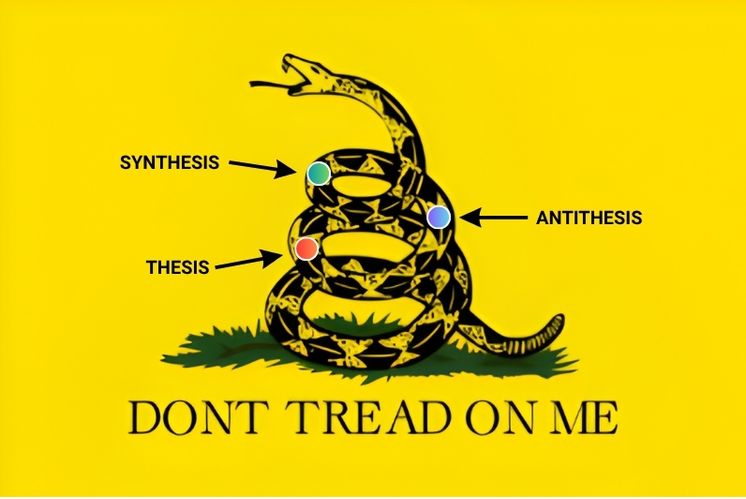
The thesis, antithesis and synthesis could be visualized together as 3 points on an evolutionary spiral.
If you are disconnected from the bigger picture of the spiral evolving upwards, American society may appear polarized to you because any two points on the spiral seem at odds with each other.
The antithesis is clearly opposed to the thesis. On account of its birth in opposition, the antithesis is against anything that reminds it of the thesis.
The synthesis believes it is the alchemy of the thesis and the antithesis but, to the antithesis, it appears opposed to it, not different from the thesis.
Polarities everywhere.
So if you’re not practiced in pausing and breathing and stepping out and noticing the bigger picture of how these connect and relate, then you never see the snake of the spiral that is climbing up and only see the polarized nature of American culture.
If you’re afraid of heat, then you can never see the alchemizing fire that burns in the dialectical cauldron that America is. You may see the fire only to get caught up on the scars that it leaves on your body as you are being synthesized into something new, oblivious to the alchemy, spitting at the very fire that is transforming you.